
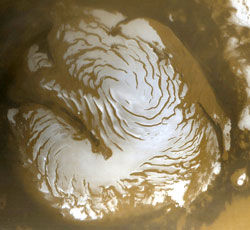
© NASA/JPL/MSSSThe ice cap on Mars’s north pole is primarily composed of water ice and containing a few percent of dust. It has a spiral structure formed by white, ice/covered areas and dark slopes where the layers in the ice cap can be seen.
Solar insolation on Mars has varied dramatically over time, mainly due to large variations in the tilt of Mars's rotational axis (obliquity) and this led to dramatic climate variations on Mars. For years people have tried to link the solar insolation and layer formation by looking for signs of periodic sequences in the visible layers, which can be seen in the upper 500 meters. Periodic signals might be traceable back to known variations in the solar insolation on Mars, but so far it has been unclear whether one could find a correlation between variations in insolation and the layers.
Correlation between ice, dust and sun
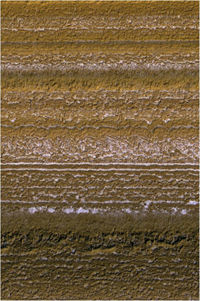
© NASA/JPL/UAImage in high resolution of the layers from the HiRISE instrument on NASA’s Mars Reconnaissance orbiter. These images show that the layers are covered with dust and frost, and the visible layers cannot be directly to examine the internal structure of the ice cap. he researchers have therefore used measurements of the layer thickness and depth in the ice sheet, which can be measured from high resolution images taken in stereo.
She explains that in the model the layer formation is driven by insolation and the dust rich layers can be formed by two processes: 1: Increased evaporation of ice during the summer at high obliquity (when the rotational axis tilts down) and 2: Variations in dust accumulation as a result of variations in the axial tilt. The model is simple, but physically possible and it can be used to examine the relationship between climate variability and layer formation.
The researchers established a framework for the model that could explain the layer formation so that it was consistent with the observations. By comparing the layer distribution in the model with precise measurements of the layer structure from high resolution satellite images of the ice cap on Mars's north pole, they have discovered that the model is able to reproduce the complex sequences in the layers.
Climate history over 1 million years
"The model dates the upper 500 meters of the northern ice cap on Mars, equivalent to approximately 1 million years and an average accumulation rate of ice and dust of 0.55 mm per year. It links the individual layers to the maxima in solar insolation and thereby establishes a dated climate history of the north pole of Mars over 1 million years," says Christine Hvidberg.
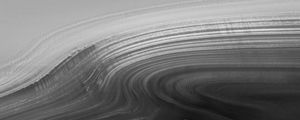
© NASA/JPL/UAImage of one of the dark slopes in the middle of the ice cap on Mars’s north pole. The layers can have varying level of dust.



if the scientists could match up this:
[Link]
to that last 500 meters (million years) of ice/dust layering on the North Polar Cap of Mars, then the solar influence could be deduced.
Do the authors know of any measurement data vs years to construct a comparison graph?