
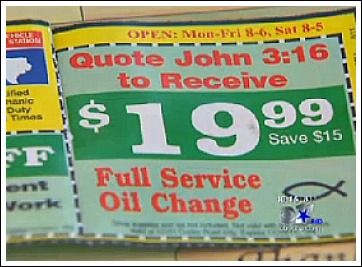
© Unknown
THE PROVOCATION: Maybe he should start quoting Acts 8:20.
Not familiar with that verse? It contains Peter's rebuke to Simon Magus, who had offered the apostles money in exchange for the gift of the Holy Spirit: "Peter answered: 'May your money perish with you, because you thought you could buy the gift of God with money! You have no part or share in this ministry, because your heart is not right before God.'"
Or maybe he should check out Matthew 6:24, which comes straight from the mouth of Jesus: "No one can serve two masters. Either he will hate the one and love the other, or he will be devoted to the one and despise the other. You cannot serve both God and money."
The amazing thing is that some Christians, like Kwik Kar owner Charlie Whittington, are apparently oblivious to what Jesus saw as a blatant conflict of interest. (Certainly there are Christians around who see the hypocrisy in this and are genuinely interested in following Jesus' advice on money, which included some rather challenging advice to his disciples: "If you would be perfect, go, sell what you possess and give to the poor.")
But Whittington is adamant: "I really believe if you talk more positive stuff you get more positive things out of it." he said. "I want to inspire people to look where they can do more. If I'm standing for what I believe, so be it. Bring it on!"
Whittington is standing up for what he believes, all right: He believes in making a buck. And he knows he can attract Christians to his business with the fish symbol on his Yellow Pages ad and discounts in exchange for Bible verses.
He received even more free advertising for his business when his policy landed him a spot on conservative windbag Glenn Beck's radio show. Product placement at its finest.
Whittington is a businessman. He wants to make money. And one astute Facebook user dared to call him on it: "This is purely a marketing ploy and a brilliant one at that," Mike Lovestar wrote. "It has generated buzz and has Christians rejoicing. Yep, you've been duped again."
Lovestar's comment was posted on the Facebook page of KTYX, the CBS affiliate in Tyler Texas that helped break the story. But he was virtually alone in seeing anything wrong with Whittington's promotion. When Eric Word-Weaver Sjerven suggested the coupon might offend people of other faiths, another user responded: "Eric ... move! Your issue will be solved!"
Another solution might be a bit more interesting: An atheist, Muslim, Hindu or Pagan could walk into the shop, recite the verse, tell Whittington it's a bunch of rubbish and demand the discount anyway. It would be interesting to see whether Whittington still honored the discount - if he didn't, it seems likely he'd face an investigation for fraudulent business practices. But this story has nothing to do with the merits of Christianity or any other religion. It has everything to do with how deeply "anything to make a buck" mentality has infiltrated our culture.
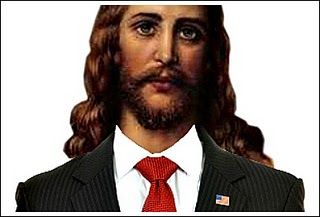
© Unknown
This much should be said: Whittington's promotion isn't against the law. His speech is protected by the First Amendment, and he has every right to offer discounts as long as he's not discriminating or asking customers to do anything illegal. But if he were to read some other verses in the Bible a little more closely, he might find himself in conflict with what they consider to be a higher law.
Jesus a capitalist? Whittington and those who agree with him would be well served by doing what he's asking his customers to do: read the Bible.





For God so loved the world, that he gave his only begotten Son, that whosoever believeth in him should not perish, but have 19.99 full service oil change.
— John 3:16 (King James Version)