
© unknown
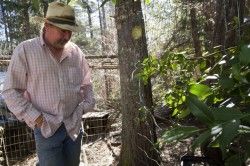
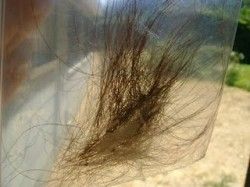
Since that night, he's been waiting for the analysis to come through. Before finding the hairs, he thought it might have been a bear that made its way through his property and caused all the damage, but after finding the feathers so high up as well as the hairs, he knew it was something else amazing and handed over the hair samples to NABS (North America Bigfoot Search) who did verify that the hairs matched those of a primate and are now waiting on final analysis to determine what the creature is. The forensics team working on the sample say that it's a very complex job to identify it since all they know right now is that it comes from a primate genus but have to first compare it to all other known primates to eliminate them first before they can classify it as a new or unknown species.
© unknown
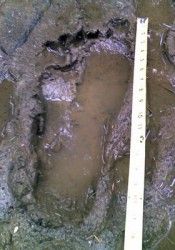
Additionally, in 2007, during a birthday celebration for his son, Stewart started hearing yells coming from his melon patch and later discovered that 50 of those melons had been pried open including fingernail indentations near circular holes which appeared to be caused by a very large hand.
David Paulides, the director of NABS, is working very closely with Stewart on the ongoing case of Bigfoot on his property. But Stewart's case is not by any means the only case he's interested in. Since he began the organization, he says that not only has he collected dozens of hair samples, all being analyzed, but he's also spent thousands of hours in the forest trying to identify food sources and forensic evidence of Bigfoot. Additionally, he's interviewed a large number of people who have had encounters with Bigfoot.
Paulides now believes that there are thousands of living Bigfoot creatures around the US and says that they are much closer to humans than we think, even having similar facial features and having hair colors that run the gamut just like humans. He also believes that Bigfoot likes to live near fresh water sources and in addition to other food sources known by witnesses, Bigfoot lives off of vegetation in the forest and streams.
© unknown
In regards to other arguments people have had such as not being able to find remains of Bigfoot in the forest, he points to the fact that you'll be hard pressed to find remains of a lion mountain as well and we know those exist. This also fits well with other scientific research, folklore and mythology from Native Americans and settlers in the Pacific Northwest who say the creature more than likely buries it's dead like other species do and may have certain intelligences that we don't realize that would give it other means of keeping itself as elusive as it has. Specifically, some of the theories out there state that Bigfoot very well could be the living survivors of the Neanderthal branch of evolution in which case it would have an advanced intelligence very close to that of humans and would understand the need to keep itself hidden, teaching its young to do the same, after negative or dangerous encounters with humans and their weapons in the past. To combat the feces argument, some biologists and zoologists have pointed to the habit of many primates to bury their faces, presumably as a hygienic habit.
Final results on the hair samples found on Stewart's property are expected to be completed and available in approximately six months. You can be sure the cryptozoology community among many others will be keeping a close eye on this one!



bigfoot, not a even a pair of boots to wear.