
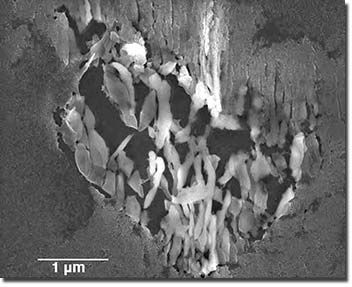
© LLNLSecondary electron image of the Coki section analyzed in this study showing mineral shards surrounded by compressed aerogel.
The research by Lawrence Livermore National Laboratory scientists and colleagues provides the first constraint on the age of cometary material from a known comet. The findings are published in the Feb. 25 edition of Science Express.
The NASA Stardust mission to comet Wild 2, which launched in 1999, was designed around the premise that comets preserve pristine remnants of materials that helped form the solar system. In 2006, Stardust returned with the first samples from a comet.
Though the mission was expected to provide a unique glimpse into the early solar system by returning a mix of solar system condensates, amorphous grains from the interstellar medium and true stardust (crystalline grains originating in distant stars), the initial results painted a different picture. Instead, the comet materials consisted of high-temperature materials including calcium-aluminum rich inclusions (CAIs), the oldest objects formed in the solar nebula. These objects form in the inner regions of the solar nebula and are common in meteorites.
The presence of CAIs in comet Wild 2 indicates that the formation of the solar system included mixing over radial distances much greater than has been recognized by scientists in the past.
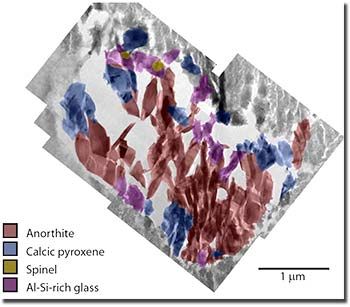
© LLNLCorresponding false color mineral map overlaid on a montage of brightfield Transmission Electron Microscope (TEM) images.
Other LLNL team members include Hope Ishii, Ian Hutcheon, John Bradley, Peter Weber and Nick Teslich. Colleagues include scientists from the University of Washington, University of California, Los Angeles and the Smithsonian Institution.
Founded in 1952, Lawrence Livermore National Laboratory (www.llnl.gov) is a national security laboratory that develops science and engineering technology and provides innovative solutions to our nation's most important challenges. Lawrence Livermore National Laboratory is managed by Lawrence Livermore National Security, LLC for the U.S. Department of Energy's National Nuclear Security Administration.



Reader Comments
to our Newsletter