
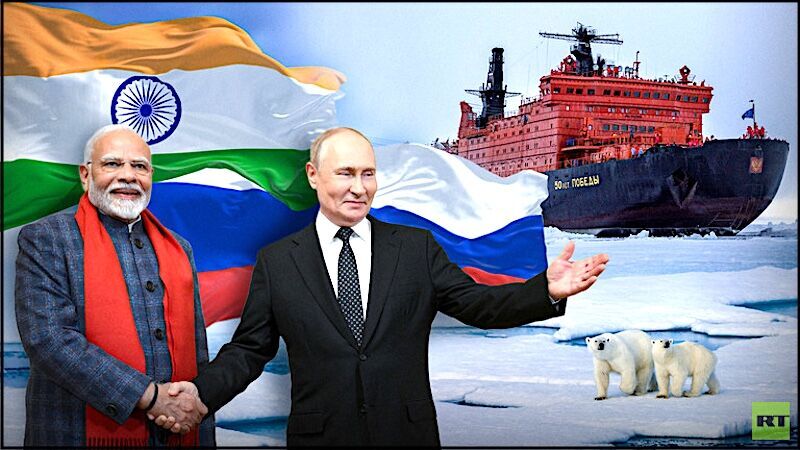
India PM Narendra Modi • Russia President Vladimir Putin
For decades, India's engagement with the Arctic was framed primarily through scientific curiosity, focused on climate research, cryosphere dynamics, and polar expeditions. The summit between Prime Minister Narendra Modi and President Vladimir Putin this December marks a qualitative shift.
Behind the formal words of the Joint Statement lies a clear and important shift. New Delhi is working to make the Arctic a key arena for its economic strategy. By committing to multi-faceted cooperation on the Northern Sea Route (NSR), intensifying trade and investment in the Russian Far East and Arctic, and holding regular bilateral consultations on Arctic issues, India is signaling that it no longer views the polar region merely as a geographic outpost, but as an integrated industrial corridor where it intends to be a rule-shaper rather than a passive observer.
Arctic pivot: India's third energy front
This 'Arctic turn' fits logically into India's broader quest for strategic autonomy in the energy transition. India has committed to reaching 500 GW of non‑fossil electricity capacity by 2030 and has already deployed over 220 GW of such capacity by 2025, putting it broadly on track to meet this goal. Existing diversification efforts, from Australia to Latin America and Africa, have reduced but not eliminated exposure to single-country or single-corridor risks, especially where transport still hinges on vulnerable choke points such as the Suez-Red Sea axis.
Against this backdrop, the Arctic offers a third vector of connectivity, a northern axis that complements the Indo-Pacific and the International North-South Transport Corridor (INSTC), and that can, over time, support both hydrocarbons and critical mineral logistics tied to India's decarbonization pathway.
The conventional narrative around the NSR reduces it to a faster shipping lane between Europe and Asia. The Putin-Modi summit outcomes suggest New Delhi is reading it differently.
The Joint Statement notes productive and mutually beneficial bilateral trade in mineral resources, including energy sources, precious stones and metals, as well as critical raw materials as a pillar of national security and supply-chain reliability. It separately highlights the strategic importance of critical minerals and rare-earths for emerging technologies and advanced manufacturing.
In parallel, India and Russia reaffirmed their readiness to intensify trade and investment cooperation in the Far East and the Arctic zone, with a 2024-2029 program covering energy, mining, manpower, and maritime transport. Taken together, these commitments effectively define the NSR not just as a route for hydrocarbons, but as a prospective 'northern minerals corridor' linking Russia's resource-rich Arctic and Far East to India's industrial base.
For India's energy transition, this corridor could emerge as a strategic hedge, although not the sole pillar. India currently has 100% import dependence for key energy-transition minerals like lithium, cobalt, and nickel, with demand expected to more than double, and in some estimates multiply several-fold, by 2030 as EVs, grid storage, and solar manufacturing scale up. By embedding critical minerals cooperation (exploration, processing, recycling technologies) within a framework that also covers Far East mining and Arctic logistics, New Delhi is creating optionality. Over the next decade, a share of these inputs could flow via northern routes that are structurally distinct from southern sea lanes and Indo-Pacific choke points. This does not replace southern diversification but deepens it, turning the Indo-Arctic into a complementary supply chain vector that can dampen price and disruption risk for India's clean-energy industries.
Developing polar human capital
Perhaps the most understated yet strategic element of the summit is the focus on people rather than just commodities. The Joint Statement records an agreement to develop mutual cooperation in the training of specialists for work in polar waters and maritime Arctic zone and to deepen collaboration in shipping and shipbuilding.
India is already one of the world's largest suppliers of seafarers, and the Directorate General of Shipping data show a steady rise in Indian officers and ratings on international vessels over the past decade. By moving early into niche skills such as ice navigation, polar-certified engineering, and cold-weather port operations, India positions itself to fill a looming labor and expertise gap as NSR traffic increases.
This human capital strategy has implications that extend beyond wages and remittances. A state that supplies the specialized workforce that keeps a critical corridor running gains a subtler form of leverage over how that corridor is operated and regulated. Indian officers and engineers embedded in NSR operations can shape everyday practices on safety, environmental monitoring, and transparency, in line with India's stated emphasis on sustainable and equitable development.
Skills built in the Arctic, ranging from ice-class ship design to remote operations in extreme climates, are also transferable to India's own polar science missions and high-altitude logistics, turning the Arctic into a laboratory for capabilities that underpin both energy security and climate resilience at home.
Governing the North with a Global South lens
The most direct expression of India's shift from observer to rule-shaper lies in governance. The summit commits both sides to hold regular bilateral consultations on Arctic issues and notes India's participation in the International Arctic Forum, while reaffirming cooperation in the Russian Far East and Arctic regions. This creates a structured diplomatic channel with the Arctic's largest coastal state at a time when the Arctic Council's work has been complicated by geopolitical tensions, limiting the influence of observer states such as India in multilateral forums. Through this bilateral track, New Delhi can insert a Global South perspective into emerging norms on Arctic shipping, search and rescue, environmental safeguards, and the governance of new mineral projects.
India's 2022 Arctic Policy explicitly links polar engagement to climate science, environmental protection, and the well-being of local and Indigenous communities. Coupled with the new critical minerals cooperation agenda, this allows India to argue that the inevitable build-out of Arctic resource corridors must not replicate past extractive hierarchies, whether in hydrocarbons or transition minerals. Instead, India can push for higher transparency in supply chains, robust environmental impact assessments, and benefit-sharing models that resonate with its positions at forums like COP and the G20, where it has repeatedly stressed just transitions and equitable access to clean-energy inputs.



Reader Comments
Looks like the same thing is happening in India: 'World’s most populated country told to have more children' [Link] So maybe everything is going on great there too? Population in a generation or two will go down. Lower and middle classes get poorer (have less children), meanwhile the super rich in India have more. Terrific!