
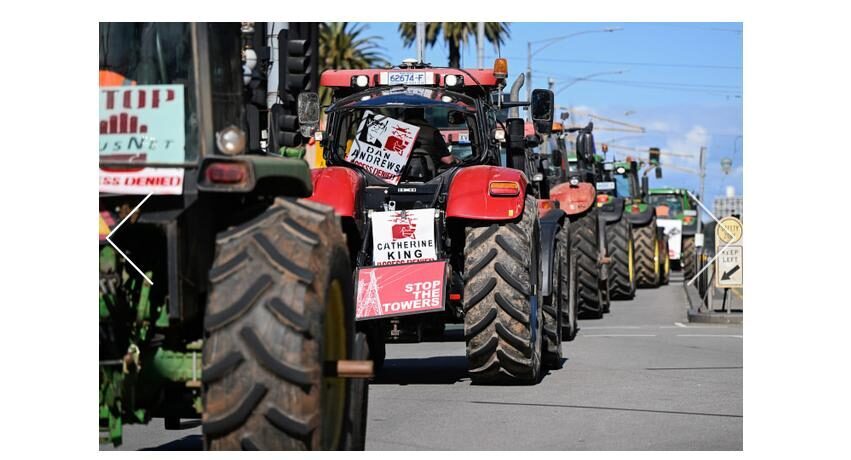
© . Joe ArmaoWestern Victoria farmers are upset over power grid operator AusNet installing power cables through their properties.
The mounting community backlash against new transmission lines needed to shift the electricity grid from coal-fired power to renewable energy looms as a crucial fight for federal and state governments, which have each set pressing climate targets.
Comment: It can only really be considered a 'shift' if the renewable energy is capable of providing an equal amount of power as the current grid, and that it's highly unlikely, because, as of yet, no country has been able to achieve this.
The Albanese government has pledged to more than double the amount of power the electricity grid sources from renewables to 82 per cent by 2030 to help achieve its target of cutting greenhouse emissions 43 per cent by the same deadline.
Boosting supplies of cheaper renewable energy is also crucial to the government's election promise to cut power bills by $275 by 2025, which has been brought into sharper focus amid heightened cost of living pressures.
Energy experts are increasingly worried that time is running out to build the thousands of kilometres of new high-voltage transmission lines needed to connect far-flung renewable energy zones to major cities, risking Australia's ability to compensate for the looming closures of coal-fired power plants.
Comment: The same has been occurring across Europe and the US, whereby power stations are being closed well in advance of any green energy stations being built, which has, unsurprisingly, resulted in the cost of energy soaring, and with raised the threat of blackouts: US facing crisis of 'system-wide, extensive' blackouts, Energy Commissioner warns
But Nationals leader David Littleproud on Tuesday accused the government of running a "reckless race" to renewables. He called for it to defer its deadlines, halt the privately run transmission projects, hold a Senate inquiry or summit into renewable energy and start a national discussion on removing Australia's moratorium on nuclear power.
"This is a virus," Littleproud said at the rally of farmers from western Victoria. "It's epicentre is Victoria, but it's spreading up the east coast."
Climate Change and Energy Minister Chris Bowen said the next decade was critical to Australia's energy future following the former government's failure to manage the shift to clean energy.
"Wasn't the last decade enough of a 'pause'?" Bowen asked.
"The leader of the Nationals' call for a 'pause' in renewable energy shows they still don't get it. In fact, the [Coalition] has gone backwards since the last election.
"You can't get to net zero in 2050 by starting in 2040."
Australia is experiencing one of the world's fastest energy transitions as the economic viability of coal-fired power stations, which still make up two-thirds of the electricity grid, is hammered by cheaper sources of renewable energy.
Under the previous government, some of Australia's biggest coal-fired power station owners announced plans to bring forward their closure dates. AGL's Liddell coal plant in NSW closed earlier this year, while at least four more - the Yallourn generator in Victoria's Latrobe Valley, NSW's Eraring and Vales Point power plants, and Queensland's Callide B - are expected to close before 2030.
Power line delays in NSW and Victoria are being driven by local objections to the effect key projects such as HumeLink in NSW and the Western Renewables Link and VNI West in Victoria will have on property values, the environment and the landscape.
Potato grower Glenden Watts, from Glengower between Bendigo and Ballarat, whose land could be traversed by the proposed VNI West transmission project, said farmers had marched on Melbourne because no one was listening to their concerns.
"We continue to be railroaded, ignored," Watts said.
"The effects to our businesses, our rural community, our ability to grow food and fibre is going to be hamstrung, at the least, if these transmission lines go through. It's time that the Labor government stops, pauses for a minute, takes a step back, [and] looks at the alternatives on the table.
"We will shut the gate ... until there is some logic in the process. Literally, the gate will be shut."
Littleproud told this masthead that governments must consider the use of nuclear power with small modular reactors to replace existing coal plants to reduce the need for new transmission lines.
Former Australian chief scientist Alan Finkel said small modular reactors, which are not in commercial use anywhere, would not be ready for deployment until at least 2040.




Comment: It's telling that the article gives less than a paragraph for why the farmers are protesting, but farmers don't usually have the luxury of leaving their jobs for the day (even if it is winter in Australia) unless the reasons for them doing so are significant.
7News.au provides a bit more information - but still not much - regarding the risks involved in these power lines: It's rather ironic that, yet again, these supposedly 'green policies' are putting farming, and the food supply, at risk: Netherlands threatens 600 'illegal' farmers with fines for failing to buy emissions licenses