
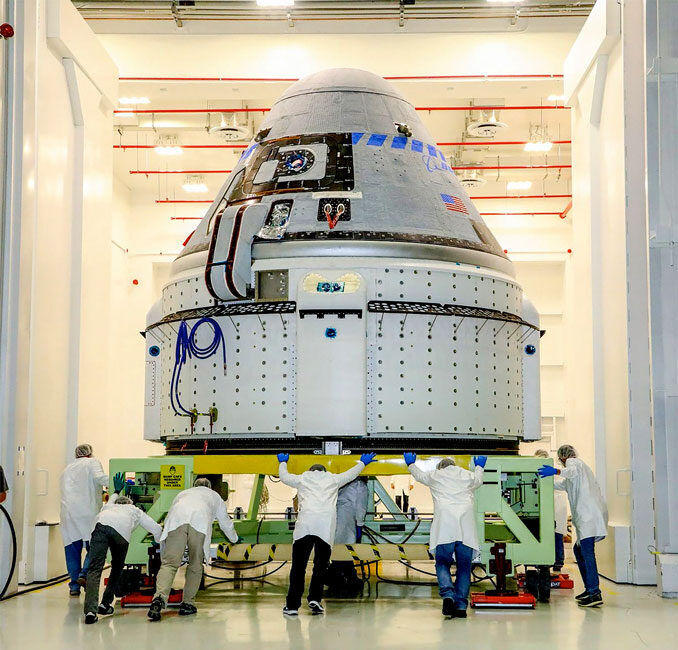
The Starliner team works to finalize the mate of the crew module and new service module for NASA's Boeing Crew Flight Test that will take NASA astronauts Barry “Butch” Wilmore and Sunita “Suni” Williams to and from the International Space Station.
Now, company and NASA officials have announced a Starliner flight to the International Space Station won't be possible any time this year.
Mark Nappi, vice president of Boeing's Starliner program, said in a Tuesday teleconference that the spacecraft won't be ready for operation until at least March of next year. The earliest launch date Starliner could actually fly, however, remains unknown by both NASA and Boeing.
"Based on the current plans, we're anticipating that we're going to be ready with the spacecraft in early March," Nappi told reporters. "That does not mean that we have a launch date in early March."
The capsule intended for the crewed flight test is currently undergoing work at Kennedy Space Center to address a weak fabric link joint system on its parachutes and the flammability of tape used to secure wiring harnesses throughout the spacecraft.
While spacecraft readiness will ultimately determine the window of launch opportunities, the process also involves finding an open slot to launch aboard a United Launch Alliance Atlas V rocket and competition with other traffic to and from the space station.
"We're now working with NASA Commercial Crew Program, the ISS, and United Launch Alliance on potential launch dates based on our readiness," Nappi said. "We'll work that throughout the next several weeks and see where we can get fit in, and then we'll set a launch date."
NASA's Joel Montalbano, manager of the International Space Station program, said Tuesday, "From an ISS standpoint, the Starliner vehicle remains a high priority to the space station program."
"Having a second crew provider is very important to the agency and to our programs," said Montalbano. "That's something that we are working hard to make sure that we achieve."
When it does launch, Starliner is planned to send two NASA astronauts, Barry Wilmore and Suni Williams, to the space station on a short-duration mission to certify its ability as a human transportation system for NASA. Boeing was selected alongside SpaceX to deliver crews to the ISS after the end of the space shuttle program in 2011; the latter company is slated to fly its eighth crewed mission under contract from NASA this month.







Comment: Whilst setbacks can be expected with cutting edge space technologies, the number of repeated issues that both NASA and Boeing have encountered in recent years - and in the case of Boeing, deadly design faults have also affected its airplanes - one does wonder whether these reflect deep problems within the companies themselves: