

© John Pereira/inaturalist.orgLosing a tail is not ideal, but getting eaten by a predator is even worse. Lizards, like the Schmidt's fringe-fingered lizard shown here, depend on a complex internal structure to help them keep their tails until it’s time to lose them.
Lizards are famous for losing their tails, but perhaps the bigger question should be: How do their tails stay on? The answer may lie in the appendage's internal design. A structure of prongs, micropillars and nanopores holds a lizard's tail on tight enough to handle most jarring while remaining primed to drop the tail in case of emergency, researchers report in the Feb. 18 Science.
Self-amputation, or autotomy, of a limb is a common defense strategy in the animal kingdom, including for many lizard species (SN: 3/8/21). But it's a risky plan: A detachable limb brings with it increased risk of accidental loss from small bumps and snags. "It has to find the just right amount of attachment, so it doesn't come off easily. But it should also come off whenever it's needed," says Yong-Ak Song, a bioengineer at New York University Abu Dhabi in the United Arab Emirates. "It's a fine balance."
A lizard's tail consists of a series of segments that connect in a row like plugs into sockets. The tail can break off along any of these points, called fracture planes, depending on how much of the tail the lizard needs to sacrifice. Between each segment, the prongs — eight cone-shaped bundles of muscles arranged in a circle — fit neatly into corresponding sockets, consisting of relatively smooth walls. Each prong is in turn covered in a forest of protrusions, or micropillars, that resemble tiny mushrooms.
The plug-and-socket connection points, or fracture planes, between each segment of a lizard's tail (one of which is illustrated in the circle) are weak points that are susceptible to accidental breaks. Lizards capable of dropping their tails have developed a complex structure of micro- and nanosized features that help the tail hold on during minor bumps and bobbles.
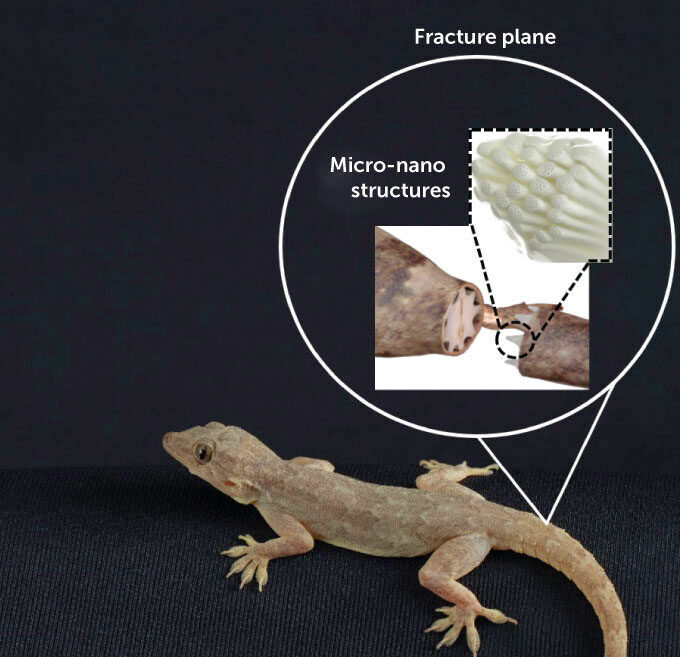
© .Shiji Ulleri/Wise Monkeys PhotographyThe plug-and-socket connection points, or fracture planes, between each segment of a lizard's tail (one of which is illustrated in the circle) are weak points that are susceptible to accidental breaks. Lizards capable of dropping their tails have developed a complex structure of micro- and nanosized features that help the tail hold on during minor bumps and bobbles
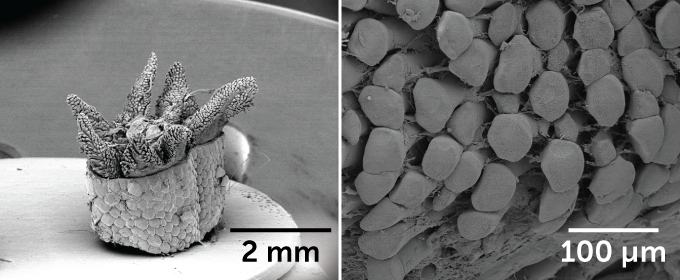
© .Navajit S. Baban/New York University Abu DhabiEach segment along a lizard’s tail contains eight cone-shaped bundles of muscles (left) that function like a plug for a socket. Zooming in on a prong reveals a landscape of mushroom-shaped micropillars covered in nanopores (right)
Suspecting that the nanopore-speckled micropillars must play another role, the team built a replica lizard tail from polydimethylsiloxane, a rubbery, fleshlike material, to mimic the separation of tail from body. This allowed the researchers to examine the forces at work during a tail amputation. They found that the deep crevasses between micropillars, along with the smaller potholes on the micropillars' surfaces, slow the spread of an initial fracture.
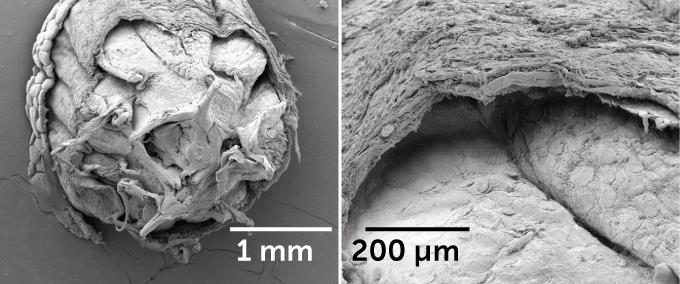
© Navajit S. Baban/New York University Abu DhabiTo connect the tail’s segments together, the prongs fit neatly into corresponding sockets (such as the shadowy indent at the top of the left image). The interior walls of the sockets (closeup shown at right) are relatively smooth, with slight imprints where the mushroom-shaped micropillars press up against the walls. This indicates that the micropillars do not interlock with the sockets’ walls, so they’re not contributing to the prong’s grip.
This adaptation is important for lizards to optimize their survival. While autotomy helps keep a lizard from becoming lunch, it's a costly defense mechanism that affects a lizard's ability to run, leap, mate and escape future predators (SN: 1/5/12). So, it's important that the lizard abandons its limb only when necessary.
This intricately designed system is a perfect example of how evolution can continually work on something to make it more effective, says Bill Bateman, a behavioral ecologist at Curtin University in Perth, Australia, who was not part of the research. "It just blows me away."



Reader Comments
Starfish must have sex otherwise, they would be stuck.
Still, it is a nice attribute to stay alive after part of your body dies.
Peace,
Ken
Way to tell me to follow the science . LOL
Typically, a hydra has 8 appendages, but kill each appendage with proper blows, and then each kill gets easier, and a Hydra can’t run away from a Woods Girl proficient. It is a matter of tactics.
Mo Hit is better upon the Hydra. peace of cake
Reminds me of an old Irish story about a man walking into a bar fight. Upon looking at what was happening in front of him, turned to the closest bloke and said 'Is this your fight or can anyone join'?
(I paraphrase)