
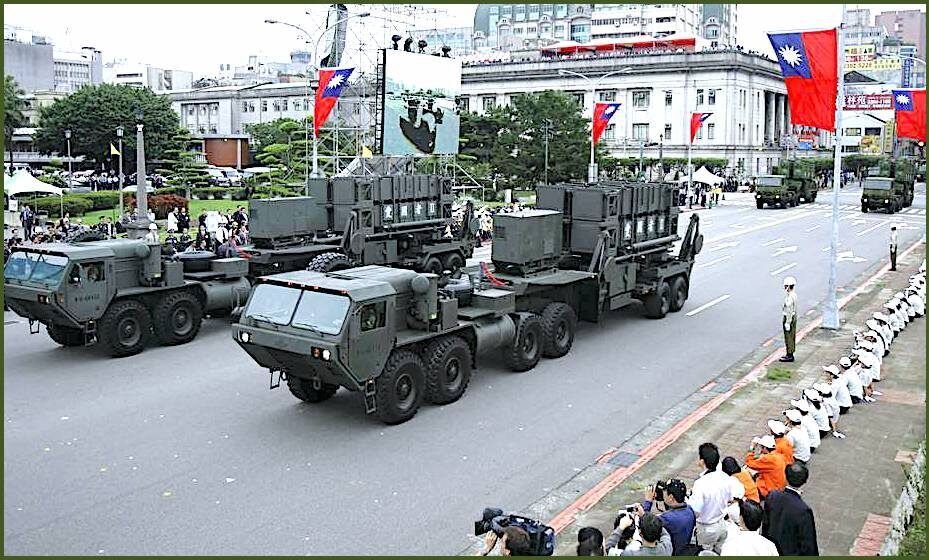
© APTaiwan's US-made Patriot surface-to-air missile batteries in Taipei.
Taiwan also hailed the approval as part of US commitments to boost the self-ruled island's defence and security amid mounting tension in the Taiwan Strait.
The US government announced on Monday the approval of possible US$100 million sale of equipment and services to Taiwan to "sustain, maintain, and improve" the Patriot system - a deal certain to further infuriate Beijing, which sees Taiwan as its territory that must be taken in control, by force if necessary.
Chinese foreign ministry spokesman Zhao Lijian said Beijing opposed the arms sale, saying it seriously damaged China-US relations and peace across the Taiwan Strait. "China will take strong and legitimate measures to defend its sovereignty and security interests," he said in a press conference on Tuesday.
In a statement, the Defence Security Cooperation Agency (DSCA) under the Pentagon said it notified Congress of the deal on Monday after it was approved by the State Department.
The deal includes equipment and services to support participation in the Patriot International Engineering Services Programme and Field Surveillance Programme for five years, including engineering aid for upkeep and improvements to the Patriot Air Defence System, it said.
It also included support for legacy missiles such as guidance enhanced missile (GEM) and Patriot advanced capability-3 (PAC-3) weapons, as well as testing of the reliability of stockpiled weapons, DSCA said.
The package also included US government and contractor technical and logistics support, and other related programme support, DSCA said, adding that the proposed sale was consistent with US law and policy:
"This proposed sale serves US national, economic, and security interests by supporting the recipient's continuing efforts to modernise its armed forces and to maintain a credible defensive capability."It said the proposed sale would help improve Taiwan's security and help maintain "political stability, military balance, economic and progress in the region".
DSCA said the proposed sale would not only help sustain Taiwan's missile density and ensure its readiness for air operations, but would also enable the island to use this capability as a deterrent to regional threats and to strengthen homeland defence.
Raytheon Technologies and Lockheed Martin would be the main contractors, it said.
DSCA stressed that the proposed sale of this equipment and support would not alter the basic military balance in the region and that there would be no adverse effect on US defence readiness because of the proposed sale.
The island's presidential office, defence and foreign ministries issued separate statements on Tuesday thanking the Biden administration and hailing the approval as firm support of the island as tensions mounted in the Taiwan Strait.
Presidential office spokesman Xavier Chang said this would be the second arms sale to Taiwan since US President Joe Biden took office and the first deal this year.
"This fully reflects that the US government has continued to attach great importance to the defence capability of Taiwan and value rock-solid partnership between the two sides."Despite persistent military threats from Beijing, Chang said, the island maintained that it would not be adventuresome, but nor would it bow to pressure and that the island would continue to upgrade its defence capability and deepen its security partnership with like-minded countries to uphold peace and stability in the region.
Beijing has never renounced the use of force against Taiwan. It has stepped up military intimidation against the island and poached Taiwan's allies to ramp up pressure against Taipei since Tsai Ing-wen of the independence-leaning Democratic Progressive Party was elected president in 2016 and refused to accept the one-China principle.
Taiwan's foreign ministry said the deal was part of the US commitment to help boost the island's security. The island's defence ministry said the deal, which was expected to come into effect within a month, was made during a 2019 meeting with US officials in the administration of former US president Donald Trump.
Washington, which does not have official ties with Taiwan but maintains close relations with the island, has been the biggest arms supplier for Taipei. It has repeatedly asked Taiwan to modernise its military to deter the mainland's threats.
Rupert Hammond-Chambers, president of the US-Taiwan Business Council, expressed his support for the deal:
"While ongoing force modernisation is essential to combat the growing threat from China, maintenance of Taiwan's existing equipment is similarly crucial."Hammond-Chambers said Taipei and Washington
"should also seek to integrate Taiwan's missile defence capabilities into America's regional architecture, including cooperation with allies such as Japan and Australia".
About the Author:
Lawrence Chung covers major news in Taiwan, ranging from presidential and parliament elections to killer earthquakes and typhoons. Most of his reports focus on Taiwan's relations with China, specifically on the impact and possible developments of cross-strait relations under the pro-independence Democratic Progressive Party and mainland-friendly Kuomintang governments. Before starting work at the South China Morning Post in 2006, he wrote for Reuters and AFP for more than 12 years.



Reader Comments
to our Newsletter