
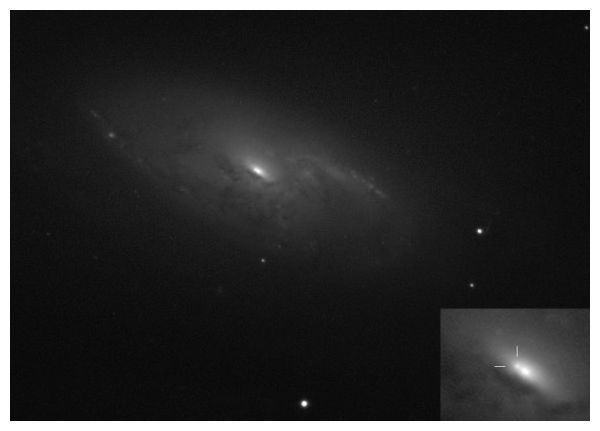
© Gianluca Masi, Francesca Nocentini and Patrick SchmeerThe new supernova with the temporary name of PSNJ12185771+4718113 nestles right up to the nucleus of the galaxy in this photo taken May 21 with a 17-inch telescope. It’s just 1″ east and 3″ south of galactic center.
A study of its light curve indicated a Type II supernova - the signature of a rare supergiant star ending its life in the most violent way imaginable. A typical supergiant star is 8 to 12 times more massive than the sun and burns at a much hotter temperature, rapidly using up its available fuel supply as it cooks lighter elements like hydrogen and helium into heavier elements within its core. Supergiant lifetimes are measured in the millions of years (10-100 million) compared to the frugal sun's 11 billion years. When silicon fuses to create iron, a supergiant reaches the end of the line - iron can't be fused or cooked into another heavier element - and its internal "furnace" shuts down. Gravity takes over and the whole works collapses in upon itself at speeds up to 45,000 miles per second.
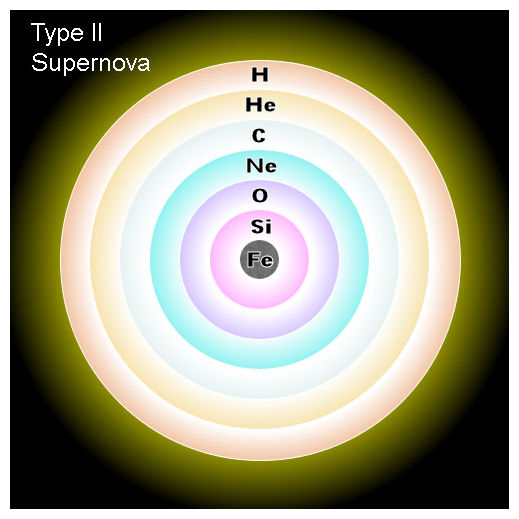
© Universe TodayThe inner core of a red or blue supergiant moments before exploding as a supernova looks like an onion with multiple elements “burning” through the fusion process to create the heat and pressure that stays the force of gravity. Fusion stops at iron. With no energy pouring from the central core to keep the other elements cooking, the star collapses and the rebounding shock wave tears it apart.
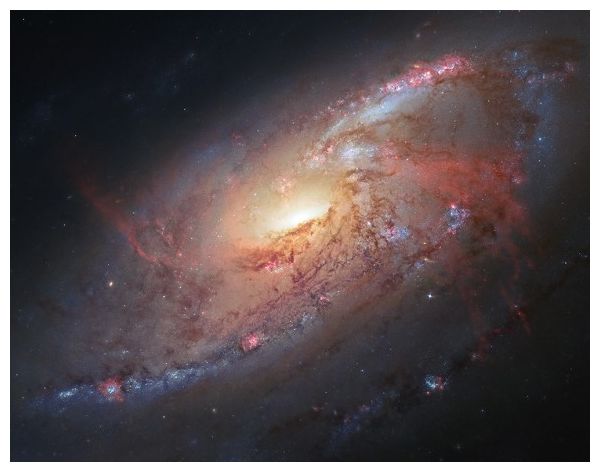
© NASA/ESAThis Hubble Space Telescope image shows how spectacular M106 truly is. Dark filaments of dust are silhouetted against billions of unresolved suns. Young star clusters rich with hot, blue stars and tufts of pink nebulosity swaddling newborn stars ornament the galaxy’s spiral arms. A supermassive black hole rumbles at the heart of the galaxy. M106 is the 106th entry in Charles Messier’s famous catalog created in the 18th century. It’s located 23.5 million light years away.
Visually the supernova will appear fainter because our eyes are more sensitive to light in the middle of the rainbow spectrum (green-yellow) than the reds and purple that bracket either side. I made a tentative observation of the object last night using a 15-inch (37-cm) telescope and hope to see it more clearly tonight from a darker sky. We'll keep you updated on our new visitor's brightness as more observations and photographs come in. You can also check Dave Bishop's Latest Supernovae site for more information and current images.
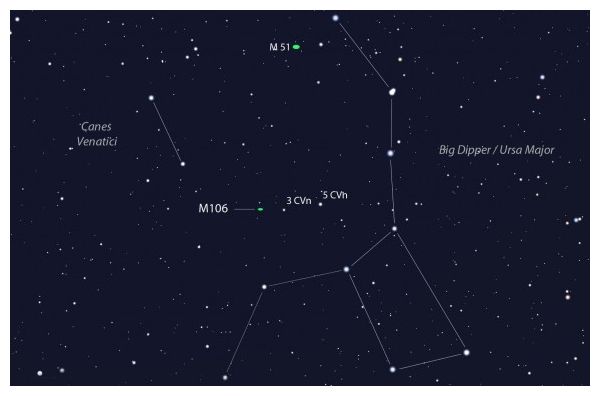
© StellariumAt magnitude +9, M106 visible in almost any telescope and easy to find. Start just above the Bowl of the Big Dipper which stands high in the northwestern sky at nightfall in late May. The 5th magnitude stars 5 CVn (5 Canes Venatici) and 3 CVn lie near the galaxy. Star hop from the Bowl to these stars and then over to M106. Stars plotted to mag. +8.



Reader Comments
to our Newsletter