
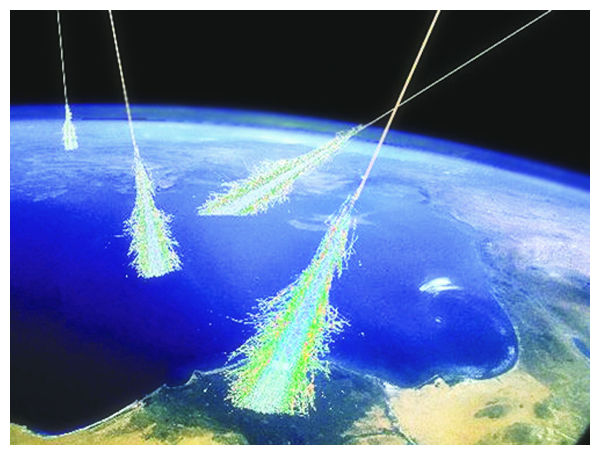
© Simon Swordy/University of Chicago, NASAArtist's impression of solar cosmic rays striking Earth's atmosphere.
The first such event since 2006, the GLE was recorded by a joint Russian/Italian spacecraft called PAMELA and is an indicator that the peak of solar maximum is on the way.
The PAMELA spacecraft - which stands for Payload for Antimatter-Matter Exploration and Light-nuclei Astrophysics - is designed to detect high-energy cosmic rays streaming in from intergalactic space. But on May 17, scientists from NASA's Goddard Space Flight Center convinced the Russian team in charge of PAMELA to grab data from the solar event occurring much closer to home.
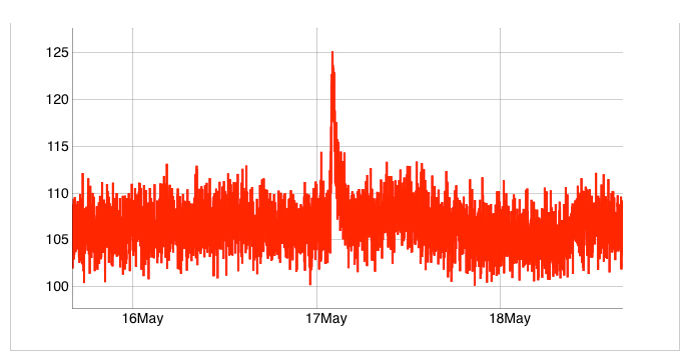
© University of Oulu/NASA's Integrated Space Weather Analysis SystemThis graph shows the neutrons detected by a neutron detector at the University of Oulu in Finland from May 16 through May 18, 2012.
"Usually we would expect this kind of ground level enhancement from a giant coronal mass ejection or a big X-class flare," said Georgia de Nolfo, a space scientist at NASA's Goddard Space Flight Center.
"So not only are we really excited that we were able to observe these particularly high energy particles from space, but we also have a scientific puzzle to solve."
Fewer than 100 GLEs have been recorded in the last 70 years, with the most powerful having occurred on February 23, 1956. Like most energetic solar outbursts, GLEs can have disruptive effects on sensitive electronics in orbit as well as on the ground, and based on recent studies may even have adverse effects on cellular systems and development.
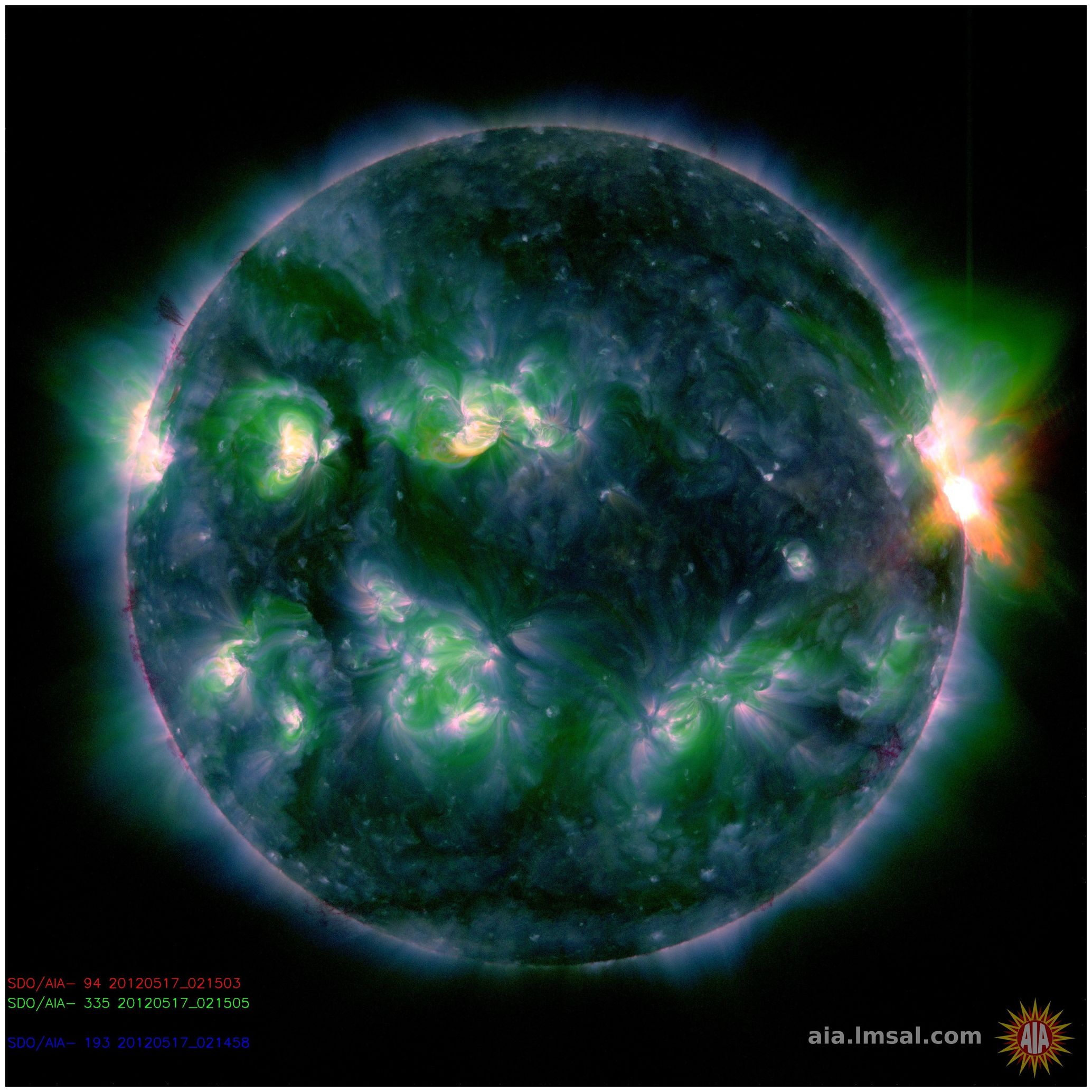
© Courtesy NASA/SDO and the AIA science teamThe M-class flare from AR 1476 on May 17, 2012 (at right).



Reader Comments
to our Newsletter