Having already unleashed two X-flares since Sept. 22nd, sunspot AR1302 appears ready for more. The active region has a complex "beta-gamma-delta" magnetic field that harbors energy for strong M- and X-class eruptions. Flares from AR1302 will become increasingly geoeffective as the sunspot turns toward Earth in the days ahead.
Marko Posavec of Koprivnica, Croatia, photographed the behemoth sunspot between flares on Sept. 24th:
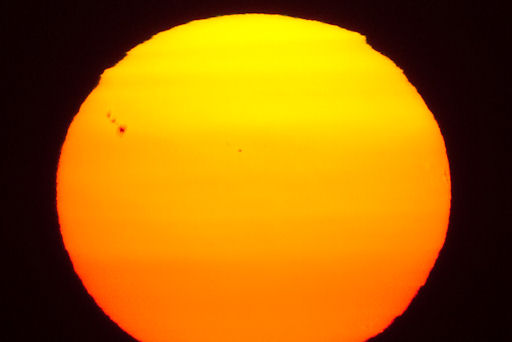
© Marko Posavec of Koprivnica, CroatiaPhoto details: Olympus E-510, Sigma 50-500mm lens (at 500mm), 1/640 sec. exposure, f/18, ISO 100
"Sunspot complex 1302 is incredibly easy to spot at sunrise or sunset," says Posavec. "Be careful, though. Even the low-hanging sun is bright enough to damage your eyes if you look at it through optics of any kind." Safe solar filters may be found in the SpaceWeather Store.
More images: from
Alan Friedman of Buffalo, NY; from
Monika Landy-Gyebnar of Balatonfured, Hungary; from
Piet Berger of Simpelveld, Netherlands; from
Howard Eskildsen of Ocala, Florida; from
Dzmitry Kananovich of Tallinn, Estonia




BAD. DO NOT LOOK AT THE SUN with unaided vision, period.
If a big flare were to go off, even with Sun on Horizon, you may potentially be blinded.
BAD. DO NOT LOOK AT THE SUN with unaided vision, period.
No definition is given for how close to the Horizon the Sun is safely viewed.
BAD. DO NOT LOOK AT THE SUN with unaided vision, period.
The uninitiated have no experience to know how careful they need to be, they are not even amatuer astronomers.
BAD. DO NOT LOOK AT THE SUN with unaided vision, period.
There is no reason to look at the Sun, not when there are plenty of sites with loads of satellite -based images.
DON'T DO IT. DO NOT LOOK AT THE SUN. Period.