
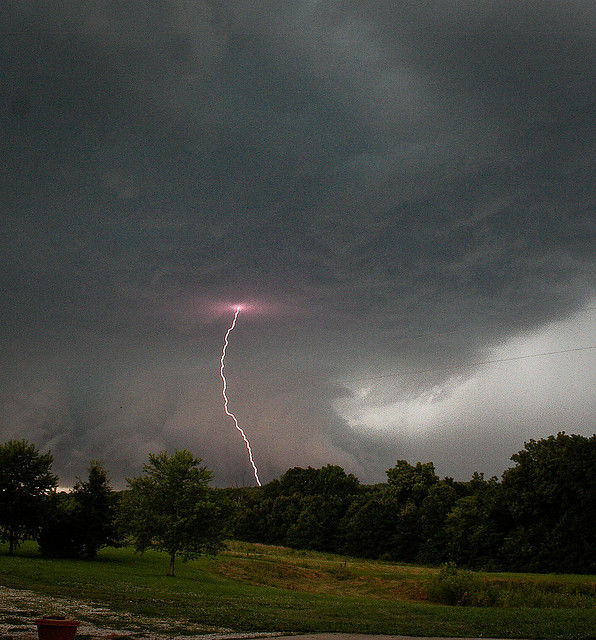
© akingagain/Flickr
On Friday, a lightning strike during a thunderstorm set an apartment building afire in Memphis. Everyone inside escaped unharmed, but damage was considerable. Five days earlier, lightning struck a building in Gallatin, starting a fire that killed a woman who lived there.
While it isn't possible to be completely safe from lightning, there are ways to reduce the chances of being harmed.
The National Weather Service safety slogan cautions, "When thunder roars, go indoors."
Take heed, urges Dr. Corey Slovis, chairman of the Emergency Medical Department at Vanderbilt University Medical Center, because the consequences of being struck by lightning range from mild burns with no long-term complications to instant death.
There were 29 lightning strike deaths nationwide in 2010, according to weather service statistics. None of them were in Tennessee, but the state has had 11 lightning deaths since 2000.
Among those who did die last year, half were struck while on a broad, flat surface and another 28 percent of them were standing under trees.
Most of the lightning patients Vanderbilt gets were either working or playing when they were struck.
"They are people who were out of doors on a golf course, coming in from the lake or out hiking or they were working outside during a storm," Slovis said.
The injuries to people who take a direct lightning strike are horrific.
Dr. Jeff Guy, who directs the hospital's burn unit, says among them are muscle contractions so violent they can snap bones.
Many people who suffer lesser lightning injuries don't initially feel bad effects, Guy said, but complications often develop.
"There's a progressive paralysis that sets in over 24 to 48 hours," Guy said "They eventually can't feel anything from the neck down and can't breathe.
"It comes on like a wave over their body," he said.
While the condition is frightening and doctors put patients on ventilators to help them breathe, the symptoms don't last long.
Subtle changes in behavior and personality can show up even months later in some cases, however. Sometimes it takes a while to connect new behavior to old injury.
"People lose their jobs, flunk out of school and it's because of a physical injury," Guy said. "We're asking those questions now (of patients)."
While being indoors reduces the chance of being struck by lightning, it doesn't eliminate it.
"Stay away from any conductors; like light fixtures and piping," said Kevin Bouchet, a forecaster with the NWS in Nashville.
Bouchet said water is a conductor, too, so don't bathe or wash dishes at the kitchen sink during a thunderstorm.
When outdoors, avoid being the tallest thing around on a large flat surface. Get off golf courses, out of farm fields and off the lake.
So where do those electrical charges that can have such disastrous consequences begin? As ice crystals banging into each other repeatedly within a cumulonimbus cloud, Bouchet said.
"When pieces of graupel (tiny ice crystals) fly into each other, that's where the charge separation occurs. Some become positive, others negative," he said.
Miners and cavers should be safest in a thunderstorm because lighting is the result of nature trying to balance the electrical charge between the cloud and the surface of the Earth. Perhaps the second-safest place to be in a thunderstorm sits in the driveway.
"You would be relatively safe in your car," Bouchet said.
The frame of a car forms what's called a Faraday cage and the lightning will travel around you, not through the passenger compartment.
Bouchet takes a nearly philosophical view of the scientific need for lightning. He calls it nature seeking equilibrium - something that will never be achieved.
"The ship will never be righted," Bouchet said.
Source: The Associated Press



Reader Comments
to our Newsletter