Earth ChangesS


Question

Hundreds of dead fish wash up on Beaver Lake


St. Paul, Minn. (WCCO) - The spring weather brought with it something pretty unsightly near St. Paul. Hundreds of fish recently died in Beaver Lake, and many of them ended up all along the shoreline.

Fish kills are not unusual this time of year, but this one has Ramsey County officials worried. The fish died even though there is an aeration system in Beaver Lake.

Ruth Klabunde walks her dogs around the lake about three times a week. The first thing she noticed was the smell.

"This is a really fun little lake to walk around," Klabunde said. "And the stench was kind of bad."

And then Klabunde says she saw the source.

"This whole little bay area here was thick with dead fish," she said.

When the ice finally went out on Beaver Lake a week and a half ago, it left behind schools upon schools of dead fish.

It's estimated that more than 7,000 pounds of dead fish - mostly catfish, sunfish and bass - have been taken out of Beaver Lake. But what caused this unusually large fish kill is still a mystery.

Beaver Lake has an aeration pump that can be turned on when oxygen levels get low. Ramsey County turned the pump on in February, but it only reaches a small part of the lake.

Bizarro Earth

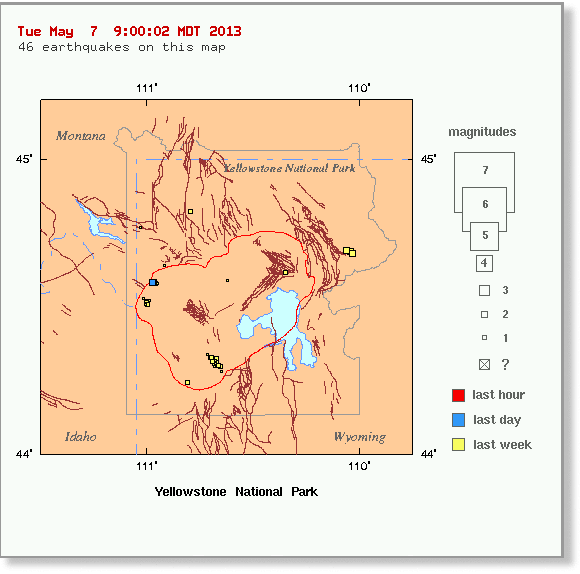
Earthquake rumblings in Yellowstone National Park

Update time = Tue May 7 9:00:02 MDT 2013

Magnitude 2.9 2013/05/07 07:22:33 44.583N 110.976W 9.5 14 km ( 8 mi) SE of West Yellowstone, MT

Image
Here are the 30 most recent earthquakes and all M>3 earthquakes on this map...

Bizarro Earth

Philippine's Mayon volcano erupts violently, spews rocks: kills five climbers

One of the Philippines' most active volcanoes spewed huge rocks and ash after daybreak Tuesday, killing at least five climbers and trapping more than a dozen others near the crater in its first eruption in three years, officials said. Rescue teams and helicopters were sent to Mayon volcano in the central Philippines to bring out the dead. At least seven were injured from a group of about 20 mountaineers who were caught by surprise by the sudden eruption, Albay provincial Gov. Joey Salceda said. Clouds have cleared over the volcano, which was quiet later in the morning. The climbers who died were struck by huge rocks, guide Kenneth Jesalva told ABS-CBN TV network by cell phone from a camp near the crater. They included a German, an Austrian and a Filipino.


The injured included foreigners and Filipino guides. Some were in critical condition, said the chief of the national disaster agency, Eduardo del Rosario. Jesalva said he was in the group that spent the night on the picturesque mountain, known for its almost-perfect cone, when the volcano rumbled back to life early in the morning and rocks "as big as a living room" came raining down on them. He rushed back to the base camp to call for help.

Bug

Cicada invasion! U.S. East Coast braces for swarms

Tens of millions of the insects are preparing to inflict a 17-yearly noisy hell on people living along America's East Coast.
Image
A cicada dries it wings on a tree branch in 2004
Colossal numbers of cicadas - quietly growing underground since 1996 - are about to emerge along much of the US East Coast to begin an orgy of passionate singing and mating.

Billions of so-called 17-year periodical cicadas, with their distinctive black bodies, buggy red eyes, and orange-veined wings will begin to settle along a roughly 900-mile stretch from northern Georgia to upstate New York.

The good news is they do not sting or bite, and are not harmful to crops.

But the eerie, cacophonous mating music they produce has simultaneously amazed and infuriated people for centuries.

In central Connecticut, particularly dense concentrations of so-called Brood II cicadas, named Magicicada septendecim, should arrive in late May or June this year as soon as the soil temperature exceeds 18C (64F).

Chris Maier, entomologist with the Connecticut Agricultural Experiment Station in New Haven, said the first scientific recording of Brood II specimens was in 1843.

Cloud Precipitation

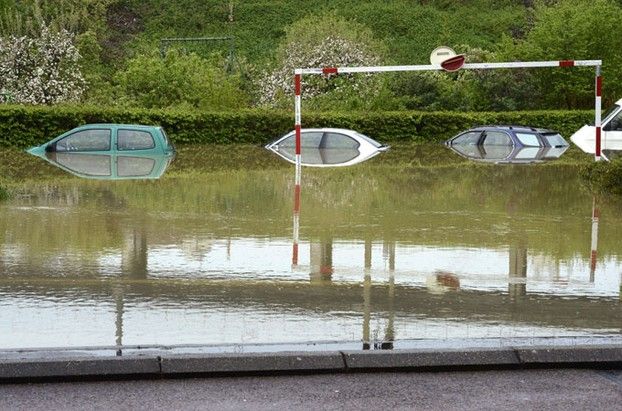
Evacuations ordered as flooding hits eastern France

Neuilly-les-Dijon flood
© AFPA flooded car park in Neuilly-les-Dijon where the Ouche river bursts its banks after days of heavy rain.
Officials in eastern France ordered evacuations Saturday after torrential rains hit the Burgundy region.

Some residents of Dijon were ordered out of their homes to escape the rising waters of the Ouche river, which overflowed its banks, after a month's worth of rain poured down over 12 hours.

Dijon firefighters had to rescue three people trapped in a car, and ferry service in Lyon was suspended because the water in the Saone river had risen to the point the boats could not pass under bridges, Radio France Internationale said.

Flood alerts in seven departments were lifted Saturday, however the downpour was expected to continue in other parts of France.

Bizarro Earth

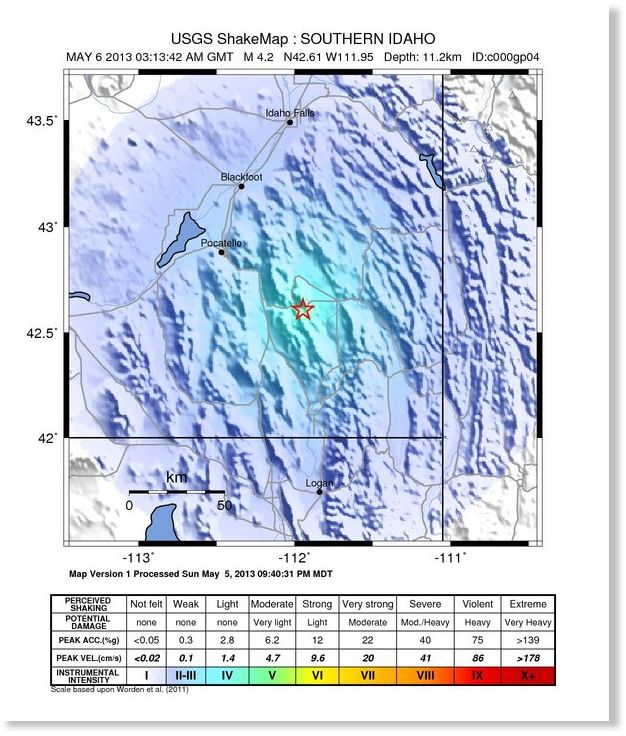
USGS: Earthquake Magnitude 4.2 - 28km W of Soda Springs, Idaho

Image
© USGS
Event Time:
2013-05-06 03:13:42 UTC
2013-05-05 21:13:42 UTC-06:00 at epicenter

Location:
42.608°N 111.947°W depth=11.3km (7.0mi)

Nearby Cities:
28km (17mi) W of Soda Springs, Idaho
50km (31mi) SE of Pocatello, Idaho
54km (34mi) SE of Chubbuck, Idaho
72km (45mi) SSE of Blackfoot, Idaho
205km (127mi) N of Salt Lake City, Utah

Technical data

Comment:
Large meteor explodes in Wyoming sky


Ice Cube

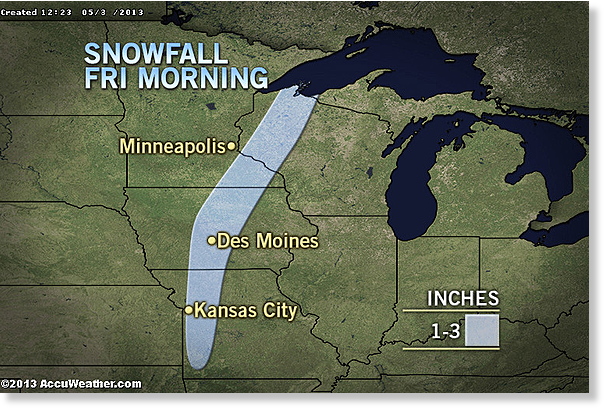
Historic snowstorm hits U.S. Plains to Upper Midwest

Image
The list of locations that have received record May snowfall from a storm that brought up to 2 feet of over the central Rockies continues to grow over portions of the Plains and Upper Midwest.

The storm will continue to drop accumulating snow through Friday morning and reaching even more unlikely locations over the Plains, Midwest and the South before it is all said and done.

Omaha, Neb., Mason City, Iowa, and Rochester, Minn., are but only several cities that have been clobbered by their biggest May snowfall on record. In many cases in the major cities in the Plains, those records date back to the 1800s.

While snow is not unheard of away from the Rockies and northern tier states during May, it is the amount of snow and the extent of that snow that is so unusual. Snowstorms during May in the Midwest are typically highly localized.

Minneapolis/St. Paul managed to avoid the heaviest snow from this storm. However, areas less than 50 miles to the southeast of the Twin Cities received between 6 and 12 inches of snow Wednesday night into Thursday. As much as 18 inches fell on part of southeastern Minnesota and northwestern Wisconsin.

Bizarro Earth

Explosions shake Alaska's Cleveland volcano

Cleveland Volcano
© Alaska Volcano Observatory
Cleveland Volcano is erupting once again. Three small explosions shook the volcano Saturday morning, and a low-level eruption is ongoing.

John Power is a seismologist with the Alaska Volcano Observatory. He writes in an email that the explosions were "similar in size to what we have seen over the past several years," although he notes that it is unusual to have three in a row.

Power says satellite imagery and a webcam in the nearby village of Nikolski show that the volcano is continuing to emit small amounts of gas, ash and steam, with plumes rising to 15,000 feet. There's no real-time monitoring network on the volcano.

Cleveland lies on a major international flight path, and in light of the explosions the Observatory has raised the aviation alert level from yellow to orange. They warn that there is the possibility of sudden explosions reaching above 20,000 feet, but so far there have been no reported disturbances to air travel.

Cleveland is one of the most active volcanoes in the Aleutians, erupting roughly two dozen times in 2012. It's last major eruptive period was in 2001, when the volcano sent ash clouds up to 39,000 feet.

Bizarro Earth

Flooding spreads in Saskatchewan - emergencies declared in three more communities

Saskatchewan flooding
© Roy Antal/Canadian PressCity crews install sandbags along Rotary Park in Regina. By Saturday 13 communities in the province had declared emergencies because of rising floodwaters.
Two First Nations and a rural municipality have been added to the list of Saskatchewan communities under flood emergencies.

The James Smith First Nation, the Cowessess First Nation and the regional municipality of Fish Creek bring the total number of communities that have declared emergencies to 13.

"We're still seeing in the rural areas significant impact to infrastructure such as roads either overtopping or having to be cut, so most of the rural municipalities are still facing some challenges," Duane McKay, Saskatchewan's commissioner of emergency management, said Saturday.

Highway 3, just west of Spiritwood, was closed Saturday because of flooding.
Meanwhile, the Water Security Agency said sandbagging and other efforts to keep the water out of the town of Radisson, northwest of Saskatoon, were holding.

The agency said the good news is that water levels appear to be going down a little around Radisson.

"With the snow cover there being decreased and it seems it's calming a little bit and we're hoping that we've seen the worst of that situation," said agency spokesman Patrick Boyle.

"The town has done a lot of mitigation work to facilitate the flow of water away from the community in Radisson."

Question

Mysterious dead fish at Eagles Mere Lake, Pennsylvania


Eagles Mere - Dead fish found at one of our area's most pristine lakes has caught the attention of state officials. The Pennsylvania Fish and Boat commission is trying to find out what caused the dead fish to wash ashore at Eagles Mere Lake in Sullivan County.

In these clear blue waters in Sullivan County, dozens and dozens of dead fish have been floating to the surface. Mostly sunfish, trout and bass have been found dead. Some people who work in the Eagles Mere lake community say it's more than fishy.

"It's scary because people fish out of there, there's kids in here in the summertime," said Brittany Mapes of Forksville.

Doug Rider is a realtor in Eagles Mere and says he walked by the lake just this past week and didn't notice the dead fish. He isn't too concerned just yet.

"When I heard about it it was surprising to me, but I have heard in the past that after the lake turns, the ice melts that the oxygen level is a little low for the fish," said Rider.

Maintenance crews have been combing the beach and shallow waters for the dead fish and burying them a short distance away in the woods. They contacted the Fish and Boat Commission and the Pennsylvania Department of Environmental Protection (DEP).

Officials with the Fish and Boat Commission say they can't say for certain what's causing all of these dead fish to turn up here at Eagles Mere Lake, but they will be investigating.