Earth ChangesS


Cloud Precipitation

Weather changes impact migrating birds


Weslaco - Experts say there has been an increase in the number of migratory birds falling from the sky in the region.

They said recent weather changes may be affecting the migrating species. Some residents reported finding dead birds in their yards.

"I heard the (bird) slam on the ground ... on the pavement," Norma Lopez said.

She found a second dead bird Monday morning.

"I didn't really get next to it or touch it, but I did see it open its mouth a few times. That was it," Lopez said. She said her friends in other Valley cities have witnessed the same phenomenon.

"I heard my friends had some outside their window. (I) also heard of another one in Brownsville," Lopez said.

Roy Rodriguez, a bird specialist at Bentsen State Park, said random bird deaths aren't new. Still, he said they are rare in the region.

"A fall out is a phenomenon where birds literally fall out of the sky after flying into a head wind," Rodriguez said.

Recent cold fronts and micro storms in the coast are making migration difficult for millions of birds, he said.

"They have to seek shelter and land. The first thing they do is head west," Rodriguez said.

Experts said another storm surge Monday could force more birds to fall out of the sky. They said people can help those birds. If the bird is breathing, place it in a box and let it rest.

"There is a lot of danger on the ground, especially from cats. Pick the bird up and put it in the box and let it rest," Rodriguez said.

Rodriguez said the bird should have water and food - like a piece of fruit. Bird seed is not recommended for exhausted birds.

Fish

Health defects found in fish exposed to Deepwater Horizon oil spill, three years later

Crude oil toxicity continued to sicken a sentinel Gulf Coast fish species for at least more than a year after the Deepwater Horizon oil spill in the Gulf of Mexico, according to new findings from a research team that includes a University of California, Davis, scientist.
Image
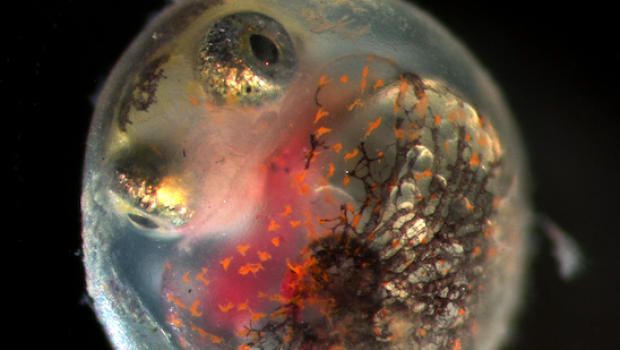
© Benjamin DubanskyGulf killifish embryos exposed to sediments from oiled locations show developmental abnormalities, including heart defects, delayed hatching and reduced hatching success.
With researchers from Louisiana and South Carolina, the scientists found that Gulf killifish embryos exposed to sediments from oiled locations in 2010 and 2011 show developmental abnormalities, including heart defects, delayed hatching and reduced hatching success. The killifish is an environmental indicator species, or a "canary in the coal mine," used to predict broader exposures and health risks.

The findings, posted online in advance of publication in the journal Environmental Science and Technology, are part of an ongoing collaborative effort to track the impacts of the Deepwater Horizon oil spill on Gulf killifish populations in areas of Louisiana that received heavy amounts of oil.

Other species that share similar habitats with the Gulf killifish, such as redfish, speckled trout, flounder, blue crabs, shrimp and oysters -- may be at risk of similar effects.

"These effects are characteristic of crude oil toxicity," said co-author Andrew Whitehead, an assistant professor of environmental toxicology at UC Davis. "It's important that we observe it in the context of the Deepwater Horizon spill because it tells us it is far too early to say the effects of the oil spill are known and inconsequential. By definition, effects on reproduction and development -- effects that could impact populations -- can take time to emerge."

Bizarro Earth

California wind-fueled wildfire erupts east of Los Angeles, but worse conditions await

Firefighters were able to beat back a powerful wildfire that bore down on a dry Southern California city, limiting the damages to a single house and curbing the threat to hundreds more. But the difficult conditions that helped fuel the 4 1/2 square-mile blaze in Riverside County on Wednesday could be even worse in parts of the state Thursday.

"Today was a transition day," state fire spokesman Julie Hutchinson said. "Tomorrow is the big wind day" Winds of 20-30 mph are expected, along with nearly non-existent humidity and an abundance of wildfire fuel. "The grass, brush and trees are very volatile. They're ready to burn," Hutchinson said. "Everything is just very dry. And not just in Southern California, statewide."

Forecasters said high pressure would send strong winds through Southern California's passes and canyons and near coastal foothills Thursday.


Igloo

Jet stream dip has brought record snow this Spring

Image
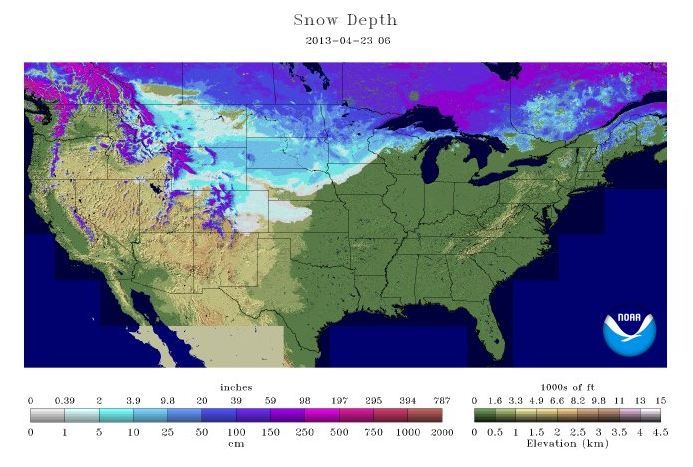
© NOAASnow depths on April 23, 2013.
Spring has gotten off to a colder- and snowier-than-average start in parts of the United States, particularly in the eastern Rockies and Upper Midwest.

Duluth, Minn., for example, has seen 51 inches (130 centimeters) of snow this April. That's not only the most snow the town has seen in any April - breaking the old mark of 31.6 inches (80 cm) - but the most snow the town has received in any month, ever, according to government records. As of Monday (April 22), a total of 995 snowfall records have also been broken so far this month, according to AccuWeather. Over the same time period last year, 195 snowfall records had been broken.

More than 91 percent of the upper Midwest also has snow on the ground as of today (April 24), meteorologist Jason Samenow wrote at the Washington Post's Capital Weather Gang blog. "Snow cover in the previous 10 years on this date hasn't even come close to reaching this extent (ranging from 19 percent to much lower)," he wrote.

So why has spring failed to take hold? Blame the jet stream.

The record snow and below-average cold is due to a trough or dip in the jet stream, which has brought blasts of freezing air as far south as the Mexican border, said Jeff Weber, a scientist with the University Corporation for Atmospheric Research in Boulder, Colo.

Question

How long before cyclonic "sting jets" are blamed on global warming?

From the University of Manchester: Storm study reveals a sting in the tail
Meteorologists have gained a better understanding of how storms like the one that battered Britain in 1987 develop, making them easier to predict.
Image
University of Manchester scientists, working with colleagues in Reading, Leeds and the US, have described how these types of cyclones can strengthen to become violent windstorms.

The Great Storm of 1987, which famously caught out weatherman Michael Fish, left a trail of destruction when winds up to 120mph swept across southern England and northern France, killing 22 people. More recently, gusts of 100mph in January 2012 damaged buildings in Scotland and cut power to tens of thousands of homes.

Such storms are characterised by severe gale-force winds known as sting jets that descend from several kilometres above the surface.

"Sting jets are these regions of strong winds that tend to occur to the south and south-east of the low centre," explained Professor David Schultz, who led the research in Manchester's School of Earth, Atmospheric and Environmental Sciences.

Snowflake Cold

Record cold in interior Alaska - heading into the USA, agriculture at risk

reader "agimarc" writes:
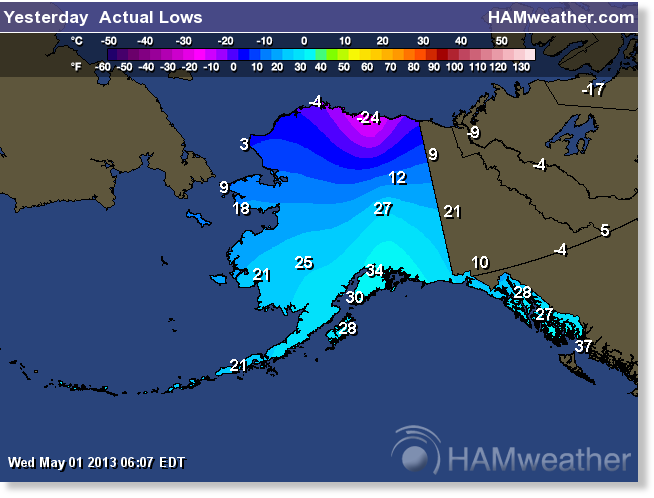
As with the Lower 48 states, spring is late and cold here in central Alaska. Fairbanks reported a record low of 2 degrees F above zero Sunday, breaking the previous record of 8 from 1924.

Here in Anchorage, looks like we are around 3 - 4 weeks late with ice of local lakes and snow off the ground. Winter was not particularly hard, but it all changed with a very cold April. And at this point it does not appear things will be warming up soon. So much for manmade global warming due to carbon dioxide emissions.
Story here: http://www.adn.com/2013/04/29/2883299/interior-alaska-sees-record-breaking.html

Image
Yes, have a look at the image at right.

Here is a complete list of record lows for Alaska in the past 7 days, 996 new record lows were set (click low temp and details tab):

http://wx.hamweather.com/maps/climate/records/7day/usak.html?cat=maxtemp,mintemp,snow,lowmax,highmin,

Bizarro Earth

5.8 magnitude earthquake near Kishtwar on Himachal-Kashmir border rattles northern India

"The quake happened at 12.27 p.m. and measured 5.8 on the Richter scale. The epicenter was near Kishtwar town at the Jammu and Kashmir and Himachal Pradesh border region," R.S. Dattatreya, director, Department of Seismology, India Meteorological Department (IMD), said. "It is a moderate tremor in Delhi and other northern regions. We ask public not to panic," he said. "The quake was 10 km beneath the earth's surface. The possibility of aftershocks are very minimal for such a low intensity quake," said L.S. Rathore, IMD's director general (meteorology).


Bizarro Earth

Australia's only active volcano Big Ben is rumbling fiercely

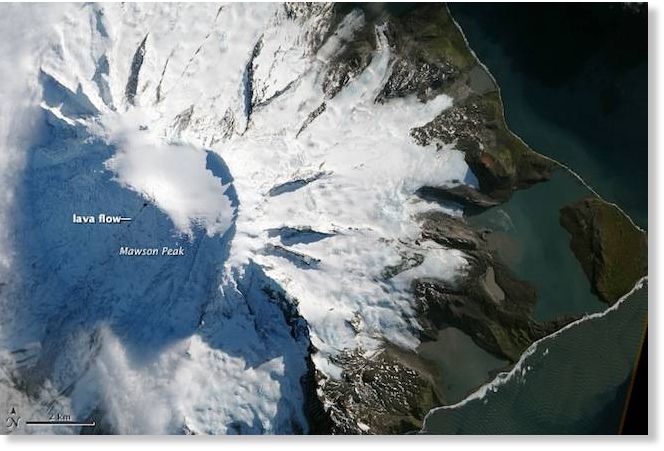
Australia's only active volcano is rumbling fiercely, with new NASA photos revealing its lava lake has overflowed its crater. The volcano in question, Big Ben, is happily located on Mawson Peak in the remote southern reaches of the Indian Ocean on Heard Island, an Australian territory. People only bother to visit Heard and its neighbour McDonald Island every couple of years, because there's little there but chilly wastelands and the territory is a nature reserve people aren't allowed to visit without a permit. Even fisherfolk chasing the apparently tasty patagonian toothfish, aka Chilean Sea Bass, don't often bother landing.
Image
© NASA
No permanent human presence exists on the islands, beyond an automated weather station. NASA keeps an eye on the islands, though, because of the volcano atop Heard Island's Big Ben occasionally fires up. Last October we reported things have started to look interesting on the island. NASA has now released the image below showing that the volcano's caldera appears to have filled with so much lava that some has since cascaded down Mawson Peak's flanks.

Bizarro Earth

Iceland's Hekla volcano: strong inflation suggests volcano could be close to erupting

Image
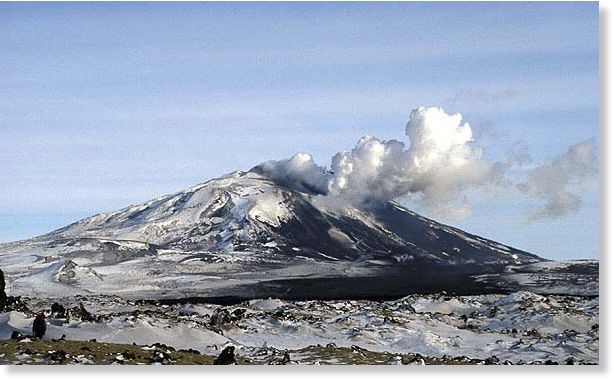
The famous Icelandic volcano is showing further signs that indicate an eruption could occur in a near future. Significant rapid inflation, concentrated in the northern part of the volcano, has been detected since early April and likely represents accumulation of rising magma underneath. Already in mid March this year, an earthquake swarm, volcanic tremor and deformation caused an alert, because it was believed that this was caused by rapid movement of magma under the volcano. The last eruption of the volcano was in March 2000, and it is estimated that by now, a significantly larger volume of magma has since then accumulated beneath the volcano. This would mean that a new eruption should be expected to be larger than the last one. Hekla's eruptions normally begin with a powerful explosive phase, and could pose a significant hazard to anyone in close (less than 10 km) proximity during the onset of it. - Volcano Discovery

X

14 killed, 4 missing in heavy Saudi rainfall

Image
© WAMFourteen people have died and four are missing due to torrential rain according to the Saudi Civil Defense General Directorate.
Fourteen people have died and four are missing due to torrential rain, said the Saudi Civil Defense General Directorate.

From Monday night until midday Tuesday, Saudi authorities received more than 4,213 reports from across the kingdom of accidents resulting from torrential rainfall.

Classes have been suspended in affected areas of the country.