Science of the SpiritS


Info

Researchers find new class of neurons that map memories

MRI Brain Scan
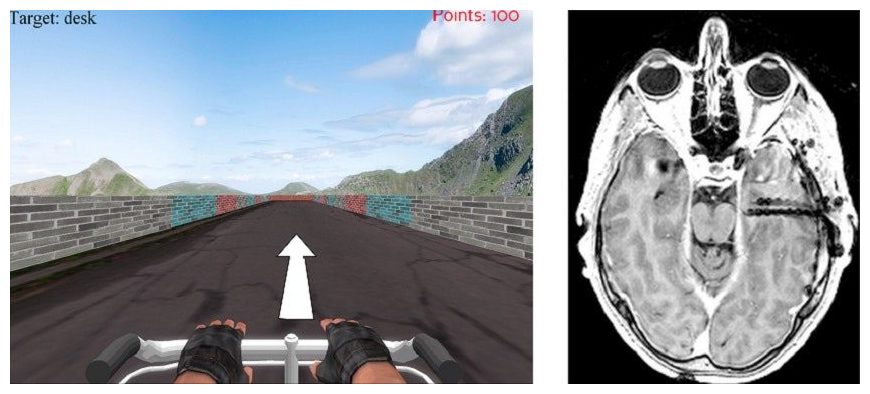
© Salman Qasim/Columbia EngineeringLeft: Screenshot of spatial memory task. Right: MRI scan showing the placement of recording electrodes (black circles) in a patient's brain.
Researchers have uncovered a new class of brain cell that acts like the red pin on a Google map to tell you where you found things on past journeys.

These neurons, dubbed memory-trace cells, are the place markers that record whether you had that mouth-watering gelati opposite the Trevi Fountain or just up the road from the Pantheon.

On a more sombre note, they are clustered in a part of the brain that takes an early hit in the onset of Alzheimer's disease and may well explain the appalling degradation of memory seen in that illness.

To unearth these very special neurons, the researchers, led by biomedical engineer Joshua Jacobs from Columbia University in the US, devised a clever video game, albeit one unlikely to rival Fortnite as a teen meme.

Players ride a trolley along a road bounded on each side by a brick wall which is divvied up into grey, blue and brown segments that act as reference points.

On the first run-through the player has to press a button when they reach an object, in one case an antique writing desk that could be a prop in a Stephen King spine tingler.

But it's on the second pass that things get really interesting. This time the player travels the same road with the desk taken away - the task is to press the button when they reach the point where they think the desk was.

None of this would be out of the ordinary if the gamer was just your average punter. Jacobs' players were, however, in a class of their own.


SOTT Logo Radio

SOTT Focus: MindMatters: Meaning in Chaos: Exploring Jordan Peterson's Maps of Meaning (Chapter 2)

maps of meaning
Dr. Jordan Peterson's 1999 classic Maps of Meaning contains much the raw material for his more recent lectures and writing. While a dense read at times, it's worth the effort. On this episode of MindMatters we take a look at the first sections in Chapter 2, which explore the universals of human experience: the unbearable present, the encounter with chaos, and its transformation into the ideal future.

With examples from everyday life and neuropsychology, Peterson shows how we are hardwired to respond to novelty, constantly comparing our present state with our ideal future - however vague our notion of it may be. And how the inescapable presence of chaos and novelty mean we must constantly adapt our goals and the steps we take to reach them, constantly learning in the process and constantly transforming the present into the future.

For a discussion on the Introduction and Chapter 1, see:

The Truth Perspective: An Introduction to Jordan Peterson's Maps of Meaning: Explaining Evil and Transforming Chaos


Running Time: 01:18:32

Download: MP3 — 71.9 MB


Info

Stress hormone helps control the circadian rhythm of brain cells in rats

Clock
© University of Copengagen
Researchers from the University of Copenhagen have shown how the brain's circadian rhythm in rats is, among other things, controlled by the stress hormone corticosterone - in humans called cortisol. This has been shown by means of a completely new method in the form of implanted micropumps.

As day turns into night, and night turns into day, the vast majority of living organisms follow a fixed circadian rhythm that controls everything from sleep needs to body temperature.

This internal clock is found in everything from bacteria to humans and is controlled by some very distinct hereditary genes, known as clock genes.

In the brain, clock genes are particularly active in the so-called suprachiasmatic nucleus. It sits just above the point where the optic nerves cross and sends signals to the brain about the surrounding light level. From here, the suprachiasmatic nucleus regulates the rhythm of a number of other areas of the body, including the cerebellum and the cerebral cortex.

However, these three areas of the brain are not directly linked by neurons, and this made researchers at the University of Copenhagen curious. Using test rats, they have now demonstrated that the circadian rhythm is controlled by means of signalling agents in the blood, such as the stress hormone corticosterone.

'In humans, the hormone is known as cortisol, and although the sleep rhythm in rats is the opposite of ours, we basically have the same hormonal system', says Associate Professor Martin Fredensborg Rath of the Department of Neuroscience.

He explains that recent years have seen an increasing, scientific focus on research on clock genes, one reason being that previous research on clock genes have found a correlation between depression and irregularities in the body's circadian rhythms.

Rainbow

Being close to water is good for the mind, body and soul

ocean
After her mother's sudden death, Catherine Kelly felt the call of the sea. She was in her 20s and had been working as a geographer in London away from her native Ireland. She spent a year in Dublin with her family, then accepted an academic position on the west coast, near Westport in County Mayo. "I thought: 'I need to go and get my head cleared in this place, to be blown away by the wind and nature.'"

Kelly bought a little house in a remote area and surfed, swam and walked a three-mile-long beach twice a day. "I guess the five or six years that I spent there on the wild Atlantic coast just healed me, really."

She didn't understand why that might be until some years later, when she started to see scientific literature that proved what she had long felt intuitively to be true: that she felt much better by the sea. For the past eight years, Kelly has been based in Brighton, researching "outdoor wellbeing" and the therapeutic effects of nature - particularly of water.

Comment: Here is another explanation for the healing effects of blue spaces:
The smell of the ocean breeze also contributes to your soothed state, which may have something to do with the negative ions in the air that you're breathing in. These oxygen atoms have an extra electron and occur in places like waterfalls and the ocean, says Shuster. A study published in the Journal of Alternative Complementary Medicine suggests that negative ion therapy could be used to treat symptoms of seasonal affective disorder.


Brain

Neurofeedback training shown to rebalance brain circuits in those with depression

brain circuit board
© Bigstock
A new study has found that patients with Major Depressive Disorder (MDD) who had recovered from symptoms were able to strengthen some of their brain connections, increasing their self-esteem.

The research showed that connectivity between certain brain regions — previously found to be decreased when people with a history of depression feel guilt — could be strengthened in a single session of neurofeedback training. Researchers used functional magnetic resonance imaging (fMRI), captured before and after the procedure, to measure the difference.

Using fMRI, the researchers found that people with depression, even when recovered from symptoms, showed less connectivity between two specific brain areas while experiencing feelings of guilt — the right anterior superior temporal (ATL) and the anterior subgenual cingulate (SCC).

Comment: See also:


Candle

Dia De Los Muertos: Mexicans honor the souls of lost loved ones on Day of the Dead

Day of the Dead celebration
Millions of Mexicans dressed up, paraded, and laid food and flowers for the souls of relatives who have passed away in celebration of the Day of the Dead on Saturday.

Residents of the San Andres Mixquic area south of Mexico City adorned relatives' graves with flowers and lit candles as they gathered together in remembrance of those loved ones who have died.

People donned special costumes and painted their faces for the commemorations, and festooned the streets with special Day of the Dead artwork.

Mr. Potato

Caitlin Johnstone: Things are only going to get weirder

Trump Ivanka Thanos
Things are getting stranger and stranger. If you would have told someone ten years ago that Dennis Rodman would one day be helping to negotiate peace between North Korea and President Donald Trump, they would have assumed you were describing some weird movie cooked up in the mind of Mike Judge or the South Park guys. But in this timeline it's an actual news story.

Everything about the last few years has been weird. The mass media's behavior has been weird, Russiagate was weird, Ukrainegate is weird, a former presidential candidate accusing a current presidential candidate of working for the Kremlin was weird, people constantly accusing strangers on the internet of being Russian agents is weird, factions of the US government constantly leaking information against other factions of the US government is weird, the DNC getting caught rigging their primary was weird, Hillary Clinton losing the election was weird, the Skripal poisoning was weird, US government officials openly tweeting about their Venezuela coup is weird, the breakdown of the entire mainstream Syria narrative is weird, Assange's arrest was weird, the campaign to censor the internet is weird, and this is just stuff off the top of my head from the areas I've been looking at in my own narrow spectrum of focus. Anyone else could list dozens of other weird new developments from their own slice of the information pie.

I often hear people in my line of work saying "Man, we're going to look back on all this crazy shit and think about how absolutely weird it was!"

Info

Science as we know it can't explain consciousness

MRI scan of the brain
© MRImanMRI scan of the brain.
Explaining how something as complex as consciousness can emerge from a grey, jelly-like lump of tissue in the head is arguably the greatest scientific challenge of our time. The brain is an extraordinarily complex organ, consisting of almost 100 billion cells - known as neurons - each connected to 10,000 others, yielding some ten trillion nerve connections.

We have made a great deal of progress in understanding brain activity, and how it contributes to human behaviour. But what no one has so far managed to explain is how all of this results in feelings, emotions and experiences. How does the passing around of electrical and chemical signals between neurons result in a feeling of pain or an experience of red?

There is growing suspicion that conventional scientific methods will never be able answer these questions. Luckily, there is an alternative approach that may ultimately be able to crack the mystery.

For much of the 20th century, there was a great taboo against querying the mysterious inner world of consciousness - it was not taken to be a fitting topic for "serious science". Things have changed a lot, and there is now broad agreement that the problem of consciousness is a serious scientific issue. But many consciousness researchers underestimate the depth of the challenge, believing that we just need to continue examining the physical structures of the brain to work out how they produce consciousness.

The problem of consciousness, however, is radically unlike any other scientific problem. One reason is that consciousness is unobservable. You can't look inside someone's head and see their feelings and experiences. If we were just going off what we can observe from a third-person perspective, we would have no grounds for postulating consciousness at all.

Light Saber

How smart people neutralize the effects of difficult people

toxic people
To deal with toxic people effectively, you need an approach that enables you, across the board, to control what you can and eliminate what you can’t. The important thing to remember is that you are in control of far more than you realize.
Toxic people defy logic. Some are blissfully unaware of the negative impact that they have on those around them, and others seem to derive satisfaction from creating chaos and pushing other people's buttons. Either way, they create unnecessary complexity, strife, and worst of all stress.

Studies have long shown that stress can have a lasting, negative impact on the brain. Exposure to even a few days of stress compromises the effectiveness of neurons in the hippocampus — an important brain area responsible for reasoning and memory. Weeks of stress cause reversible damage to neuronal dendrites (the small "arms" that brain cells use to communicate with each other), and months of stress can permanently destroy neurons. Stress is a formidable threat to your success — when stress gets out of control, your brain and your performance suffer.

Most sources of stress at work are easy to identify. If your non-profit is working to land a grant that your organization needs to function, you're bound to feel stress and likely know how to manage it. It's the unexpected sources of stress that take you by surprise and harm you the most.

Research from the Department of Biological and Clinical Psychology at Friedrich Schiller University in Germany found that exposure to stimuli that cause strong negative emotions — the same kind of exposure you get when dealing with toxic people — caused subjects' brains to have a massive stress response. Whether it's negativity, cruelty, the victim syndrome, or just plain craziness, toxic people drive your brain into a stressed-out state that should be avoided at all costs.

Comment: Saving your sanity and career: Six toxic relationships to avoid like the plague


Snakes in Suits

Smooth-talking charmers: Why psychopaths can be so attractive to the unsuspecting

psychopaths dating
© JSTOCK/ShutterstockYoung men with stronger psychopathic traits tend to have higher social intelligence and more relaxed attitudes towards casual sex.
The old cliché of psychopaths being smooth-talking charmers might not be far wrong, at least according to a new study.

The study carried out by psychologists from Brock University and Carleton University in Canada claims that young women are more attracted to men with stronger psychopathic personality traits, despite these prospective partners having little interest in a committed relationship.

Reporting in the journal Evolutionary Psychological Science, the researchers wanted to follow up on "reports" that psychopathic traits were attractive in potential romantic partners, despite the known pitfalls of entering interpersonal relationships with psychopaths.

For the first part of their study, the researchers recruited 46 men, aged 17 to 25, and gauged psychopathy and social intelligence using a filmed fake date scenario with a female research assistant for about 2 minutes. According to the study, the majority of the male participants (89 percent) self-reported as heterosexual.

Comment: Psychopaths are masters at wearing a mask to disarm their prey - it behooves everyone to learn how to spot these 'intraspecies predators':