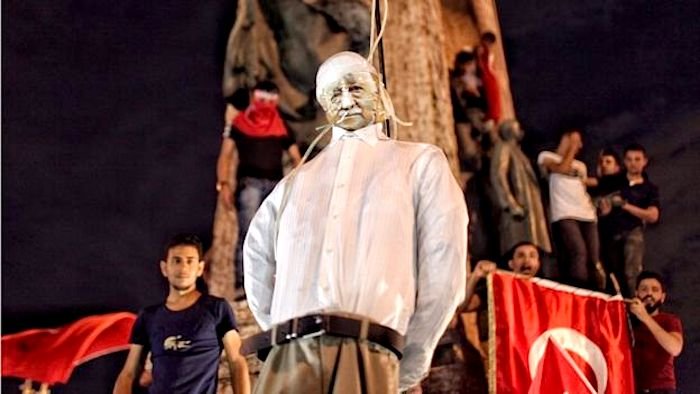
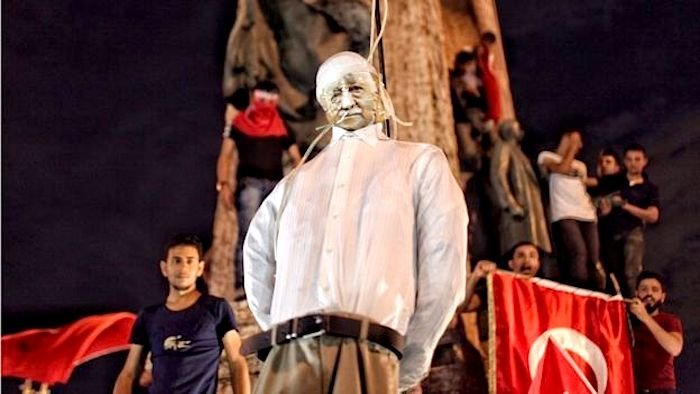
© Getty imagesPresident Erdogan supporters hang Gulen effigy for role in attempted coup.
are the only two rational means that are, as of yet, available to reconstruct the source behind the 15 July 2016 Turkish coup-attempt.
One can reasonably assume that some nation's intelligence-operation was involved, and that this would have entailed either America's
CIA or Turkey's equivalent, the
MIT or
National Intelligence Organization, or else both. A
merica's CIA has been behind coups in "more than 50 countries". Throughout the CIA's existence, it has organized or helped others in organizing, most of the world's coups.
Whereas previous empires (i.e., previous international dictatorships)
have functioned mainly via overt invasions (using the military),
the US international dictatorship operates mainly via coups (using intelligence-operatives) - coups are the American aristocracy's particular specialty; the
CIA is the world-champion specialist in this field, and no other intelligence agency is anywhere in its league, for such operations.Indeed, the
US is the first empire that has functioned mainly by coups, instead of by outright (i.e., military) invasions. The reason for this is that after World War II, when the Allied Powers defeated the fascist powers, the Axis - which had sought to build their empires clearly via the military route (invasions) -
the military route has been recognized by publics everywhere as being
incompatible with democracy, so that, after WW II, no nation any longer can credibly claim to be a "democracy" if it engages in an invasion that isn't clearly a response to, and defending against, an existing invasion by the country that's being invaded by the given country. Even America's (and Britain's)
2003 invasion of Iraq was claimed to be 'defensive' in nature. (How anyone after that invasion can trust the West, is a question for experts in mass-psychology to address; it's not a matter to be discussed here. But, after the 2003 invasion of Iraq,
coups are practically the only viable means for the US government to enforce its foreign policies. Consequently, the US coup-machine is likely to be even more important post-2003 than it was pre-2003. And US President Barack Obama certainly recognizes that.)













Comment: Though we think Malik mischaracterizes the Syrian government and military's approach, and we are skeptical that the poor policy choices of the U.S. are the result of a faulty narrative (rather, the faulty narrative seems willfully designed in order to create suboptimal conditions), the rest of the article is a fair, detailed, and insightful look at the un-reality of Sunni-Shia sectarianism in Syria and Iraq. Readers will be forgiven if 'divide and conquer' comes to mind... We have the U.S. to blame for that, and their 'Sunni vs. Shia' fiction continues to prevent Syria and Iraq from regaining their stability and sovereignty they so desperately need.