Science & TechnologyS


Telescope

Galactic monster mystery solved

Image
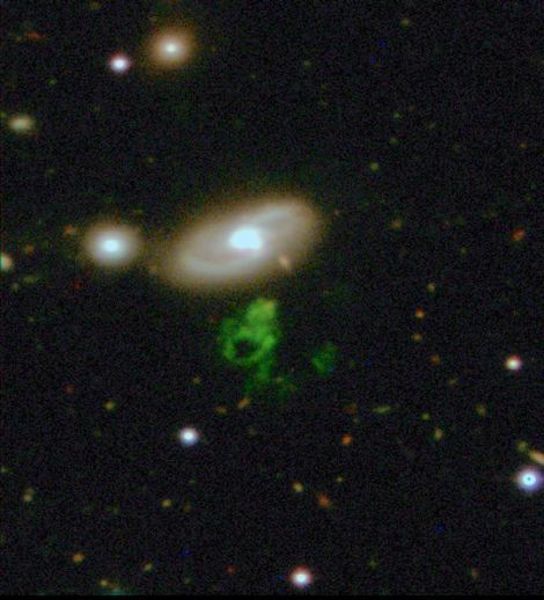
© Dan Smith, Peter Herbert, Matt Jarvis, ING Hanny's Voorwerp confirms there is a lot of gas in intergalactic space.
Scientists have come up with a possible explanation for a weird monstrous-looking bright green gas cloud floating in intergalactic space.

The mysterious cloud was discovered in 2007, by Dutch school teacher Hanny van Arkel while combing though images for the Galaxy Zoo galactic classification project.

Located near the spiral galaxy IC 2497 some 700 million light years away in the constellation Leo Minor, it is known as Hanny's Voorwerp, which is Dutch for Hanny's object.

What makes Hanny's Voorwerp astounding is that it is so unusual - a monstrous green blob with a huge central hole some 16,000 light years across.

Although galactic in scale, it is clearly not a galaxy because it does not contain stars.

Spectrographic readings confirmed it is a giant gas cloud.

But astronomers could not explain why it was glowing an unusual bright green colour.

Last year scientists proposed that some 10,000 years ago, IC 2497 suddenly underwent a dramatic outburst of quasar-like radiation and then became quiet. What we see today is simply a reflection of that outburst.

In other words, Hanny's Voorwerp is a quasar light echo.

Telescope

"Galactic Archaeologists" Find Origin of Milky Way's Ancient Stars

Image
© Andrew Cooper/John Helly/Durham UniversityThis simulation shows a Milky Way-like galaxy around five billion years ago when most satellite galaxy collisions were happening.
Many of the Milky Way's ancient stars are remnants of other smaller galaxies torn apart by violent galactic collisions around five billion years ago, according to researchers at Durham University.

Scientists at Durham's Institute for Computational Cosmology and their collaborators at the Max Planck Institute for Astrophysics, in Germany, and Groningen University, in Holland, ran huge computer simulations to recreate the beginnings of our galaxy.

The simulations revealed that the ancient stars, found in a stellar halo of debris surrounding the Milky Way, had been ripped from smaller galaxies by the gravity generated by colliding galaxies.

Cosmologists predict that the early Universe was full of small galaxies which led short and violent lives. These galaxies collided with each other leaving behind debris which eventually settled into more familiar looking galaxies like the Milky Way.

Evil Rays

Obama okays spectrum auction

Nothing comes for free, see

President Obama has nodded through the spectrum auction proposed by the National Broadband Plan, knocking back the idea of any freebies in favour for revenue-generating auctions.

Following best-practice PR, the 500MHz to be put on the auction block is being billed as a new initiative to open up the airwaves, but in fact it's all part of the plan that was proposed by the FCC back in March, but that was before Obama put his magic fingers on it.

"The President's plan will nearly double the amount of commercial spectrum available to unleash the innovative potential of wireless broadband", says Larry Summers, director of Obama's National Economic Council, commenting on the president appending his signature to the idea.

Pharoah

Secret ancient code, basis of all modern civilisation, cracked

'As big as Jesus' diary' claims ex IT-guy prof

A former IT type, nowadays a part-time professor of scientific philosophy, says he has cracked a "hidden mathematical musical code" in the works of the famous ancient Greek savant Plato.

According to Dr Jay Kennedy, a visiting scholar at Manchester uni, his discovery "shows us how to combine science and religion", perhaps putting an end to "today's culture wars" between irritable god-botherers and strident atheists. Indeed Kennedy says his work will "revolutionise the history of the birth of Western thought".

Rocket

Flying car gets helpful road-kit weight exemption from feds

Terrafugia gets headroom for airbags, crumple zones etc

Terrafugia - flying car
© The RegisterNow with airbags.
The Terrafugia Transition, closest thing to a flying car yet built, has received a unique exemption from the US government allowing production models to be 110 pounds heavier than a normal "light sport aircraft". This will permit the car/plane combo to satisfy safety requirements when driving on roads.

The Transition has been under development by startup firm Terrafugia, founded by flying-enthusiast MIT engineers, since 2006. It is basically a normal light single-engined plane with folding wings and a more substantial, four-wheeled undercarriage.

With wings folded a Transition can be driven on roads at normal highway speeds. On reaching an airport - or a suitable bit of private land, with the owner's permission - it can extend the wings and make a normal rolling takeoff to cruise the skies at 115mph.

Cow

Biggest thing in farming for 10,000 years on horizon

Dirtboffins argue for lawn-style perennial grainfields

Agro-boffins in America say that mankind could be on the verge of the "biggest agricultural breakthrough in 10,000 years", as researchers close in on "perennial grains".

At the moment, most grain grown around the world has to be replanted after every crop. Farming so-called "annual" grain of this sort consumes a lot of resources and is hard on the land, which is especially worrying as half the world's population lives off farmland which could easily be rendered unproductive by intensive annual grain harvests.

"People talk about food security," says soil science prof John Reganold. "That's only half the issue. We need to talk about both food and ecosystem security."

Info

Computer Automatically Deciphers Ancient Language

Tablet
© MITAn incidental challenge in developing a computer system that could decipher Ugaritic (inscribed on tablet) was developing a way to digitally render Ugaritic symbols (inset).
In his 2002 book Lost Languages,Andrew Robinson, then the literary editor of the London Times' higher-education supplement, declared that "successful archaeological decipherment has turned out to require a synthesis of logic and intuition ... that computers do not (and presumably cannot) possess."

Regina Barzilay, an associate professor in MIT's Computer Science and Artificial Intelligence Lab, Ben Snyder, a grad student in her lab, and the University of Southern California's Kevin Knight took that claim personally. At the Annual Meeting of the Association for Computational Linguistics in Sweden next month, they will present a paper on a new computer system that, in a matter of hours, deciphered much of the ancient Semitic language Ugaritic. In addition to helping archeologists decipher the eight or so ancient languages that have so far resisted their efforts, the work could also help expand the number of languages that automated translation systems like Google Translate can handle.

To duplicate the "intuition" that Robinson believed would elude computers, the researchers' software makes several assumptions. The first is that the language being deciphered is closely related to some other language: In the case of Ugaritic, the researchers chose Hebrew. The next is that there's a systematic way to map the alphabet of one language on to the alphabet of the other, and that correlated symbols will occur with similar frequencies in the two languages.

Info

Cosmic Noise Could Point to Space Storms

Solar Prominence
© NASANASA's Transition Region and Coronal Explorer, or TRACE satellite, took this close-up of a looping solar prominence in September 2005.
A signal astrophysicists once dismissed as contamination of X-ray observations could actually improve forecasts of dangerous space weather that threatens Earth.

Charged particles within the solar wind give off so-called soft X-rays when they collide with the magnetic field that shrouds Earth. The soft X-rays have longer wavelengths and lower frequencies than their hard X-ray cousins.

This signal was once dismissed as local cosmic noise that interfered with space observatory surveys of hot, distant objects such as supernovas, until some scientists realized its significance for Earth.

Measuring the soft X-ray emissions could allow scientists to build a real-time picture of what's happening with the planet's magnetic field, also known as the magnetosphere, which protects Earth against solar storms. Past observations show that soft X-ray data changes almost immediately in response to changes in the solar wind.

Family

Why Do Couples Start to Look Like Each Other?

While you may be familiar with the old saying, "opposites attract," in reality, what the heart wants is someone who resembles its owner - and that resemblance increases the longer two lovebirds stay together.

University of Michigan psychologist Robert Zajonc conducted an experiment to test this phenomenon. He analyzed photographs of couples taken when they were newlyweds and photographs of the same couples taken 25 years later.

The results showed that the couples had grown to look more like each other over time. And, the happier that the couple said they were, the more likely they were to have increased in their physical similarity.

Zajonc suggested that older couples looked more alike because people in close contact mimic each other's facial expressions. In other words, if your partner has a good sense of humor and laughs a lot, he or she will probably develop laugh lines around their mouth - and so will you.

Magnify

T. Rex Plodded Like an Elephant, Nerve Study Says

Image
© David Evans/National GeographicAsian elephants walk down a road in Sri Lanka
The mighty Tyrannosaurus rex was no quick, agile killing machine - the "tyrant king" dinosaur just didn't have the nerves.

Instead, most times T. rex probably plodded along like an elephant, according to a new study that estimated the "speed limit" of nerve signals running through the dinosaur's body.

When a vertebrate - an animal with a backbone - stubs its toe, electrical signals get carried from the toe to the spinal cord by a nerve, which is made up of bundles of long, fiberlike cells.

Since the researchers couldn't study a T. rex's nerves directly, the team looked at how nerves work in a range of modern animals, from the tiny shrew to midsize dogs and pigs to massive Asian elephants.