
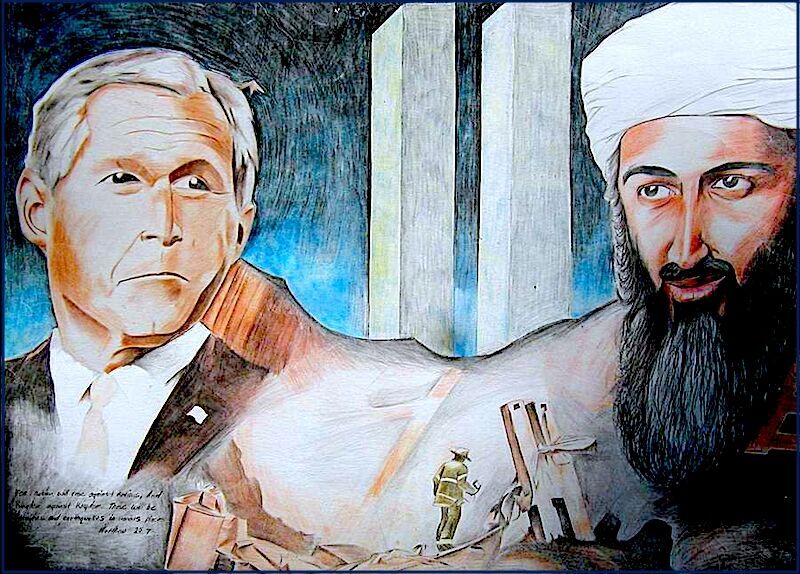
© ar.inspiredpencil.comUS President George Bush and Osama Bin Laden
The identification of insiders is not only an issue in stock market fraud, but above all a means of establishing, directly or indirectly, the identity of the perpetrators of the attacks and their accomplices.
Insider trading
In the aftermath of the attacks, maneuvers characteristic of "insider trading" were observed in the six days preceding the attack [1] . The stock of United Airlines (the company that owned the planes that crashed into the South Tower of the WTC and in Pittsburgh) artificially fell by 42%. That of American Airlines (the company that owned the plane that crashed into the North Tower of the WTC, and the one that allegedly crashed into the Pentagon) fell by 39%. No other airline in the world had been subject to comparable maneuvers, with the exception of KLM Royal Dutch Airlines. So it can be deduced that a plane from the Dutch company had probably been chosen for a fifth hijacking.
Similar actions were observed on put options on the shares of Morgan Stanley Dean Witter & Co., which increased twelvefold in the week before the attacks. This company occupied twenty-two floors of the WTC. The same was true for put options on the shares of the world's leading stockbroker, Merrill Lynch & Co., whose headquarters are in a neighboring building threatened with collapse, which increased twenty-fivefold. And especially for put options on the shares of the insurers involved: Munich Re, Swiss Re, and Axa.
The Chicago Securities and Exchange Commission was the first to raise the alarm. It found that on the Chicago Stock Exchange, insiders had made $5 million in capital gains on United Airlines, $4 million on American Airlines, $1.2 million on Morgan Stanley Dean Witter & Co., and $5.5 million on Merrill Lynch & Co.
The supervisory authorities of each major stock exchange are recording the capital gains made by insiders. The investigations are being coordinated by the International Organization of Securities Commissions (IOSCO) [2] . On October 15, it held a video conference where national authorities presented their progress reports. It appears that the illicit capital gains amount to hundreds of millions of dollars, constituting the "largest insider trading case ever committed."
It was possible to establish that the majority of the transactions had been "carried out" by Deutsche Bank and its American investment subsidiary, Alex. Brown [3] . This company was headed, until 1998, by a colorful character, AB Krongard. A Marine captain, keen on shooting and martial arts, this banker became an advisor to the director of the CIA and, since March 26, number three in the American intelligence agency. Given the importance of the investigation and the influence of AB Krongard, one might have thought that Alex. Brown would have cooperated without difficulty with the authorities to facilitate the identification of the insiders. This was not the case.
Similarly, one might have thought that the revelation by Ernest Backes [4] , a few months ago, of the existence of recordings of the main interbank transactions by two clearing organizations would have facilitated the investigators' hunt. Here again, this was not the case.
It is as if, despite the belligerent declarations of Western leaders, we had given up on pursuing the investigations to their conclusion and had quickly declared forfeit: even when world peace is at stake, the opacity of tax havens would not allow transactions to be "traced" and traced back to the criminals.
Moreover, the insiders prudently waived the possibility of collecting $2.5 million in capital gains on American Airlines that they had not had time to cash in before the alert was raised.
Osama Bin Laden's fortune
At the same time, extensive investigations were conducted to determine the extent of the fortune of Osama bin Laden, the alleged mastermind of the attacks, and to identify the companies he controlled. A graduate in management and economics from King Abdul Aziz University, Osama bin Laden is a shrewd businessman. In 1979, he was asked by his tutor, Prince Turki al-Faisal al-Saud (director of the Saudi secret service from 1977 to August 2001), to financially manage the CIA's covert operations in Afghanistan. Within a few years, the CIA had invested $2 billion in Afghanistan to thwart the USSR, making these operations the most expensive ever undertaken by the Agency.
In 1994, having become a public enemy of the United States and having been stripped of his Saudi nationality, Osama bin Laden inherited approximately $300 million, corresponding to his share in the Saudi Bin Laden Group (SBG) [5].
This holding company, the largest in Saudi Arabia, generates half of its turnover in construction and public works, and the other half in engineering, real estate, distribution, telecommunications and publishing. It formed a Swiss investment company, SICO (Saudi Investment Company), which created several companies with subsidiaries of the Saudi National Commercial Bank. SBG holds significant stakes in General Electric, Nortel Networks and Cadbury Schweppes. SBG is represented in the United States for its industrial activities by Adnan Khashoggi (former brother-in-law of Mohammed al-Fayed), while its financial assets are managed by the Carlyle Group. Until 1996, the structures of SBG's subsidiaries were prepared in Lausanne by its advisor, the Nazi banker François Genoud [6] . The SBG is inseparable from the Wahhabi regime, to the point of having long been the official and sole contractor for the construction and management of the kingdom's holy sites, Medina and Mecca. Similarly, it won the majority of construction contracts for the construction of US military bases in Saudi Arabia and the reconstruction of Kuwait after the Gulf War. The group was founded in 1931 by the patriarch, Sheikh Mohammed bin Laden. After his accidental death in 1968, his eldest son, Salem, succeeded him. He, in turn, died in a plane "crash" in Texas in 1988. From then on, the SBG is headed by Bakr, the founder's second son.
Although the SBG claims to have severed all ties with Osama bin Laden since 1994, many authors, distinguishing between positive and customary law, claim that the fundamentalist leader continues to exercise moral authority over it and to receive dividends.
Osama Bin Laden [7] invested his inheritance in the creation of several banks, agribusinesses and distribution companies in Sudan. Among these, he placed $50 million in Al-Shamal Islamic Bank, of which Tadamon Islamic Bank is the other major shareholder. Through this, Osama Bin Laden is the financial partner of the Ministry of Social Affairs of the United Arab Emirates and of the Dar al-Maal al-Islami which Prince Mohammad Al-Faisal Al-Saud uses to finance all Wahhabi movements around the world on behalf of Saudi Arabia.
Osama bin Laden is also reputed to have held shares in the Dubai Islamic Bank of Mohammed Khalfan bin Kharbash, the UAE's finance minister. First with the support of Colonel Omar Hassan al-Bashir, and later Hassan al-Turabi, he developed various companies in Sudan, building an airport, roads, installing a pipeline, and controlling most of the gum arabic production. Despite these achievements, he was expelled from Sudan in 1996. Furthermore, Osama bin Laden is believed to have been a shareholder in the Al-Shifa pharmaceutical laboratory, suspected by the United States of preparing chemical weapons and bombed for this in 1998. Finally, he is suspected of playing a central role in the international opium trade, of which Afghanistan is the world's leading producer.
Osama bin Laden exercises spiritual authority over powerful Muslim charities, most notably the International Islamic Relief Organization (IIRO) and the foundation of King Fahd's brother-in-law, Abdul Aziz al-Ibrahim.
If we add to these assets the stockpiles of weapons from the first Afghan war that Osama bin Laden may have retained, his fortune can be estimated at between $300 million and $500 million. This is a far cry from the $6 billion mentioned by some political figures.
In any case, no evidence has been found that would link the companies controlled by the fundamentalist leader to the insider trading of September 11.
Osama Bin Laden's Financial Partners
Two leading figures appear to be omnipresent in Osama bin Laden's societies: Sheikh Khaled Salim bin Mahfouz and Saleh Idris.
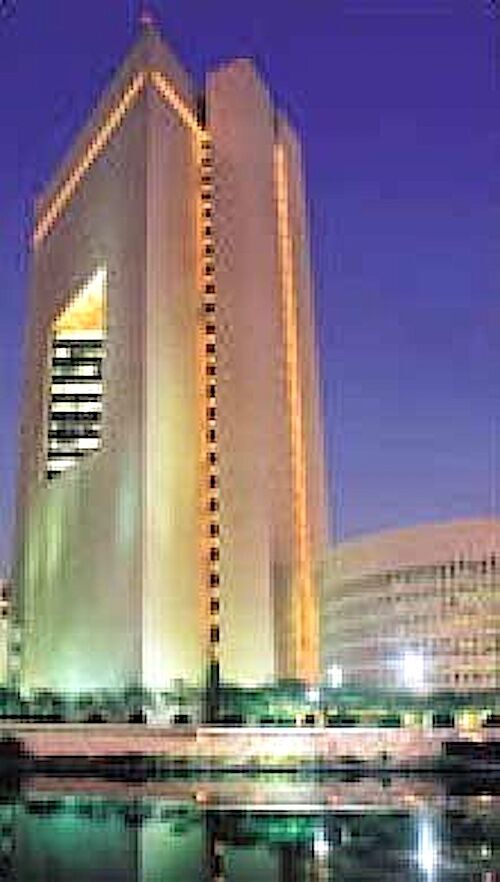
National Commercial Bank • Jeddah
Although regular partners of Osama Bin Laden, Khaled Ben Mahfouz is a respected businessman in the international financial markets. This is all the more disturbing because he was at the heart of the main banking scandal of the early 1990s, the BCCI crackdown [9] .
The Bank of Credit and Commerce International (BCCI) was an Anglo-Pakistani establishment present in seventy-three countries. It was jointly owned by three major families: the Gokals (Pakistan), the Ben Mahfouzs (Saudi Arabia) and the Geith Pharaohs (Abu Dhabi).
It was used by Ronald Reagan to bribe the Iranian government to delay the release of the American hostages from the Tehran embassy and thus sabotage the end of Jimmy Carter's presidency (Operation known as "October Surprise"). Then, under the leadership of former CIA Director and Vice President George Bush (senior), the Reagan administration again used BCCI to funnel Saudi donations to the Contras in Nicaragua, and to funnel CIA money to the Mujahideen in Afghanistan. BCCI was also involved in the arms trafficking of Syrian trader Sarkis Sarkenalian, in the Keatinga scandal in the US, in the affairs of trader Marc Rich, in the financing of the Abu Nidal group, etc. Ultimately, the bank collapsed when it was established that it was also laundering money for the Medellin Cartel.
It defrauded a million small depositors when it closed its doors.
The fact that BCCI may have been manipulated, if not created, by the CIA should come as no surprise. There is a long tradition of banking in the American secret services, dating back to the founding of the OSS by corporate lawyers and Wall Street brokers. Two former CIA directors, Richard Helms and William Casey, worked at BCCI, as did two prestigious CIA agents of influence, Adnan Khashoggi and Manucher Ghobanifar (the main traders in the Iran-Contra affair). Not to mention Kamal Adham (King Faisal's brother-in-law and head of the Saudi secret service until 1977), Prince Turki al-Faisal al-Saud (head of the Saudi secret service from 1977 to August 2001), and Abdul Raouf Khalil (deputy director of the Saudi secret service).
Comment: Office of Strategic Services (OSS) was the first intelligence agency of the United States, formed during World War II. The OSS was formed as an agency of the Joint Chiefs of Staff (JCS) to coordinate espionage activities behind enemy lines for all branches of the United States Armed Forces.
For the record, it should be noted that the BCCI also appears to have played a hidden role in France. It is said to have served, in particular, to conceal the transfer of American-French nuclear technology to Pakistan and to pay for the release of hostages. A businessman from Hauts-de-Seine, close to Charles Pasqua, was indicted abroad for his role at the BCCI, independently of his indictments in France in the Elf-Thinet affair. Three years after the bank's collapse, its former executives acted as intermediaries in the awarding of the Sawari-II contract and organized a system of kickbacks intended to finance Edouard Balladur's presidential campaign. The questions raised by this sale of stars to Saudi Arabia led Jacques Chirac, upon his arrival at the Élysée Palace, to have the telephone of Edouard Balladur's former Minister of Defense, François Léotard, wiretapped.
BCCI worked closely with SICO [10] , the Swiss investment subsidiary of the Saudi Bin Laden Group, and among its directors was one of Osama Bin Laden's brothers, Salem.
A year before its bankruptcy, BCCI was used to set up a vast operation to enrich George Bush Jr., then director of a small oil company, Harken Energy Corporation. Harken took the Bahrain oil concessions as a kickback for the American-Kuwaiti contracts negotiated by President George Bush Sr. [11] . Khaled Ben Mahfouz was an 11.5% shareholder in Harken. His shares were "carried" by one of his attorneys, Abdullah Taha Bakhsh. While one of Osama Bin Laden's brothers, Salem, was represented on the Harken board of directors by his American attorney, James R. Bath.
Held jointly and severally liable for the BCCI bankruptcy, Khaled Ben Mahfouz was indicted in the United States in 1992. He managed to have the charges against him dropped in 1995, following a $245 million settlement with the bank's creditors.
Saleh Idris, meanwhile, is the director of Saudi Sudanese Bank, the Sudanese subsidiary of Khaled Ben Mahfouz's National Commercial Bank. He was Osama bin Laden's associate in the Al-Shifa pharmaceutical factory. In the United Kingdom, Salah Idris is the majority shareholder of IES Digital Systems, a major company producing high-tech surveillance equipment.
Baroness Cox expressed surprise in the House of Lords last week that IES Digital Systems currently provides security for the UK's most sensitive government and military sites [12] .
From BCCI to the Carlyle Group
BCCI's principals and clients are now part of the Carlyle Group , an investment fund created in 1987, four years before the bank's collapse. Carlyle now manages a portfolio of $12 billion. It holds majority stakes in Seven Up (which handles bottling for Cadbury Schweppes), Federal Data Corporation (which, for example, equipped the Federal Aviation Administration with its civil air traffic control system), and United Defense Industries Inc. (the main supplier to the American, Turkish, and Saudi militaries). Through the companies it controls, the Carlyle Group ranks 11th among American arms companies.
In 1990, the Carlyle Group was implicated in an extortion case. A Republican Party lobbyist, Wayne Berman, had extorted American pension funds to finance the Bush election campaigns; one of these funds had agreed to pay the Carlyle Group $1 million to secure a public contract in Connecticut.
The Carlyle Group manages the bulk of the Saudi Binladen Group's financial investments.
Among its leaders are Sami Mubarak Baarma, Khaled Ben Mahfouz's attorney in the UK, and Talat Othmann, a former director of Harken Energy Corporation, the company that enabled George Bush Jr. to enrich himself illegally.
The Carlyle Group is chaired by Frank C. Carlucci (former Deputy Director of the CIA, then Secretary of Defense). It is advised by James A. Baker III (former Chief of Staff to President Reagan, then Secretary of the Treasury, and finally Secretary of State under George Bush Sr.) and Richard Darman (former Director of the Budget).
To represent it abroad, the Carlyle Group uses John Major [13] (former British Prime Minister) and George Bush Sr. [14] (former Director of the CIA, then President of the United States). In France, the Carlyle Group has become the reference shareholder of Le Figaro (see RV 99/0422).
***
Contrary to popular belief, Osama bin Laden was not just a CIA subcontractor, employed to fight Arab nationalism, and later the USSR, in the name of radical Islam. He was — and his family remains — one of the Bush family's main financial partners.
If it is true, as many US officials claim, that the bin Laden family continues to maintain relations with Osama and finance his political activities, then the Carlyle Group, which manages the Saudi Bin Laden Group's financial investments, would necessarily be involved in insider trading. George Bush Sr. would then be one of the lucky beneficiaries of the stock market maneuvers of September 11, 2001.
References:
[ 1 ] See "Black Tuesday: The World's largest Insider Trading Scam?" by Don Radlauer, International Policy Institute for Counterterrorism, Israel, September 9, 2001. http://www.ict.org.il/articles/arti...
[ 2 ] http://www.iosco.org/iosco.html
[ 3 ] See "Suspicious Profits Sit Uncollected Airlines Investors Seem to Be Lying Low" by Christian Berthelsen, and Scott Winokur, San Francisco Chronicle , September 29, 2001.
[ 4 ] Cf. Revelation$ , by Denis Robert and Ernest Backes, Les Arènes ed., 2001. http://www.arenes.fr/livres/page-li...
[ 5 ] http://www.saudi-Binladen-group.com (since September 11, this server is temporarily unavailable).
[ 6 ] François Genoud, executor of Dr. Goebbels's will, was considered "the banker of the Fourth Reich." He worked with numerous anti-Jewish groups around the world and notably financed the actions of "Carlos."
[ 7 ] The information on Osama Bin Laden's personal wealth is taken from an unpublished study carried out by a private firm at the end of 2000, which Intelligence OnLine reported on and which was widely cited in the press.
[ 8 ] Cf. Hearing of James Woolsey, Director of the CIA, before the US Senate, September 3, 1998.
[ 9 ] The BCCI scandal has been the subject of a large body of literature. We have referred primarily to " The BCCI Affair ," report by Sen. John Kerry (D-Mass.) and Sen. Hank Brown (R-Colo.) to the Senate Committee on Foreign Relations, Subcommittee on Terrorism, Narcotics and International Operations, September 30, 1992. Full text available at http://www.fas.org/irp/congress/199... .
[ 10 ] Initially, SICO was called CYGNET.
[ 11 ] See "Fuel for Fantasy," Forbes , September 3, 1990; and "Ex-Bush Aide Turns to Stumping for Kuwait...While Jr. Reaps Oil Windfall", The Guardian , December 12, 1990.
[ 12 ] "Terror link TVs guard UK", The Observer , October 14, 2001.
[ 13 ] See "John Major link to Bin Laden dynasty", Sunday Herald , October 7, 2001.
[ 14 ] See "Bush of Arabia," The Nation , March 27, 2000 and "Elder Bush in Big GOP Cast Toiling for Top Equity Firm," The New York Times , March 5, 2001.
Thierry Meyssan
[ 1 ] See "Black Tuesday: The World's largest Insider Trading Scam?" by Don Radlauer, International Policy Institute for Counterterrorism, Israel, September 9, 2001. http://www.ict.org.il/articles/arti...
[ 2 ] http://www.iosco.org/iosco.html
[ 3 ] See "Suspicious Profits Sit Uncollected Airlines Investors Seem to Be Lying Low" by Christian Berthelsen, and Scott Winokur, San Francisco Chronicle , September 29, 2001.
[ 4 ] Cf. Revelation$ , by Denis Robert and Ernest Backes, Les Arènes ed., 2001. http://www.arenes.fr/livres/page-li...
[ 5 ] http://www.saudi-Binladen-group.com (since September 11, this server is temporarily unavailable).
[ 6 ] François Genoud, executor of Dr. Goebbels's will, was considered "the banker of the Fourth Reich." He worked with numerous anti-Jewish groups around the world and notably financed the actions of "Carlos."
[ 7 ] The information on Osama Bin Laden's personal wealth is taken from an unpublished study carried out by a private firm at the end of 2000, which Intelligence OnLine reported on and which was widely cited in the press.
[ 8 ] Cf. Hearing of James Woolsey, Director of the CIA, before the US Senate, September 3, 1998.
[ 9 ] The BCCI scandal has been the subject of a large body of literature. We have referred primarily to " The BCCI Affair ," report by Sen. Joseph Kerry (D-Mass.) and Sen. Hank Brown (R-Colo.) to the Senate Committee on Foreign Relations, Subcommittee on Terrorism, Narcotics and International Operations, September 30, 1992. Full text available at http://www.fas.org/irp/congress/199... .
[ 10 ] Initially, SICO was called CYGNET.
[ 11 ] See "Fuel for Fantasy," Forbes , September 3, 1990; and "Ex-Bush Aide Turns to Stumping for Kuwait...While Jr. Reaps Oil Windfall", The Guardian , December 12, 1990.
[ 12 ] "Terror link TVs guard UK", The Observer , October 14, 2001.
[ 13 ] See "John Major link to Bin Laden dynasty", Sunday Herald , October 7, 2001.
[ 14 ] See "Bush of Arabia," The Nation , March 27, 2000 and "Elder Bush in Big GOP Cast Toiling for Top Equity Firm," The New York Times , March 5, 2001.



Reader Comments
to our Newsletter