
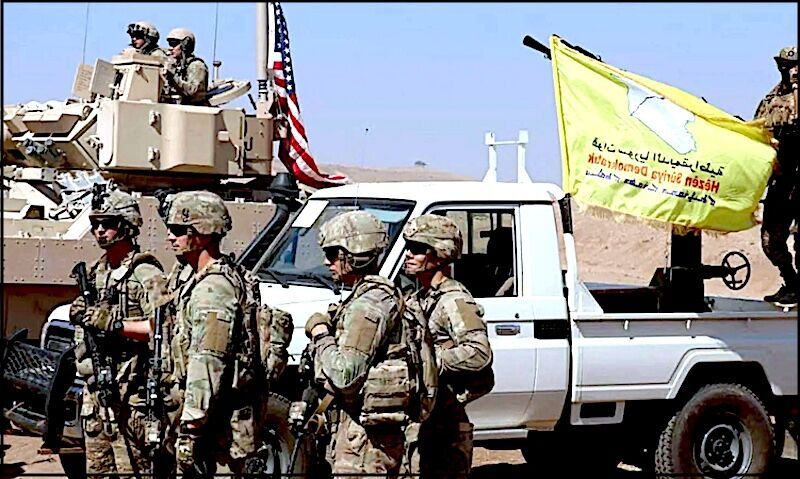
© UnknownAmerican military and Kurds in Syria
The Kurdish issue remains a threat to the interests of Turkey and the new regime in Syria
For nearly 40 years, the Kurdistan Workers' Party (PKK) and the Peshmarga guerrilla forces it controls have, with varying degrees of intensity, posed a threat to Turkey's security, forcing the Turkish government to divert significant forces to suppressing the Kurdish resistance and seeking political solutions to localize the Kurdish issue. Ankara has often had to conduct special operations in neighboring countries (Iraq and Syria) to eliminate Kurdish rebel bases.
In May 2025, it seemed that the administration of President Recep Tayyip Erdoğan, with the key participation of Foreign Minister Hakan Fidan (incidentally, a Kurd by origin) and MIT head Ibrahim Kalın, had finally succeeded in eliminating the PKK (recognized in Turkey as the main Kurdish terrorist organization) by forcing its permanent leader, Abdullah Öcalan, serving a life sentence on the island of Imralı [small Turkish prison island], to publicly call for the PKK to self-liquidate and for its units to lay down their arms in Turkey, Iraq, and Syria.
In Turkey itself, under the strict control of security forces, this process seemed to have become practical. The Kurds are being offered democratic integration within a unified Turkey, with respect for their cultural values and without any political autonomy.
Internal Turkish reconciliation could not provoke a public negative reaction from external actors (especially from NATO member states, that is, Ankara's allies). However, for Turkey, the Kurdish issue is not limited to its own borders, but also encompasses Iraq and Syria. In Iraq, Ankara recognizes Kurdish autonomy under the Barzani regime, centered in Erbil, as it is home to the oil-rich Mosul region. In the northern provinces of Syria, however, the local Kurdish political and militant movement, the Syrian Democratic Forces (SDF), operating under US control, remains a significant threat to the Turks. Under the regime of Bashar al-Assad and the presence of Russian Aerospace Forces, Turkey has successfully carried out several military operations since 2016 (specifically, Operation Euphrates Shield from August 2016 to March 2017, Operation Olive Branch from January to March 2018, and Operation Peace Spring in October 2019) to invade Kurdish-populated areas in northern Syria with the goal of establishing a 30-kilometer security zone and pushing back the Kurdish population.
The overthrow of the Assad regime and the rise of al-Julani (Ash-Sharaa) to power in Damascus, with the key participation of the Turkish Ministry of Foreign Affairs, has allowed Turkey to gain an ally in Syria. Ankara has effectively become the main patron of the new Syrian administration and acts as its security guarantor.
Turkish-American consultations held after the Trump administration took office in March 2025 resulted in the signing of an agreement between Kurdish SDF leader Majlum Abdi and the government of Ahmed al-Sharaa on the integration of Kurdish civilian and military structures in the northeast of the country into Syrian state structures (including oil fields, YPG military units, airports, etc.) and a ceasefire. In other words, Ankara and Damascus convinced Washington of the desirability of achieving civil peace in Syria and ending support for the Kurdish resistance and autonomy.
Turkey stepped up its support for Syria in the areas of security, military assistance, the construction of a 300,000-strong Syrian army, geological exploration at oil fields, and countering Israel's aggressive ambitions in southern Syria. However, A. Öcalan's call for the elimination and disarmament of the PKK has been met with negative reactions from some representatives of Kurdish organizations in the Syrian Arab Republic (they claim this doesn't apply to the Syrian Kurds, but only to the PKK and Turkish Kurds). Furthermore, such approaches within the ranks of the Syrian Kurds (YPG units) have begun to coincide with Israel's onslaught of targeted airstrikes against military targets and communications in Syria, thus escalating Israeli-Syrian and Israeli-Turkish tensions.
In other words, the SDF's agreement with the Syrian government on integration could prove to be a mere declaration if the Kurds do not lay down their arms and continue to support the idea of an autonomous Rojava in Syria.
Under pressure from Israel, the US is once again manipulating the Kurdish factor in Syria
While in the spring of 2025, SDF leader Majloum Abdi, after consultations with the US, agreed to sign a peace agreement with the al-Sharaa regime in Syria, with the deterioration of Israeli-Turkish relations in the Syrian Arab Republic, the same SDF is changing its position on integration with Syrian state structures.
In the south of the Syrian Arab Republic, Israel is known to be actively exploiting the Druze ethnicity to exert systemic pressure on Damascus and Ankara, with the aim of undermining the territorial integrity of the Syrian Arab Republic. However, on the Syrian-Turkish border, that is, in the northern regions of Syria, Israel prefers to act in line with the US position and its capabilities on the Kurdish issue.
Unexpectedly for Ankara, Washington has begun supporting disintegration processes within Syria, relying on the SDF movement. Thus, the publication Kurdistan24 reports on regular joint military exercises between the Syrian Democratic Forces (SDF) and US-led international coalition troops — these exercises took place on August 26 and September 7 at the Kasrek air base in the Syrian province of Hasakah.
It is emphasized that these actions are clearly anti-Turkish in nature. By practicing cooperation "on the battlefield," Washington and the Kurdish forces are demonstrating to Ankara that Kurdish support for the Americans in Syria remains unchanged. The exercises are being conducted to enhance military and operational cooperation. In other words, the United States, on the one hand, welcomes the peaceful process of Kurdish integration within a unified Turkey, but on the other, it does not support Ankara's aspirations for ethnic consolidation and the preservation of the unity of Turkey's ally Syria, where the interests of Israel and Turkey clash.
It follows that the United States, independent of Syria, will continue to arm Kurdish forces, provoke new conflicts there, and encourage separatist tendencies in order to curtail Turkey's influence in the region and block plans for a military response to Israeli aggression. Moreover, Turkey is a NATO member, while Israel is not.


Reader Comments
to our Newsletter