
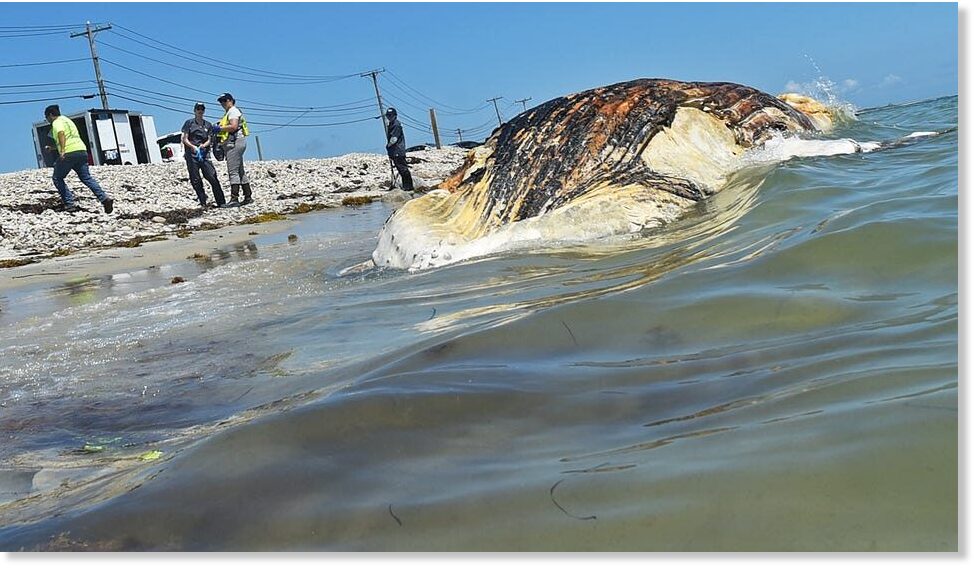
© COLIN FURZEBaby humpback whale at Town Beach in Westport Tuesday.
Nicholas Vidmar of Westport Animal Control said the dead humpback was spotted over the weekend in the water near Gooseberry Island, then washed ashore at one of the private properties along East Beach Road.
Earlier Tuesday the body was pulled by tugboat to Town Beach, where biologists and researchers from the International Fund for Animal Welfare attempted to determine how it died.
"They think it's no less than a year old," Vidmar said, adding that it was possibly female and about 20 to 25 feet long.
Determining the humpback whale's cause of death
Juvenile humpbacks can weigh thousands of pounds. A crew from the Westport Highway Department was on hand with heavy equipment and chains to drag the carcass onto land, peel off its lower jaw and much of the skin on the ventral side, or its belly.
Kristy Volker, assistant research coordinator with IFAW, estimated by the state of decomposition that it had been likely dead for a week. A westward wind blew an overpowering odor of rotten flesh along Town Beach, where beachgoers were still enjoying the sun and surf, though many people stopped to watch out of curiosity as about nine scientists clad in rubber gear opened the whale and pulled armfuls of intestines from inside, laying them in organized piles on the shoreline.
Workers from International Fund for Animal Welfare want to know more about the deceased humpback baby whale.
Volker said on Tuesday afternoon that her team had only a brief look at the animal's dorsal side, or back, before it was laid on the beach for examination. "Externally, from what we have seen, there's nothing obvious," she said. "But we'll see what the other side presents, and we'll see what the inside presents.
This is a pretty late stage of decomposition, unfortunately, so a lot of those organs are going to be pretty compromised," she added, noting that the heat accelerated the process. "Some of them might not even be recognizable at this point because of the decomposition."
Volker said at this time of year, this area is the normal habitat for humpbacks.
"Earlier in the season there are larger aggregations of humpbacks off Martha's Vineyard, off the [Vineyard] Sound.
There's a very large aggregation of them currently off Stellwagen [Bank]," she said.
Vidmar noted that IFAW has worked with the town before, including recently, when bodies of seals and dolphins wash ashore.
"We get calls all the time on Gooseberry Island and Cherry & Webb," he said.
What will be done with the whale afterward?
Highway Surveyor Chris Gonsalves said the necropsy would take several hours and, once complete, the whale would be buried underneath Town Beach at that spot. The process would be made easier because the IFAW crew was taking apart the large animal into smaller pieces.
Volker said even if they couldn't conclusively determine what killed the whale, studying it would still be beneficial.
"Whale strandings like this can be an opportunity for us to at least learn more about these animals," she said.



Reader Comments
to our Newsletter