
© Fx-1988
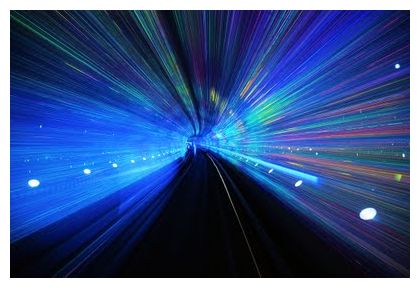
A paper published in Natural Science brings some boring common sense to the speed-of-light-travel table. In order to travel huge distances in next to no time, people need to travel close to the speed of light. In so doing, travelers cover extremely large distances very quickly and, thanks to the quirks of relativity, would feel like it took mere minutes because of an effect known as time dilation, which squashes perceived time.
Trouble is, traveling close to the speed of light brings about other effects, too. In Natural Science, Edelstein and Edelstein point out that hydrogen in any craft cable of traveling at the speed of light would also prevent it from traveling at the speed of light. They explain:
In other words, travel close to the speed of light and you'll be bombarded with so much radiation that you kick the bucket. The knock-on effect is that even if it's possible to create a craft capable of traveling close the speed of light, it wouldn't be able to transport people.Unfortunately, as spaceship velocities approach the speed of light, interstellar hydrogen H, although only present at a density of approximately 1.8 atoms/cm3, turns into intense radiation that would quickly kill passengers and destroy electronic instrumentation. In addition, the energy loss of ionizing radiation passing through the ship's hull represents an increasing heat load that necessitates large expenditures of energy to cool the ship.
Instead, there's a natural speed limit imposed by safe levels of radiation due to hydrogen, which means humans couldn't travel faster than half the speed of light unless they were willing to die almost immediately. Dammit.
Source: Natural Science



Reader Comments
Who honestly thinks light-speed "travel" would occur using conventional mechanistic processes, like the acceleration of matter?
We're talking about a different mechanism that operates by a different set of rules.
"That's impossible" is an old game played by the mentally inert. Of course it's possible. It's just a matter of figuring out how.
If superluminal communication is possible, then I'd say so is superluminal travel. Once again "knowledge is the key". Maybe "Nassim" is on the right track.
if this is true, but I remember reading about some very respected scientists in the 19th centruy, who were absolutely convinced that trains would never be able to travel faster than 40 or 50 miles per hour (I don´t remember exactly), not because the train couldn´t go that fast, but because all the air would get sucked out and all people on board would die.