
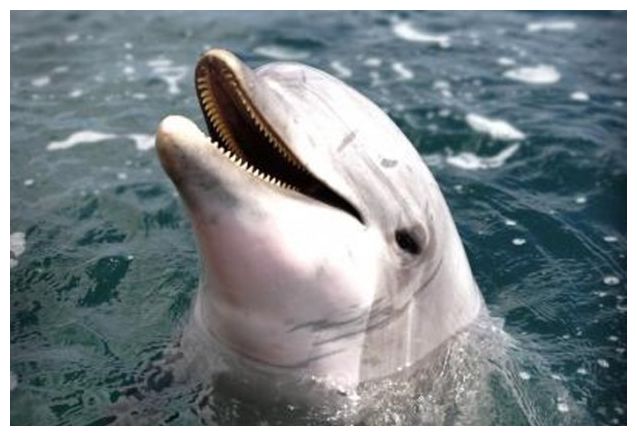
© Brian BranstetterThe female dolphin SAY who performed a continuous echolocation tasks for 15 days.
Dolphins meet these 24-hour security requirements by sleeping with one half of their brain while surfacing to breath and avoiding predators with the other half, according to new research published this week in PLoS ONE.
A group of San Diego researchers has shown that these marine mammals have evolved the ability for unihemispheric sleep, or the ability to sleep with either half of the brain.
"These majestic beasts are true unwavering sentinels of the sea," lead author Brian Branstetter, from the National Marine Mammal Foundation in San Diego told The Telegraph. "The demands of ocean life on air breathing dolphins have led to incredible capabilities, one of which is the ability to continuously, perhaps indefinitely, maintain vigilant behavior through echolocation."
In the study, the marine biologists used the dolphins' echolocation abilities to test their alertness over an extended period of time that would have left the animals sleep-deprived had they not rested.
The two dolphin participants, a male called Nay and a female called Say, swam around their tank looking for targets using echolocation. Each target was a device that recorded a dolphin's sonar pulse and responding with a modeled impulse of its own. The device pulse was designed to replicate an actual physical target, taking into account the range and sound profile of each echolocation click.
Once the dolphin detected the pulse it was required to push a response paddle to acknowledge detection of the target. Pressing the correct paddle resulted in the sounding of a 'success' tone and the release of a fish reward. Pressing the incorrect paddle resulted in neither tone nor reward.
Both dolphins were able to accurately detect the targets over several five-day sessions, with accuracy ranging from 75 to 99 percent. The female dolphin was the better performer - missing only two targets after continuously echolocating for five days. The researchers noted that Say was also more enthused about performing the tasks as she would often squeal with delight after correctly identifying a target.
The results of the study seem to confirm that dolphins are capable of unihemispheric sleep. When sleeping this way, the animals often keep one eye open.
The researchers theorized that these sea creatures most likely evolved this capability as they are constantly under threat from shark attacks. Many dolphins are spotted with bite marks and their ability to remain vigilant via echolocation allows them to detect threats, even in dark and murky waters.
"From an anthropomorphic viewpoint, the ability of the dolphin to continuously monitor its environment for days without interruption seems extreme," the report said. "However, the biological, sensory and cognitive ecology of these animals is relatively unique and demanding."
"If dolphins sleep like terrestrial animals, they might drown. If dolphins fail to maintain vigilance, they become susceptible to predation," it continued. "As a result, the apparent 'extreme' capabilities these animals possess are likely to be quite normal, unspectacular, and necessary for survival from the dolphin's perspective."



Here's the give away "researchers theorized that these sea creatures most likely evolved this capability as they are constantly under threat from shark attacks"
So evolution is gradual takes millions/thousands of years... so how long did the evolution process take dolphins to develop unihemispheric sleep pattern?? and before that what did the dolphins do to sleep while having to breath constantly by surfacing and also to stay safe from predators? What did they do???? How did they do???
It's so easy to say "these sea creatures most likely evolved this capability"
Even a half brain dead third grader can make such statements.