
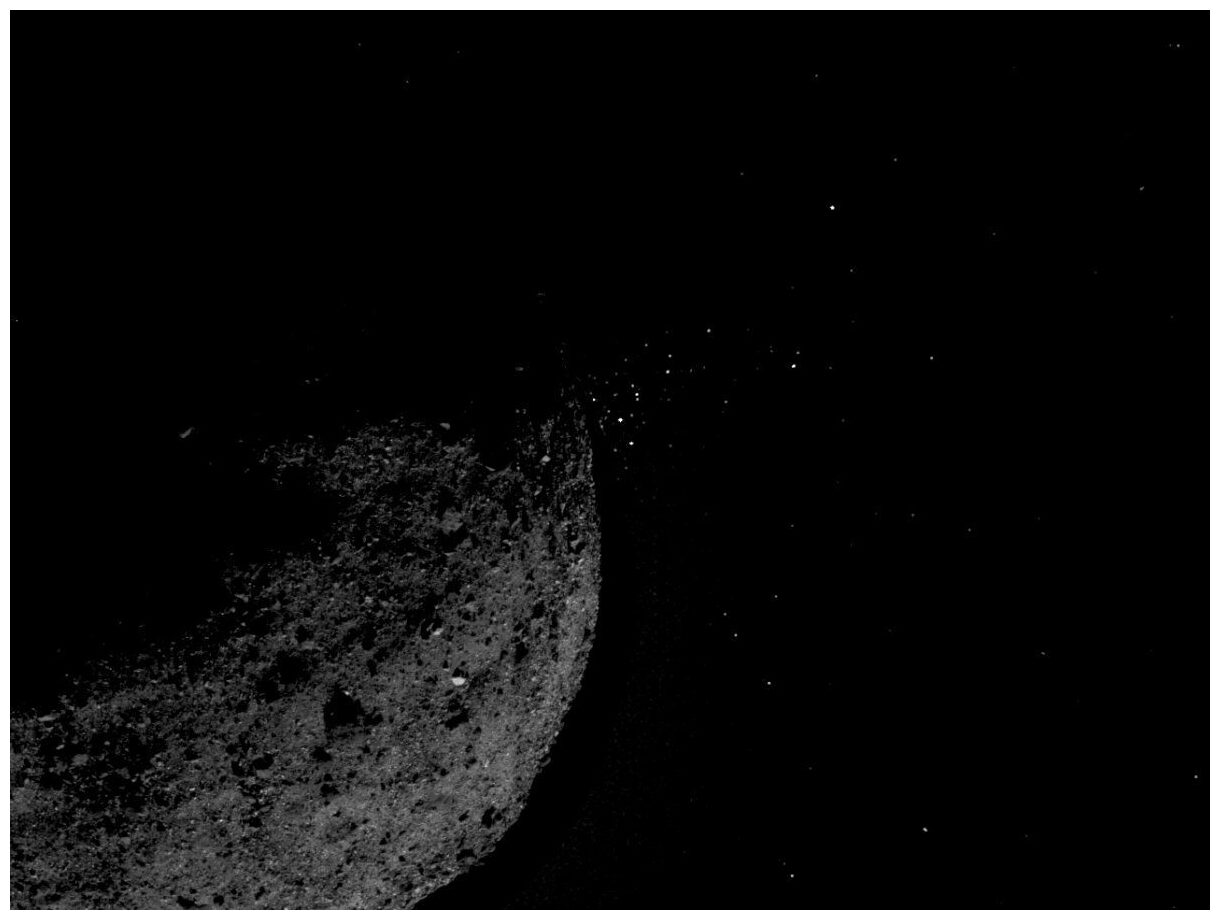
© NASA/Goddard/University of Arizona/Lockheed MartinBennu ejecting particles from its surface on Jan. 19, 2019.
These fragments were long thought to come strictly from comets whose crusts had been heated by the Sun and cracked open. But early in 2019, NASA's OSIRIS-Rex spacecraft (short for Origins, Spectral Interpretation, Resource Identification, and Security-Regolith Explorer) captured images from the near-Earth asteroid Bennu that flipped that line of thinking on its head.
The images showed small bits of rock launching off the asteroid's surface. Some of the rock fell back to the surface and some went into orbit around Bennu for several days, but about 30 percent was ejected with enough speed that its pieces escaped the asteroid's gravity and began to orbit around the Sun.
"This was surprising," says Robert Melikyan, a graduate student at the University of Arizona's Lunar and Planetary Laboratory. "Bennu doesn't have a lot of volatile material that can heat up and break up the way comets do."
Melikyan and a team of researchers modeled the evolution of the asteroid's dust cloud in a study published in the Journal of Geophysical Research: Planets earlier this year and found that the particles both spread out around Bennu's orbit and follow a similar elliptical path around the Sun.







Comment: It's a shame to see the research trend of 15-20 years ago veer off course away from comets as the likely cause of sudden catastrophic climate change. However, it's good to see that at least some climate science acknowledges that the only climate change worth really worrying about is the sudden, NATURALLY-CAUSED kind.
We get it though. Comets are just too much for people. It's scary to contemplate, and disturbs too many beliefs.