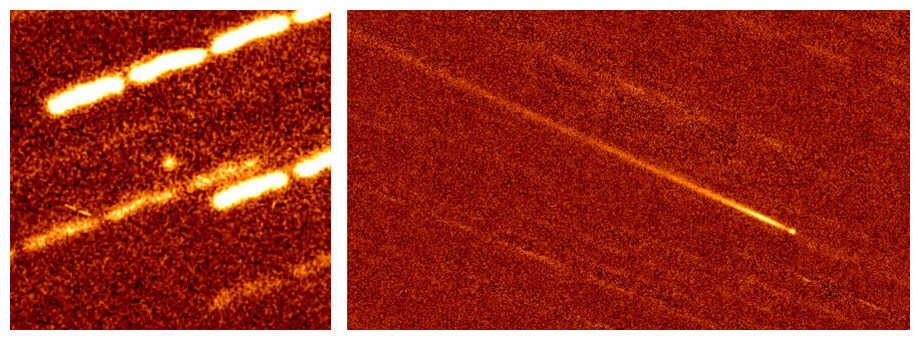
© Subaru Telescope/CFHT/Man-To Hui/David TholenNear-Sun object 323P/SOHO observed by the Subaru Telescope on December 21, 2020 (left) and CFHT on February 11, 2021 (right). 323P/SOHO on its way to perihelion is seen as a point source in the center of the left image; after the perihelion, the comet has developed a long narrow tail as seen in the right image.
The Solar System is a dangerous place. In textbooks we see figures of celestial bodies orbiting around the Sun in orderly orbits. But that's because if an object's orbit doesn't fit this pattern, gravitational effects from other objects destabilize the orbit. One common fate for such ejected bodies is to become comets in near-Sun orbits where they will eventually plunge into the Sun. Because these comets pass so close to the Sun, they are difficult to spot and study. Most have been discovered by accident in solar telescope observations. But even taking this difficulty into account, there are far fewer near-Sun comets than expected, indicating that something is destroying them before they get a chance to make their fatal final dive into the Sun.
To better understand these comets, a group of astronomers from Macau, the US, Germany, Taiwan, and Canada observed an elusive near-Sun comet called 323P/SOHO with multiple telescopes including the Subaru Telescope, the Canada France Hawaii Telescope (CFHT), the Gemini North telescope, Lowell's Discovery Telescope, and the Hubble Space Telescope. The orbit of 323P/SOHO was poorly constrained, so the group didn't know exactly where to look for it, but the wide field of view of the Subaru Telescope allowed them to "cast a wide net" and find the comet as it approached the Sun. This was the first time 323P/SOHO was captured by a ground-based telescope. With this data, the researchers were able to better constrain the orbit, they knew where to point the other telescopes and were waiting when 323P/SOHO started to move away from the Sun again.