Secret HistoryS


Handcuffs

British intelligence in the dock for CIA torture

Nashiri/Hawsawi
© MI6 CARD/WikipediaAbd al-Rahim Nashiri • Mustafa al-Hawsawi
Recent developments raise the prospect that British intelligence agents could finally face justice for their little-known role in the CIA's global torture program.

Britain's foreign and domestic intelligence apparatus is facing scrutiny by a tribunal tasked with intelligence oversight. On May 26, London's infamously opaque Investigatory Powers Tribunal (IPT) unanimously issued a landmark ruling which means the complaints of two Saudis brutally tortured at CIA black sites and jailed for years in Guantanamo Bay can finally be heard, at least behind closed doors.

The British government insisted that the Tribunal, which explicitly examines wrongdoing by London's security and intelligence agencies, did not have jurisdiction over the cases of Mustafa al-Hawsawi and Abd al-Rahim Nashiri. But the IPT disagreed.

Noting that "the underlying issues raised by this complaint are of the gravest possible kind," the tribunal declared that "if the allegations are true, it is imperative that that should be established," as "it would be in the public interest for these issues to be considered."

The ruling means the Tribunal is likely to hear a complaint from Mustafa al-Hawsawi, who's remained in US custody since American troops captured the man they claim is "a senior al-Qaida member" in 2003.

Info

X-ray scans reveal 'hidden mysteries' in ancient Egyptian necropolis paintings

New scans reveal that Ancient Egyptian artists flubbed a tomb painting depicting royalty.
Ramesses II
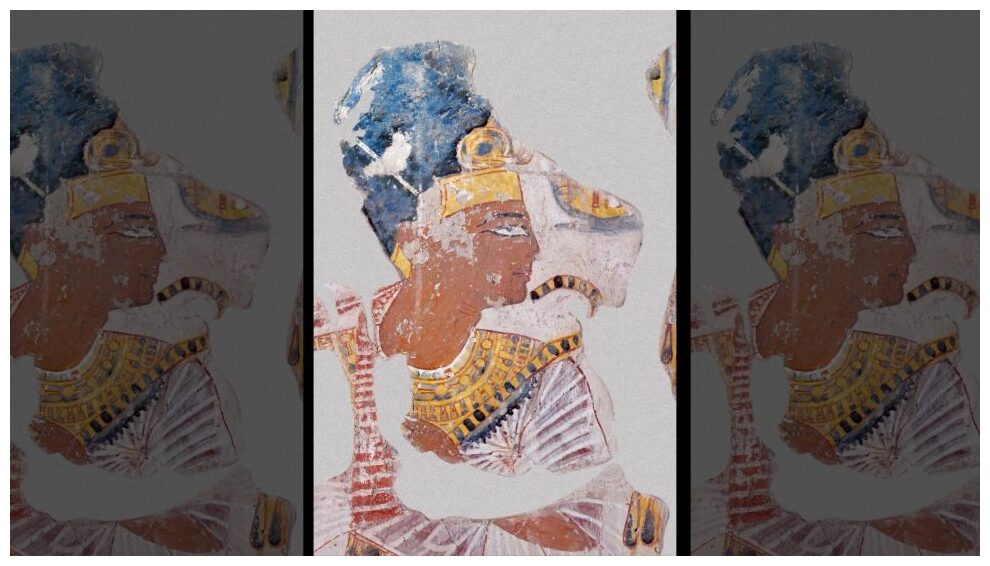
© Martinez et al.; (CC-BY 4.0)The portrait of Ramesses II, including his Adam's apple, in Nakhtamun's tomb.
More than 3,000 years ago, ancient Egyptian artists flubbed a royal portrait that was discovered in a tomb within a vast necropolis, a new study suggests.

The painting, of the pharaoh Ramesses II (reign circa 1279 B.C. to 1213 B.C.), is in the tomb of an official named Nakhtamun, who was buried near Thebes (modern day Luxor). In the painting, the pharaoh has some stubble on his face and is facing a figure whose features cannot be seen well, according to a new study published Wednesday (July 12) in the journal PLOS One.

This has led past scholars to propose that the painting shows the pharaoh mourning the death of his father, the pharaoh Seti I (reign circa 1294 B.C. to 1279 B.C.), the team wrote. But a new scan of the portrait suggests otherwise.

Using a portable version of X-ray fluorescence imaging (XRF), a technique that uses X-rays to determine the chemical composition of an object, the team scanned the Ramesses II painting and one other artwork from the necropolis, revealing details that were not visible with the naked eye.

However, not everyone agrees with the team's new interpretations of the Ramesses II painting nor with the study's suggestions about when this artwork was created.

Black Magic

Human skulls suggest use in necromancy during Roman-era in cave near Jerusalem

necromancy skull roman
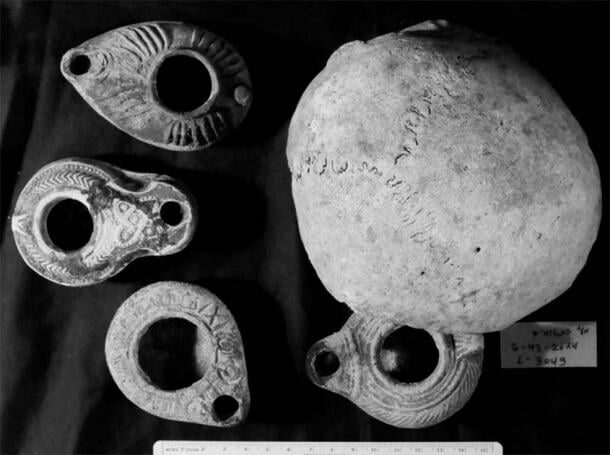
© (B. Zissu/ Te’omim Cave Archaeological Project )Oil lamps and human skulls found in the cave were used for ancient magical practice and ritual acts according to study.
A cave in the Jerusalem Hills may once have served as a local oracle where people communed with the dead in the hopes of learning about the future. Known as the Te'omim Cave, the creepy crevice is littered with human skulls and other items associated with necromancy, and is described by researchers as a possible "portal to the underworld".

Analyzing the discoveries made at the cave, the authors of a new study suggest that Te'omim might have hosted "secret rites involving necromancy and communication with the dead, mainly by witches."

"These rites were usually conducted within tombs or burial caves, but sometimes they took place in a nekyomanteion (or nekromanteion) - an 'oracle of the dead'," explain the researchers. "These shrines were generally located in caves or next to water sources that were believed to be possible portals to the underworld."

Comment: See also:


Question

Could an industrial civilization have predated humans on Earth?

A thought experiment plumbs archaeology and geology to ask whether our own species will leave a trace.
Planet of the Apes Scene

In the 1968 film Planet of the Apes, a crew of human astronauts travels into the future and lands on an alien planet that a civilization of non-human primates inhabits. Only when the film's protagonist discovers a half-buried Statue of Liberty on the shore does he realize that this is not an alien world, but rather a future Earth dominated by a new species of intelligent apes that have outcompeted humans.

The scene is as provocative today as it was 55 years ago. Homo sapiens, the futurists tell us, may one day be succeeded by another intelligent species. But how do we know another intelligent species didn't come before us? After all, if civilization had also arisen from an earlier, now-extinct animal species, where are the ruins of its cities? If we found fossils of dinosaurs that lived tens of millions of years ago, we should also have found relics of tombs and temples built in the deep past.

In 2018, climatologist Gavin Schmidt and astrophysicist Adam Frank published an intriguing paper in the International Journal of Astrobiology called, "The Silurian hypothesis: Would it be possible to detect an industrial civilization in the geological record?" The title is derived from a Doctor Who episode featuring a reptilian race known as the Silurians who gained intelligence before humans. The purpose of the Silurian hypothesis isn't to assert that another civilization came before us. Rather, it's a thought experiment to get us thinking about how we would know if a pre-human civilization once existed, a point that might be too subtle for some netizens in our age of Ancient Aliens memes.

Schmidt and Frank acknowledge that paleontologists haven't uncovered fossilized evidence of pre-human civilizations — but that's the point. If a civilization thrived millions of years prior to us, its artifacts could have been destroyed. Geological processes such as tectonic plate subduction and glaciation could easily erase evidence of ancient urbanization.

Better Earth

New evidence of human occupation in Oregon 18,000 years ago

oregon rock shelter
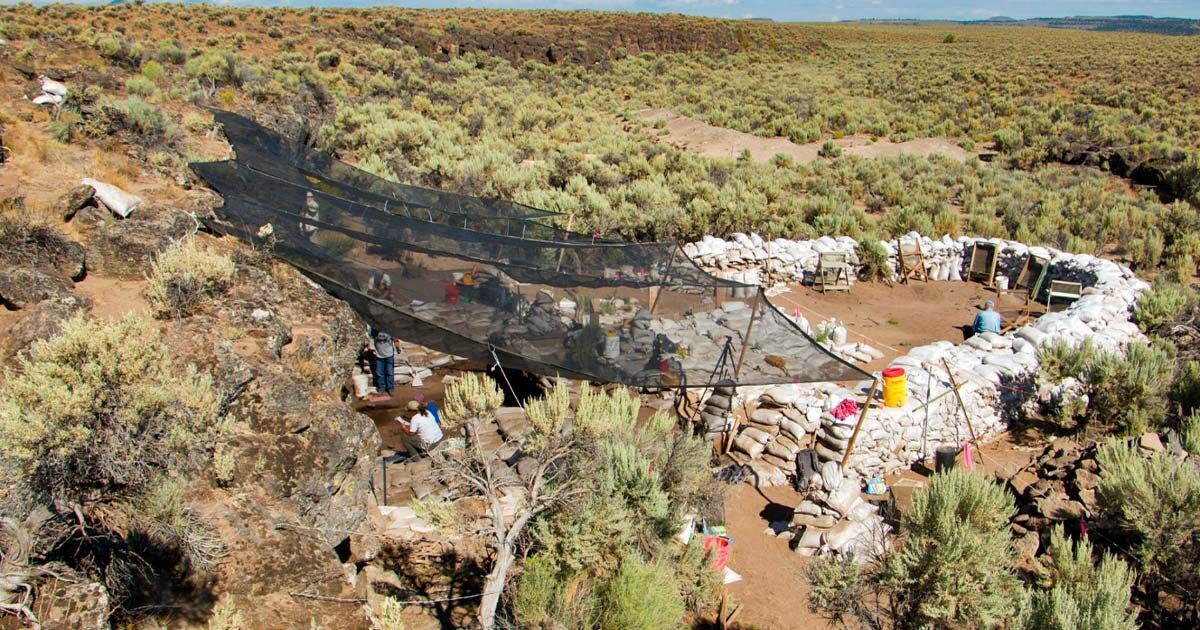
Oregon archaeologists have found evidence suggesting humans occupied the Rimrock Draw Rockshelter outside of Riley, Oregon more than 18,000 years ago.
University of Oregon's Museum of Natural and Cultural History Archaeological Field School, led by archaeologist Patrick O'Grady, has been excavating at the Rimrock Draw Rockshelter. Excavation has been occurring since 2011 under an official partnership agreement with the Bureau of Land Management. Discoveries at the site have included stone tools and extinct-mammal tooth fragments from the Pleistocene era. The pieces of tooth enamel are identified as bison (Bison sp.) and camel (Camelops sp.).

In 2012, O'Grady's team found camel teeth fragments under a layer of volcanic ash from an eruption of Mount St. Helens that was dated over 15,000 years ago. The team also uncovered two finely crafted orange agate scrapers, one in 2012 with preserved bison blood residue and another in 2015, buried deeper in the ash. Natural layering of the rockshelter sediments suggests the scrapers are older than both the volcanic ash and camel teeth.

Comment: Other evidence suggests human occupation on the American continents goes even further back than that: And check out SOTT radio's: MindMatters: America Before: Comets, Catastrophes, Mounds and Mythology


Better Earth

Giant, 300,000 year-old handaxes found at rare Ice Age site in Kent, UK

handaxe
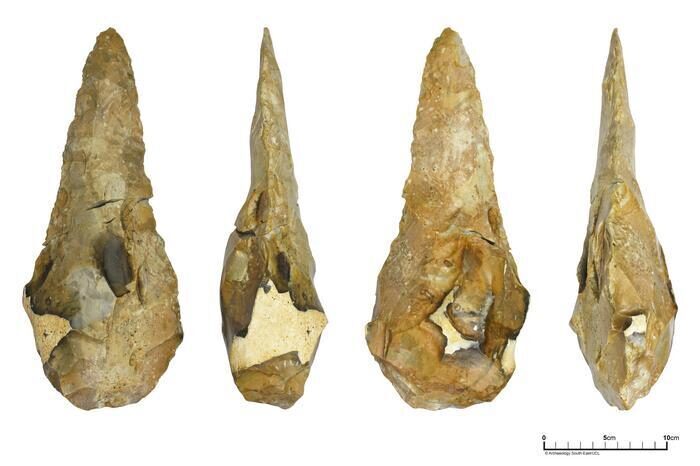
© Archaeology South-East/ UCLThe largest giant handaxe.
Researchers at the UCL Institute of Archaeology have discovered some of the largest early prehistoric stone tools in Britain.

The excavations, which took place in Kent and were commissioned in advance of development of the Maritime Academy School in Frindsbury, revealed prehistoric artifacts in deep Ice Age sediments preserved on a hillside above the Medway Valley.

The researchers, from UCL Archaeology South-East, discovered 800 stone artifacts thought to be over 300,000 years old, buried in sediments which filled a sinkhole and ancient river channel, outlined in their research, published in Internet Archaeology.

Amongst the unearthed artifacts were two extremely large flint knives described as "giant handaxes". Handaxes are stone artefacts which have been chipped, or "knapped," on both sides to produce a symmetrical shape with a long cutting edge. Researchers believe this type of tool was usually held in the hand and may have been used for butchering animals and cutting meat. The two largest handaxes found at the Maritime site have a distinctive shape with a long and finely worked pointed tip, and a much thicker base.

Comment: See also: The Golden Age, Psychopathy and the Sixth Extinction


Better Earth

26,000-foot Himalayan mountain summit crumbled around 1190 CE, leaving evidence in the plains below

Annapurna in Nepal
© DepositphotosThe base camp at Annapurna in Nepal, one of the tallest mountains on Earth.
Earth is home to 14 "eight-thousanders," summits that top off at more than 8,000 meters, or 26,247 feet, above sea level. All of these grand mountains tower over the Himalayas, the highest place in the world.

But our planet is dynamic — could there have been additional peaks like these, since lost? "We wanted to know whether, 830 years ago, the Earth and the Himalayas had one more," says Jérôme Lavé, a geomorphologist at the National Centre for Scientific Research (CNRS) and the University of Lorraine in France.

The answer, according to Lavé and his colleagues, appears to be yes. In a new paper, published in the journal Nature on July 6, they've found evidence of an ancient landslide that reshaped South Asia's geography — and linked that to the collapse of a peak that would have once been one of the tallest mountains on Earth.

Lavé says his team first spotted the fingerprints of this medieval landslide not in the Himalayas, but far to the south, near the India-Nepal border, in the flat plains around the Narayani River.

Comment: As Laura Knight Jadcyzk writes in Meteorites, Asteroids, and Comets: Damages, Disasters, Injuries, Deaths, and Very Close Calls, there is evidence and reports of other disasters and catastrophic events occurring around the same time elsewhere on our planet:
1000 - Alberta, Canada - The date of this meteor strike is estimated.
"What local hunters in Whitecourt thought for years was a sinkhole is actually the crater left behind by a meteor that fell to earth 1,000 years ago and is now attracting international attention from researchers. ... The crater is 36 metres wide and six metres deep, which is small as far as most craters go, ... Herd thinks the meteor came from the asteroid belt and measured one metre across. However, researchers have so far found 74 different pieces of the original meteor - which is called a meteorite once it hits the ground - scattered around the crater, some up to 70 metres away." LINK
1064 - Chang-chou, China - Daytime fireball, meteorite fall; fences burned.

1160-1177 - Iran - Hossein Alizadeh Gharib, after discovering several young impact craters in Iran, searched the historical records and found this:
The result of my search through a vast collection of Persian chronicles and works of meteorological, astronomical and literary (mostly still in manuscript form) was the discovery of more than 100 cases of fireball phenomena, falls and meteorite showers, along with the following accident which caused the death of people. Mohammad Ebn Mahmoud Tousi, in his great work entitled Ajayeb-ol-Makhlooghat ("miraculous phenomena"), which is an encyclopedia of miracles recorded in the years 556-573 AH (1160-1177 AD), in the chapter entitled "About falling stones," he writes, "... and we set to write another chapter about rains of stones and whether stones may fall out of the sky or not ..." Then he mentions several cases of meteorite falls and gets to this phenomenon: "... and I heard from a trustworthy person, who told me: "I was sitting in the shade in Qazvin (100 km south of the Caspian Sea) when it appeared a cloud with a thunder and in a shadow a stone fell then another one, both identical. I was curious as to where they came from. Then came the news that in Hoosam (called today Rud Sar, a city in northern Iran at the Caspian Sea) stone rain fell and a large number of people were killed."

Perhaps it was the same incident as described by an unknown author in Sovara-ol-Aghalim ("Faces of lands"), which is a geographical description of the medieval world written in 748 AH (1347 AD), in the fourth chapter of his book: "... and a man told that he had seen in Qazvin that the stone fell to the ground with lightning ..." ("A Fatal Meteorite Shower in the 12th Century Iran," Meteorite! magazine, 1999 November issue)
According to Wikipedia, the city of Rudsar had a mosque in the year 979, that the city "was ruined due to unknown reasons" and reconstructed between the years 1393-1435. [Entry added 3/3/2013]

1178 - 18 June on the Julian calendar, 25 June, Gregorian
In this year, on the Sunday before the Feast of St. John the Baptist, after sunset when the moon had first become visible a marvelous phenomenon was witnessed by some five or more men who were sitting there facing the moon. Now there was a bright new moon, and as usual in that phase its horns were tileted toward the east; and suddenly the upper horn split in two. From the midpoint of the divisin a flaming torch sprang up, spewing out, over a considerable distance, fire, hot coals, and sparks. Meanwhile the body of the moon which was below writhed, as it were, in anxiety, and, to put it in the words of those who reported it to me and saw it with their own eyes, the moon throbbed like a wounded snake. Afterwards it resumed its proper state. This phenomenon was repeated a dozen times or more, the flame assuming various twisting shapes at random and then returning to normal. Then after these transformations the moon from horn to horn, that is along its whole lengthe, took on a blackish appearance. The present writer was given this report by men who saw it with their own eyes, and are prepared to stake ther honour on an oath that they have made no addition or falsification in the above narrative. (Gervase of Canterbury)
See also:


Info

Genetic analysis reveals a woman dubbed 'Ivory Lady' as the highest-ranking individual in Copper Age Spain

The Ivory Lady
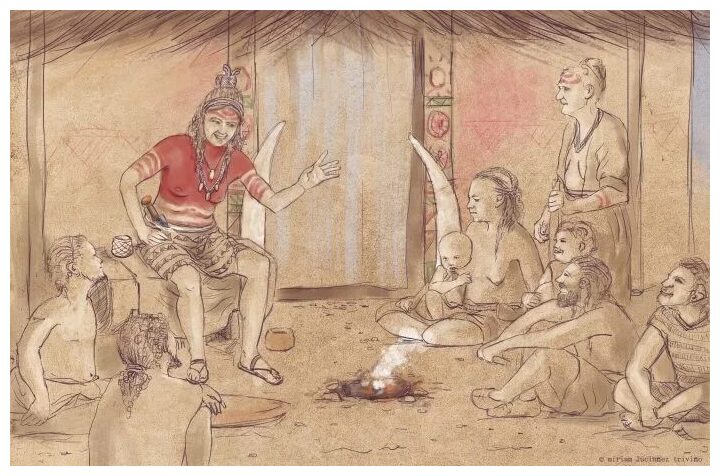
© Miriam Luciañez TriviñoRecreation drawing of ‘The Ivory Lady’.
According to a study published Thursday (July 6) in the journal Scientific Reports, the highest-status individual in ancient Copper Age society in Iberia was a woman, not a man as previously thought.

Since its discovery in 2008, the skeleton of a high-ranking individual buried inside a tomb in the Iberian Peninsula between 3,200 and 2,200 years ago was thought to be the remains of a man. However, a new analysis reveals that this person was actually a woman.

Archaeologists in Spain dubbed the woman the "Ivory Lady" based on the bounty of grave goods found alongside her skeleton, including an ivory tusk surrounding her skull, flint, an ostrich eggshell, amber, and a rock crystal dagger.

For more than a decade, archaeologists believed that this individual was a man, even nicknaming him the "Ivory Merchant." As well as being a rare example of a single occupancy burial, the grave contained a large number of valuable goods, suggesting that this individual — originally thought to be a young male aged between 17 and 25 years. — held a high status within society.

Info

Archaeologists may have found ruins of fabled entrance to Zapotec underworld

Spanish missionaries deemed Lyobaa to be a "back door to hell" and sealed all entrances.
LIDAR Scan
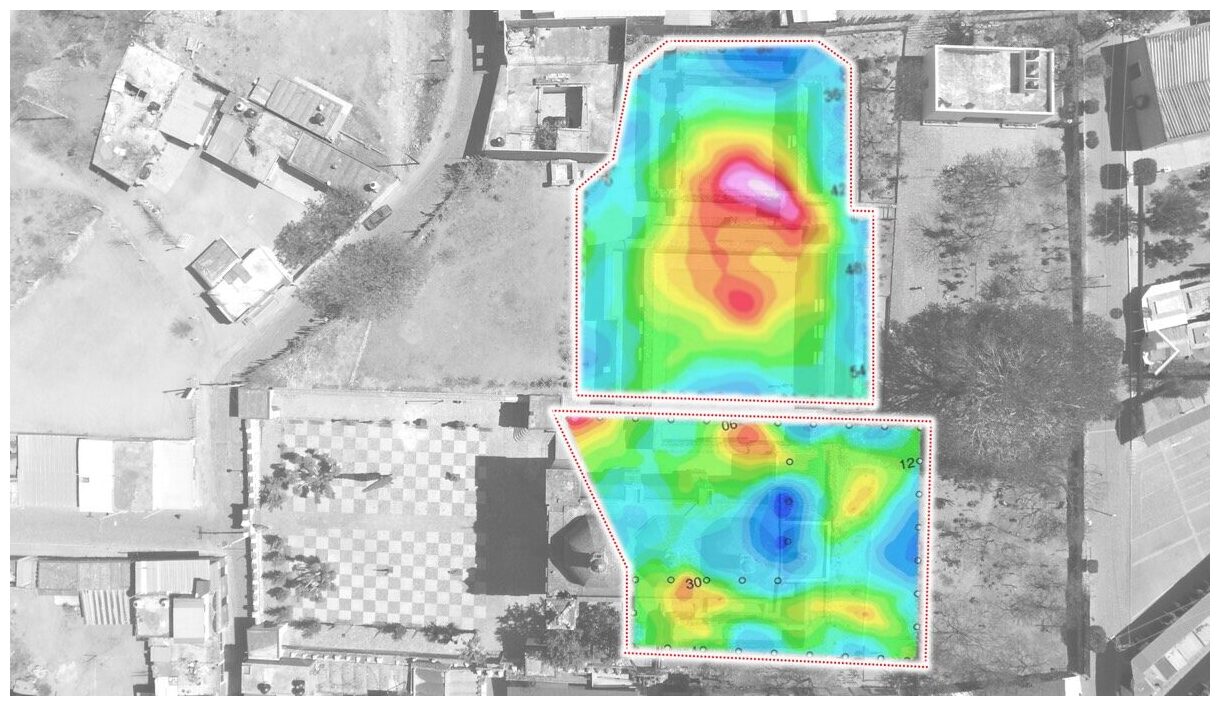
© Marco M. Vigato/ARX ProjectSeismic tomography scan of the Church Group at the frequency of 4.76 Hz, revealing areas of low velocity (in blue) that could indicate the presence of underground chambers or natural cavities.
In 1674, a priest named Francisco de Burgoa published his account of visiting the ruins of the Zapotec city of Mitla in what is now Oaxaca in southern Mexico. He described a vast underground temple with four interconnected chambers, the last of which featured a stone door leading into a deep cavern. The Zapotec believed this to be the entrance to the underworld known as Lyobaa ("place of rest"). Burgoa claimed that Spanish missionaries who explored the ruins sealed all entrances to the temple, and local lore has long held that the entrance lies under the main altar of a Catholic church built over the ruins.

An international team of archaeologists recently announced that they found evidence for this fabled underground labyrinth under the ruins — right where the legends said it should be — after conducting scans of the site using ground penetrating radar (GPR), electrical resistivity tomography (ERT), and seismic noise tomography (SNT). The team also found evidence of an earlier construction stage of a palace located in another part of the site.

Mitla is one of the most significant archaeological sites in Oaxaca Valley. It was an important religious center, serving as a sacred burial site — hence its name, which derives from Mictlan ("place of the dead" or "underworld"). The unique structures at Mitla feature impressively intricate mosaics and geometric designs on all the tombs, panels, friezes, and walls, made with small polished stone pieces fitted together without using mortar.

Document

Leaked documents reveal Reuters helped overthrow Egyptian democracy

soldier
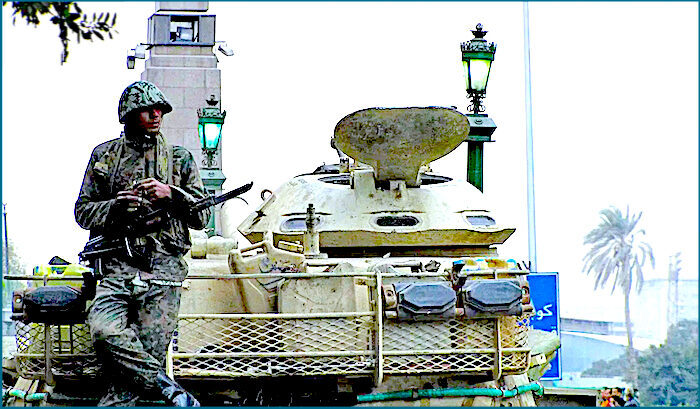
© unknownSoldier in Tahrir
Reuters served as a channel for the UK Foreign Office to covertly fund an Egyptian outlet that clamored for the overthrow of the country's first democratically elected leader, leaked documents show.

This July 3 marks the 10th anniversary of Egyptian army chief General Abdel Fattah Sisi's violent seizure of power in Cairo. The first democratically elected leader in 5000 years of Egyptian history, Mohamed Morsi, was swept from office, his supporters were massacred by the hundreds, and he ultimately died in prison. With US and UK support, Sisi quickly reversed any tentative democratic gains made during the country's brief, difficult transition from the rule of longtime Western-backed autocrat Hosni Mubarak.

In the decade since Sisi's coup, his government has systematically crushed opposition to his rule. Political parties and critical media have been banned en masse, activists, journalists, and civil society actors harassed, disappeared, tortured and jailed, and prisons transformed into hotbeds of systemic sexual violence, and other horrific abuse. It is estimated that half of Egypt's 120,00 inmate population are currently incarcerated for political reasons, one of the highest rates in the world.

The circumstances of Morsi's forced ejection from office, and of Egypt's regression to one of the most repressive countries on Earth under Sisi's rule, have been well-documented, despite many NGOs and news outlets fleeing the country over the years. Yet, there is a crucial component of the historical record that has not been revealed until now.

Leaked documents reviewed by The Grayzone reveal that the media giant Reuters worked closely with the British Foreign Office to drive the fateful events of July 3, 2013. What follows is the story of how Cairo's first democratically elected government in history was undermined, Sisi's blood-spattered coup whitewashed, and the military entrenched in power, through covert propaganda funded in secret by London.