Science & TechnologyS


Jet2

Fighter pilot gets shot down everytime in dogfight simulations for the first time by AI

AI Interceptor
© YouTube/Outer Places
Artificial intelligence has beaten humans at chess, Go, and even complex MOBA games like DoTA, but now they're moving up to real wargames-specifically, combat flight simulators against real fighter pilots. And unfortunately for us, it looks like they're devastatingly good at it.

A new AI, called ALPHA, went head-to-head against retired U.S. Air Force Colonel Gene Lee and shot him down every single time, despite the fact that he's "controlled or flown in thousands of air-to-air intercepts as mission commander or pilot" and flown against simulated AI opponents for years. After several hour-long tests, Lee didn't even get a single kill.

To put this in perspective, if life were a sci-fi movie, Colonel Gene Lee is probably the one guy in the world the Pentagon would call to blow a rogue AI-controlled fighter jet out of the sky. Instead, ALPHA bested him at every turn.

Comment: Do you think for a moment that a letter could stop the military from recovering such promising technology and developing it?


Info

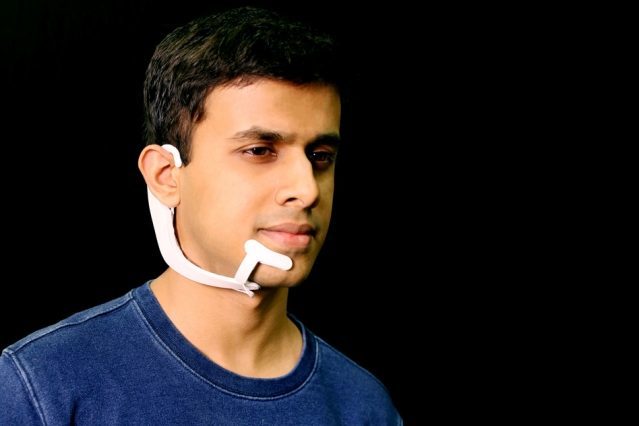
Subtle signals: Computer interface can transcribe words users 'speak silently'

Electrodes on the face and jaw pick up otherwise undetectable neuromuscular signals triggered by internal verbalizations.
silent speech detector, MIT AlterEgo project
© Lorrie Lejeune/MITArnav Kapur, a researcher in the Fluid Interfaces group at the MIT Media Lab, demonstrates the AlterEgo project.
MIT researchers have developed a computer interface that can transcribe words that the user verbalizes internally but does not actually speak aloud.

The system consists of a wearable device and an associated computing system. Electrodes in the device pick up neuromuscular signals in the jaw and face that are triggered by internal verbalizations - saying words "in your head" - but are undetectable to the human eye. The signals are fed to a machine-learning system that has been trained to correlate particular signals with particular words.

The device also includes a pair of bone-conduction headphones, which transmit vibrations through the bones of the face to the inner ear. Because they don't obstruct the ear canal, the headphones enable the system to convey information to the user without interrupting conversation or otherwise interfering with the user's auditory experience.


Comment: See also:


Info

Pre-human civilizations existed suggest new study

Pre-Human Civilization
© University of Rochester illustration/Michael OsadciwHow do we really know there weren't previous industrial civilizations on Earth that rose and fell long before human beings appeared?
Reptilian menaces called Silurians evolved on Earth before humankind - at least in the Doctor Who rendition of the universe. But science fiction aside, how would we know if some advanced civilization existed on our home planet millions of years before brainy humans showed up?

This is a serious question, and serious scientists are speculating about what traces these potential predecessors might have left behind. And they're calling this possibility the Silurian hypothesis.

When it comes to the hunt for advanced extraterrestrial civilizations that might exist across the cosmos, one must reckon with the knowledge that the universe is about 13.8 billion years old. In contrast, complex life has existed on Earth's surface for only about 400 million years, and humans have only developed industrial civilizations in the last 300 years. This raises the possibility that industrial civilizations might have been around long before human ones ever existed - not just around other stars, but even on Earth itself.

"Now, I don't believe an industrial civilization existed on Earth before our own - I don't think there was a dinosaur civilization or a giant tree sloth civilization," said study co-author Adam Frank, an astrophysicist at the University of Rochester in New York. "But the question of what one would look like if it did [exist] is important. How do you know there hasn't been one? The whole point of science is to ask a question and see where it leads. That's the essence of what makes science so exciting."


Display

Google's ad technology mirroring of Facebook model exposes it to privacy backlash

google building
© Reuters
No one at Google envied Mark Zuckerberg last week as he was being grilled by Congress. But for years, they certainly coveted the personal data that made Facebook Inc. a formidable digital ad player. And the strategies they set to compete have now placed Google squarely in the cross hairs of a privacy backlash against the world's largest social-media company.

The House and Senate questioned Zuckerberg for about 10 hours after revelations that data on millions of Facebook users got into the hands of Cambridge Analytica, a consulting firm that worked on President Donald Trump's 2016 presidential campaign. The hearings centered on the digital information and machinery Facebook built up to serve targeted ads. No company has a bigger business doing that -- except Google. When the grilling ended, Democrats and some Republicans called for broad privacy regulation, putting Google on the hot seat next to Zuckerberg.

"Google, in every respect, collects more data. Google, in every respect, has a much bigger advertising business," said David Chavern, president of News Media Alliance, a publisher trade group. Rather than "a Facebook privacy law," he expects regulation to target the entire industry.

2 + 2 = 4

Education, not income, a better predictor of life expectancy

income life expectancy
© Lutz/KebedeCurve showing the relationship between income and life expectancy in 1970, 1990 and 2010
Rising income and the subsequent improved standards of living have long been thought to be the most important factors contributing to a long and healthy life. However, new research from Wolfgang Lutz and Endale Kebede, from IIASA and the Vienna University of Economics and Business (WU) has shown that instead, the level of education a person has is a much better predictor of life expectancy.

In 1975, Samuel Preston developed the Preston Curve, which plotted the GDP per person on the horizontal axis against life expectancy on the vertical axis. The curve shows a clear but flattening upward trend in life expectancy with increasing GDP. The curves also shift upwards over time which has been explained by better healthcare.

In 1985, John Caldwell and Pat Caldwell suggested instead that lowered mortality resulted from better female education. In their new paper, Lutz and Kebede used global data from 174 countries from 1970-2015 to test the two hypotheses. Whether income or education is more important for improving health and life expectancy is an important question for policymakers deciding where to direct funding.

Comment: Some countries are reporting a decrease in life expectancy. Considering the generally poor quality of education this is no surprise.


Mr. Potato

Desperate global warming 'scientists' theorize Earth's cyclical climate fluctuations due to ancient unknown civilisations

earth space
© GettyWas there someone here before us?
They really are desperate to prove their Global Warming Thesis:

Fifty-six million years ago, the Earth warmed far above the temperatures we experience today - and ice at the poles melted.

Could the event - the Paleocene-Eocene Thermal Maximum (PETM) - be evidence of global warming caused by an extinct civilisation which ruled Earth before mankind?


Comment: The dinosaurs came and went because of global cataclysms and abrupt climate change - are they at fault because they didn't invent electric cars? Dinosaurs appeared much earlier, then their numbers exploded during planetary upheaval and mass extinction event


It sounds like the kind of crackpot conspiracy to be found on 'ancient alien' UFO sites, but scientists have seriously investigated the idea.

Comment: Our planet cycles through extended ice age periods and short inter-glacial periods, but they have nothing to do with the use of fossil fuels. Increasingly, it seems more likely to be due to effects from our Sun, which is also related to Electric Universe theory and cyclical catastrophe's.

After all, nearly all the planets in our solar system, including our star, as well as others, are showing significant signs of change.

See: Also: And check out SOTT radio's: Behind the Headlines: Earth changes in an electric universe: Is climate change really man-made?


Info

Space diamonds found in meteorite came from an ancient destroyed planet

Ancient Impact Event
© YouTube
What's cooler than finding a meteorite? Finding diamonds in that meteorite. And what's even cooler than finding space diamonds? Discovering that those diamonds may be from an ancient lost protoplanet that was destroyed in the early days of our solar system.

According to a new study published Nature Communications, that's exactly what we have on our hands-one of the study's co-authors, Philippe Gillet, claims that the large diamonds his team found in the Almahata Sitta meteorite "cannot be the result of a shock but rather of growth that has taken place within a planet."

The Almahata Sitta meteorite crashed into the Nubian Desert of Sudan in 2008 and has been a subject of study ever since.

The team of scientists studying its interior found both graphite and diamonds and discovered that the latter contained crystals that are only formed under extreme pressure conditions-scientists estimated it would take around 200,000 bars, or 2.9 million pounds per square inch (psi) to create them.

Microscope 2

Researchers accidentally improve plastic-eating enzyme

plastic
© Reuters
Two years after scientists reported the presence of plastic-munching bacteria at a recycling plant in Japan, accidental mutations to an enzyme has boosted its pollution-digesting powers.

More than 300 million tons of plastic is produced globally, with environmentalists warning that oceans are becoming choked by materials such as polyethylene terephthalate (PET) - the key component of plastic bottles and packaging.

Researchers from the University of Portsmouth and the US National Renewable Energy Laboratory (NREL) say they have inadvertently improved PETase, an enzyme used by the bacteria Ideonella sakaiensis, to make it better at degrading plastic.

Robot

New AI technology maybe able to read your inner feelings

AI Technology
© YouTube
If you thought Facebook and Cambridge Analytica were on the cutting edge when it comes to violating privacy, you haven't seen anything yet: new tech from Dolby Labs may be able to read your inner feelings based on subtle tells like eye dilation, skin heat, brainwaves, speech patterns, and carbon dioxide on your breath.

If perfected, it won't matter how composed you seem to the naked eye-a complex AI program will be able to add up all these factors and use them to create a picture of your psychology.

This isn't the first technology to start peering into people's headspace. Earlier this month, we reported on a new device created by the University of California that can translate brain waves directly into words in real time.

It's an amazing breakthrough for neuroscience, but it's also the first, troubling step toward real-life mind-reading, which may expose our private thoughts to the world.

Microscope 2

'Satellite' junk DNA may actually be essential for human survival

Junk DNA
© Kim Kyung-Hoon / Reuters
When biologists first examined the landscape of human genes they were perplexed by the, seemingly useless pieces of DNA that floated in the structure. It was labelled 'junk DNA' and the name stuck.

However, new research suggests it may not be junk at all. In fact the DNA, which is now called satellite DNA, plays a crucial role in holding the genome together and, by extension, the survival of much of life on Earth.

The study, which has been published in the journal eLife, outlines that the "junk" is actually essential for the cell's survival because it performs the vital function of ensuring that chromosomes bundle correctly inside the cell's nucleus.

"We were not quite convinced by the idea that this is just genomic junk," lead author on the study, Yukiko Yamashita, said."If we don't actively need it, and if not having it would give us an advantage, then evolution probably would have gotten rid of it. But that hasn't happened."