Science & TechnologyS


Sheeple

Government's funding framework breeds scientific conformity

Here is a list of beliefs in the biomedical and climate sciences that must not be questioned if you're applying for a government grant:

- That global warming is caused by humans;

- That AIDS is caused by a virus;

- That radiation, cigarette smoke and other toxins are dangerous in proportion to their strength, no matter how small the dose;

- That heart disease is caused by saturated fats;

- That cancer is caused by mutations.

Hourglass

Ancient Global Dimming Linked to Volcanic Eruption

A "dry fog" that muted the sun's rays in A.D. 536 and plunged half the world into a famine-inducing chill was triggered by the eruption of a supervolcano, a new study says.

Mount Pinatubo
©Bullit Marquez/AP
Filipino farmers plow their rice fields as Indonesia's Mount Pinatubo spews ash following a major eruption in this photo taken July 8, 1991.

A year-long global cooling followed - but it was nothing compared to a massive cooling event in A.D. 536 that withered crops, sparked wars, and helped spread pestilence.

Now scientists have uncovered the first physical evidence that the ancient chill was due to a supervolcano eruption.

Telescope

Vanishing Rings of Saturn

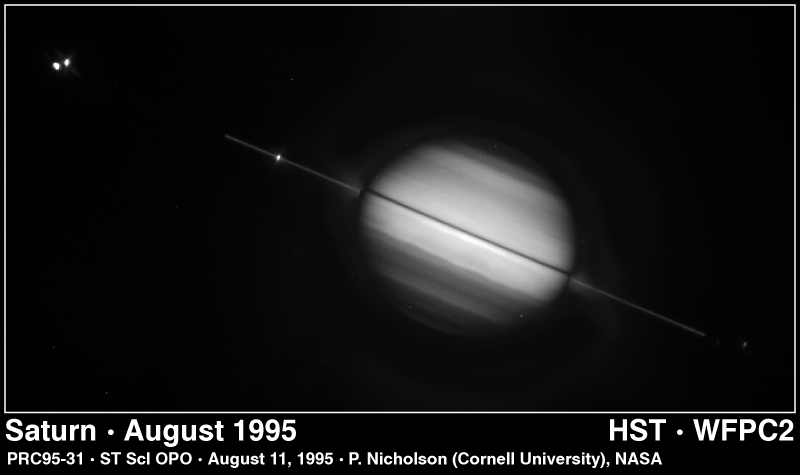
Saturn: jewel of the solar system, taker of breaths, ringed beauty. Even veteran astronomers can't help but gasp when they see her through a small telescope.

Red Alert: Saturn's rings are vanishing.

P. Nicholson- Cornell University
©NASA
Saturn August 11, 1995 as captured by P. Nicholson of Cornell University

Star

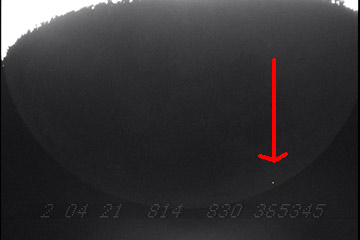
Lunar meteor impact on video

Go outside, look up at night, wait long enough, and zip! You'll see a tiny bit of rock burn up in our atmosphere: a meteor.

But other objects get hit too, including the Moon. It happens more rarely; the Moon presents a smaller cross-section to get hit, and its gravity is lower so it cannot draw in material as well as Earth. But hit it does get, and if you watch long enough you'll see one.

George Varros
©George Varros

Comment: For the past five years, SOTT has been following the news for evidence of fireballs and meteors. Read the SOTT blog for up to date news on the droplets that are beginning to turn to rain.

For more information on the prospect of planetary impact read Laura Knight-Jadczyk's original article, "Something Wicked This Way Comes" and her new series of Comet articles.


Better Earth

Damage Control? Keeping the Earth Asteroid-Free Takes Science, Soft Touch

Ex-astronaut Rusty Schweickart wants to save the world from an incoming asteroid -- the multimegaton variety blamed for killing the dinosaurs -- and he thinks that the only sure-fire way to keep them away is by using, of all things, diplomacy.

Mr. Schweickart was on the Apollo 9 mission that circled the earth testing the lunar lander, and had a successful post-NASA career in business. Now 72, he is spending his retirement trying to alert the world to the problem of Near Earth Objects, or NEOs.

Comment:
Because asteroids have these sorts of easily imagined happy endings, it's a more pleasant apocalypse to contemplate than, say, global warming, for which there is no such easy solution.

Deadly asteroids also have something else going for them: They can be dealt with for a relatively small amount of money. [...]Such a tracking program would likely give us a warning time of decades ahead of any possible collision.
While the above paragraphs attempt to make the issue of asteroid collision sound like an easy to deal with situation, consider this scenario, from The Cosmic Winter, by Victor Clube and Bill Napier, as is presented in the SOTT editorial The Hope.


Display

Satellite image reveals new crater


hickman crater
©2008 Digital Globe
Hickman Crater

Next time you're virtually roaming Google Earth, make sure you take a close look at any unusual landforms.

Geologist Arthur Hickman did just that, and is now the proud parent of the Hickman Crater, a meteorite crater in the Hamersley Ranges.

Telescope

Two college students find asteroid

Fort Worth, Texas -- Two Texas college students discovered an asteroid while examining images of space on a computer, a report said.

Tarrant County College students Ryan Gallagher and Robbyn Kindle, 40, were recommended by their former physics professor, Raymond Benge, to be part of an international program to examine images of space for asteroids, the Fort Worth (Texas) Star-Telegram reported.

Comment: It appears that it is not so rare for students to dscover asteroids:
More students find asteroids
US: High School Students Discover Asteroid
Polish students discover two asteroids
Undergraduates Discover More than 1,300 Asteroids


Question

Reality Check: Do identical twins have identical DNA?


twins
©Leif Parsons
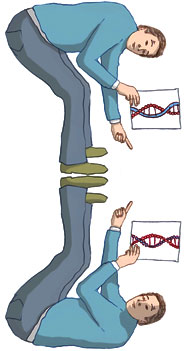
THE CLAIM: Identical twins have identical DNA.

THE FACTS: It is a basic tenet of human biology, taught in grade schools everywhere: Identical twins come from the same fertilized egg and, thus, share identical genetic profiles.

But according to new research, though identical twins share very similar genes, identical they are not. The discovery opens a new understanding of why two people who hail from the same embryo can differ in phenotype, as biologists refer to a person's physical manifestation.

Arrow Down

Flashback June: Wear a hard hat this month - Look out, look out, there are meteorites about

You probably didn't realise it, but June is quite a dangerous month. Statistically, more meteorites fall in June than at any other time of the year - and 30 June is a particularly hazardous day. Since records began, 116 meteorites have plunged to Earth in June - their high season - compared with only 57 in March - their low season. At least 17 people are said to have been killed by meteorite impact.

Meteorites are pieces of rock - usually stone, sometimes metal and, occasionally, a mixture of both - which find their way to Earth from the asteroid belt, Mars, the Moon and, possibly, a few comets. They typically weigh a couple of kilograms (though this can vary tremendously) and strike the Earth with velocities usually in the range of 100 to 250 metres per second. The Middlesbrough meteorite, for example, which landed on 14 March 1881, had a terminal velocity of 126 metres per second and weighed about 1.6 kilograms. Fortunately, it did little damage but had anyone been unfortunate enough to get in its way they would not have lived to tell the tale.

Telescope

Novel Spots Found On Jupiter

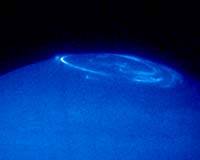
Scientists have observed unexpected luminous spots on Jupiter caused by its moon Io. Besides displaying the most spectacular volcanic activity in the solar system, Io causes auroras on its mother planet that are similar to the Northern Lights on Earth. The auroral emissions linked to the volcanic moon are called the Io footprint.

northern pole of Jupiter
©LPAP/Universite de Liege
Hubble Space Telescope ultraviolet image of the northern pole of Jupiter. Among many other auroral structures, the Io footprint is the most equator-ward feature close to the centre of the image. This spot is always located close to the feet of the magnetic field lines connected to the satellite Io.