Science & TechnologyS


Cloud Lightning

Mohenjo-Daro glassified by electricity?

Some have suggested ancient technology glassified these Indus Valley ruins but electricity is a more plausible explanation.

Mesopotamia and the Fertile Crescent region are thought to be the "birthplace" of civilization and the central focus for human culture dating back to the beginning of recorded history. No one knows for sure just how old the generalized composite that we call "society" really is - both because of archeological deficiencies and because of radiometric disconformity - but one of the oldest sites is located in the Indus Valley of Pakistan and appears to date from around 3000-2500 BCE.

Mohenjo-Daro
©Arvind Garg
The ruins of Mohenjo-Daro in the Sindh province of Pakistan.

Telescope

A Stellar Explosion You Could See on Earth!

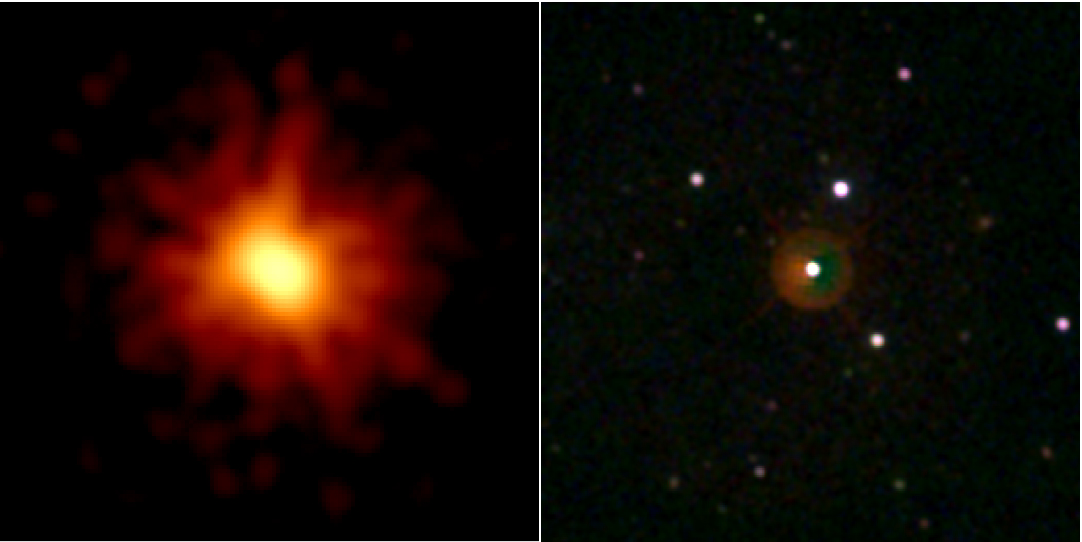
WASHINGTON - A powerful stellar explosion detected March 19 by NASA's Swift satellite has shattered the record for the most distant object that could be seen with the naked eye.

The explosion was a gamma ray burst. Most gamma ray bursts occur when massive stars run out of nuclear fuel. Their cores collapse to form black holes or neutron stars, releasing an intense burst of high-energy gamma rays and ejecting particle jets that rip through space at nearly the speed of light like turbocharged cosmic blowtorches. When the jets plow into surrounding interstellar clouds, they heat the gas, often generating bright afterglows. Gamma ray bursts are the most luminous explosions in the universe since the big bang.

Gamma ray burst
©NASA/Swift/Stefan Immler, et al.
The extremely luminous afterglow of GRB 080319B was imaged by Swift's X-ray Telescope (left) and Optical/Ultraviolet Telescope (right). This was by far the brightest gamma-ray burst afterglow ever seen.

Comment: "Most gamma ray bursts occur when massive stars run out of nuclear fuel. Their cores collapse to form black holes or neutron stars."

This is according to standard astronomy. There is another school of thought, which is winning increasing popularity and which does explain many astronomical phenomena. It is the proponents of the "Electric Universe".

See: Big Bang Cosmology: Going Down a Black Hole?


People

Genetic Study Unlocks Latin American Past

European colonisation of South America resulted in a dramatic shift from a native American population to a largely mixed one, a genetic study has shown.

Rio de Janeiro
©AP
The arrival of Europeans changed more than just the landscape

Display

Giant marine life found in Antarctica

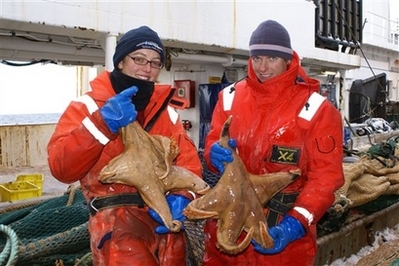
WELLINGTON, New Zealand - Scientists who conducted the most comprehensive survey to date of New Zealand's Antarctic waters were surprised by the size of some specimens found, including jellyfish with 12-foot tentacles and 2-foot-wide starfish.

A 2,000-mile journey through the Ross Sea that ended Thursday has also potentially turned up several new species, including as many as eight new mollusks.

Giant starfish
©(AP Photo/NZ IPY-CAML, John Mitchell)
In this undated photo supplied by the National Institute of Water and Atmospheric Research, or NIWA, Benthic team members Sadie Mills, left, NIWA curatorial technician and Niki Davey, NIWA marine ecologist hold giant Macroptychaster sea star (starfish) measuring up to 60 cm across in Antarctic waters. Scientists found that some marine life doesn't come small in Antarctic waters, with giant-sized specimens surprising researchers during a survey of New Zealand's Antarctic seas that ended this week.

Calculator

Flashback Money: It's More Than An Incentive According To University Of Minnesota Researcher

ScienceDaily (Nov. 17, 2006) - Why are some people more self-sufficient than others? Why are some people more willing to volunteer or help out than others? What makes some people seem stand-offish, while others move right in and help?
Research conducted by Kathleen Vohs, assistant professor of marketing at the Carlson School of Management, University of Minnesota, demonstrates that money -- more specifically, people's exposure to the concept of money -- can start to answer these questions. The research is published in the Nov. 17 issue of Science.

Comment: Bottom line: capitalism makes people less altruistic. Why are we not surprised?


Bulb

First study hints at insights to come from genes unique to humans

Among the approximately 23,000 genes found in human DNA, scientists currently estimate that there may be as few as 50 to 100 that have no counterparts in other species. Expand that comparison to include the primate family known as hominoids, and there may be several hundred unique genes.

Despite the distinctive contributions these genes likely make to our species, little is known about the roles they play. Now scientists at Washington University School of Medicine in St. Louis have produced the first detailed analysis of the cellular functions of a hominoid-only gene, TBC1D3. They affirmed earlier evidence linking the gene to cancer, showing that TBC1D3's protein can keep cellular growth factors active and helps turn on RAS, a protein that is active in a third of all human cancers.

Heart

Fossil sheds light on the history of sex

A long, thin rope-like creature standing erect on the sea floor up to 570 million years ago has been identified as the first animal on Earth to have had sex.

Funisia
©Unknown
Sex for the creature would have been "functional rather than a social affair"

Magic Hat

Boomerang returns, even in space

In an unprecedented experiment, a Japanese astronaut has thrown a boomerang in space and confirmed it flies back, much like on Earth.

Telescope

Scientists discover signs of ancient life on Mars

For the first time, satellite imagery reveals thick Martian salt deposits scattered across the planet's southern surface, which one planetary scientist claims could be sites of ancient life.

The mats of sodium chloride - the same taste-enhancing mineral found on your kitchen table - serve as more evidence of Mars' watery past, and researchers think the briney pools that made them could have been hospitable to life.

Info

New Strategy To Prevent Genetically Altered Rice From Uncontrolled Spreading

A method of creating selective terminable transgenic rice was reported by the scientists of Zhejiang University. Unintended spreading of transgenic rice by pollen and seed dispersal is a major concern for planting transgenic rice, especially transgenic rice expressing pharmaceutical or industrial proteins.

transgenic rice
©Chaoyang Lin et al. PLoS
Field trial for selective termination of the transgenic rice. The transgenic plants and the conventional control rice plants were sprayed with Bentazon. The picture was taken 7 days after the spray. The surviving plants were rice plants not carrying the transgene.