
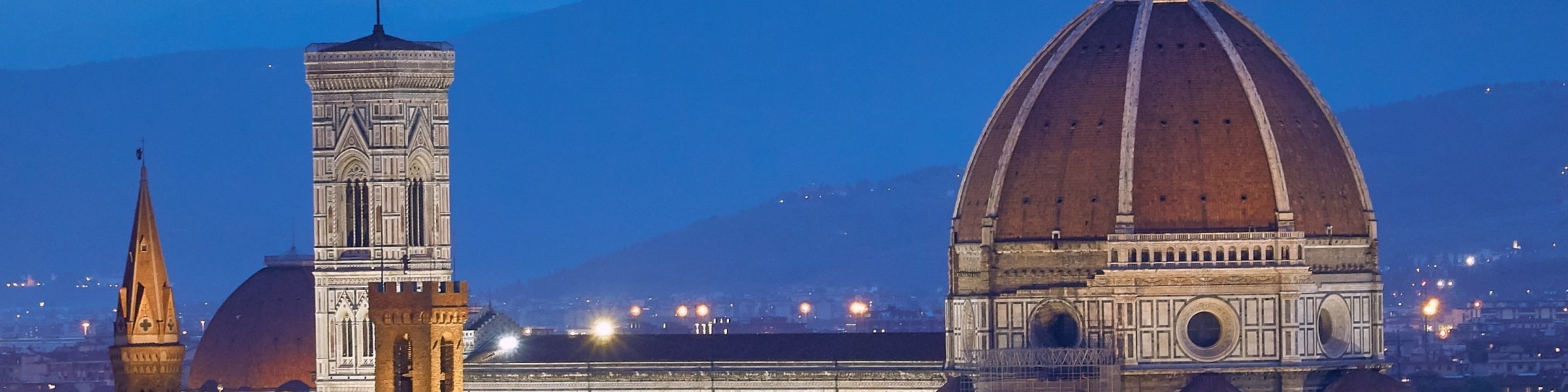
© Mark Boss on UnsplashSanta Maria del Fiore in Florence, Italy, a World Heritage site, is the largest masonry dome standing today. Through computational methods, researchers from Princeton and the University of Bergamo have mathematically proven the structural physics at work in domes of this type.
The construction of the Florentine duomo by Filippo Brunelleschi has been an engineering marvel for more than 500 years, showcasing ancient techniques that still hold valuable insights for modern engineering. Until now, it has remained a mystery how the master goldsmith and sculptor managed to build the masterpiece that pushes the limits of what is possible to construct even with modern building technologies, and how the masters who followed Brunelleschi carried on the tradition.
In a collaborative study in the July 2020 issue of Engineering Structures, researchers at Princeton University and the University of Bergamo revealed the engineering techniques behind self-supporting masonry domes inherent to the Italian renaissance. Researchers analyzed how cupolas like the famous duomo, part of the Cathedral of Santa Maria del Fiore in Florence, were built as self-supporting, without the use of shoring or forms typically required.
"Nothing is more moving," said Attilio Pizzigoni, co-author of the study, "than reading the lightness of the heavens in stone, in an absolute and simple form such as that of the Florentine cupola."
Sigrid Adriaenssens, professor of civil and environmental engineering at Princeton, collaborated on the analysis with graduate student Vittorio Paris and Pizzigoni, professor engineering and applied sciences, both of the University of Bergamo. Their study is the first to quantitatively prove the physics at work in Italian renaissance domes and to explain the forces that allow such structures to have been built without formwork typically required, even for modern construction. Previously, there were only hypotheses in the field about how forces flowed through such edifices, and it was unknown how they were built without the use of temporary structures to hold them up during construction.
For Adriaenssens, the project advances two significant questions. "How can mankind construct such a large and beautiful structure without any formwork — mechanically, what's the innovation?" she asked. Secondly, "What can we learn?" Is there some "forgotten technology that we can use today?"
The detailed computer analysis accounts for the forces at work down to the individual brick, explaining how equilibrium is leveraged. The technique called discrete element modeling (DEM) analyzed the structure at several layers and stages of construction. A limit state analysis determined the overall equilibrium state, or stability, of the completed structure. Not only do these tests verify the mechanics of the structures, but they also make it possible to recreate the techniques for modern construction.
The researchers said the results could be especially useful in cases where remote construction, by drone for example, could be done with minimal temporary supports.
"With these studies," said Pizzigoni, "we aim to approach moments in history when the sole form of technology available to man was the abstract rationality of geometry. [...] What we as designers, architects and builders can learn from the past is the knowledge of a structural equilibrium of form based on the geometry of materials and of their reciprocal measurements in three-dimensional space."
Verifying the physics of the dome
The specific structure that the team studied was Santa Maria, in Ciel d'Oro, of Montefiascone, Italy. The crux of their analysis rests on the geometrical pattern of bricks used throughout the interior dome, which appears to be the lynchpin vital in making the structure self-supporting. The bricks form a herringbone, a V-shaped pattern, between the horizontal field bricks and vertical bricks at the beginning and end of the horizontal rows. The arrangement creates lines of staggered vertical bricks that extend diagonally across the curvature of the dome.
The arrangement produced is a complex cross-herringbone spiraling pattern. One herringbone from both the left and right angles repeatedly cross each other, providing stability for the interior bricks and maintaining the dome's curvature. The researchers' analysis showed essentially that this is a double-helix of support that distributes and equalizes weight and thrust within the structure. This system of cross-herringbone veins is known as a double loxodrome.
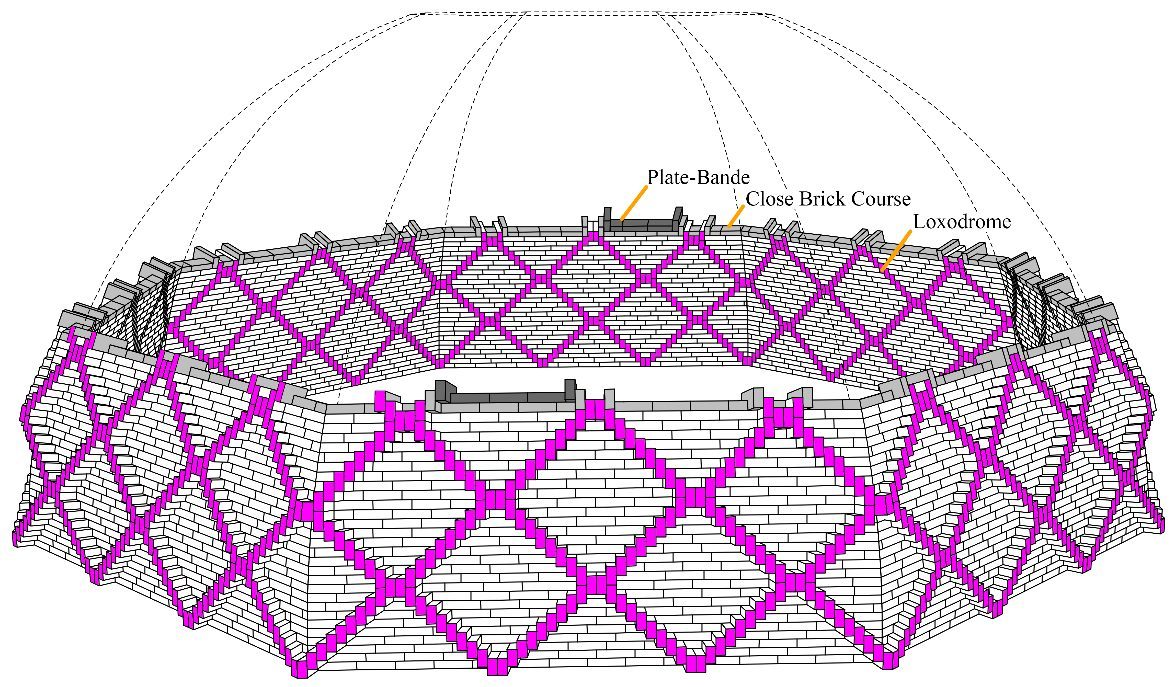
The double loxodrome is comprised of rows of vertical bricks that crisscross around the dome and are filled in by horizontal bricks. Effectively, each course of bricks creates a structural element known as a plate-bande that wedges interior bricks between the vertical end caps.
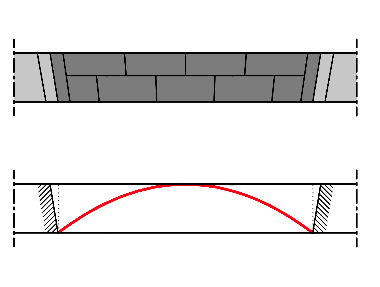
© Chala Hadimi, courtesy of Aga Khan Documentation Center, MIT Libraries (AKDC@MIT)The plate-bande is the integral element that distributes force throughout the dome, maintaining the shape and stability of the structure. Image: courtesy of the researchers.
While the physics of the structure are no longer grounds for considerable debate after this computational verification, the historical origins of the herringbone technique remain unexplained. Since Brunelleschi did not leave behind drawings or construction notes, some researchers attribute the technique to an influence from Arab and Byzantine domes. For example, the Friday Mosque (Masijid-i Jami') of Ardestan in Isfahan, Iran, was built with the technique circa 1088 C.E., a century before the construction of the Santa Maria del Fiore's dome in Florence.
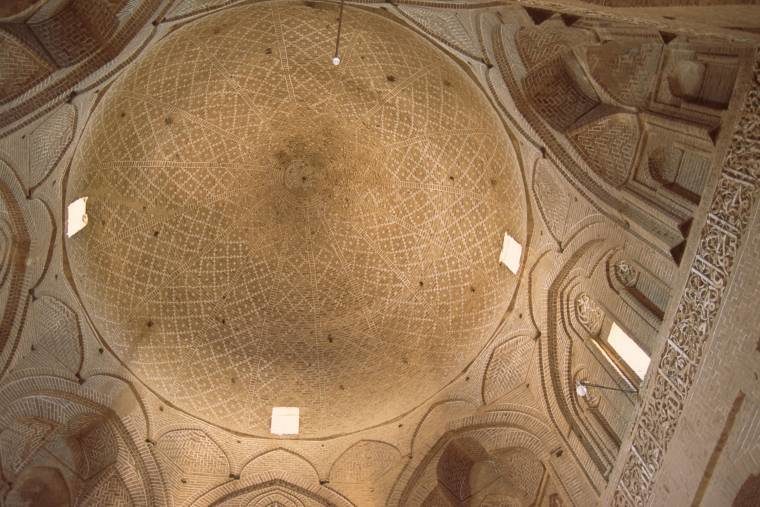
© Chala Hadimi, courtesy of Aga Khan Documentation Center, MIT Libraries (AKDC@MIT)The Ardestan Friday Mosque in Isfahan, Iran built circa 1088C.E. exhibits the double loxodrome technique.
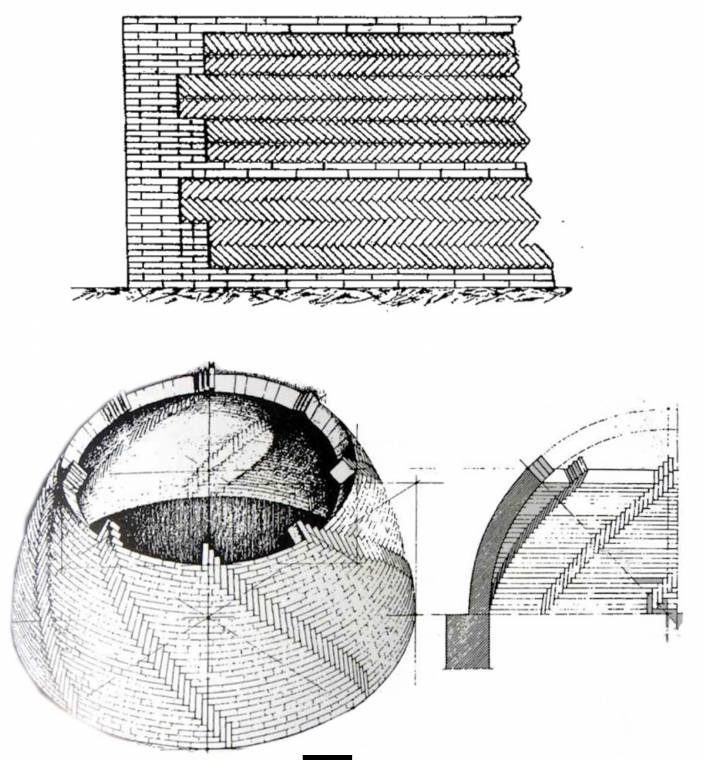
An ancient Roman technique used in walls and hearths called opus spicatum, resembles the single loxodrome used by Brunelleschi in the Florentine duomo. Images: Opus spicatum, drawing of C. G. de Montauzan. Revolution dome and herringbone spiralling pattern, drawing of F. C. Gurrieri.
Since the double loxodrome technique was used after Brunelleschi by the Sangallo masters throughout Italy, including in St. Peter's Basilica in the Vatican, this suggests to researchers that the Sangallo domes were an evolution on Brunelleschi's original single loxodrome structure. The Sangallo architects went on to build many double loxodrome domes across Italy during the renaissance. What remains unknown is why the method was not used after the 16th century, said Paris.
Comment: It's worth noting that the period that followed included events like the Black Death, the Little Ice Age, and the witch trials - to name but a few.
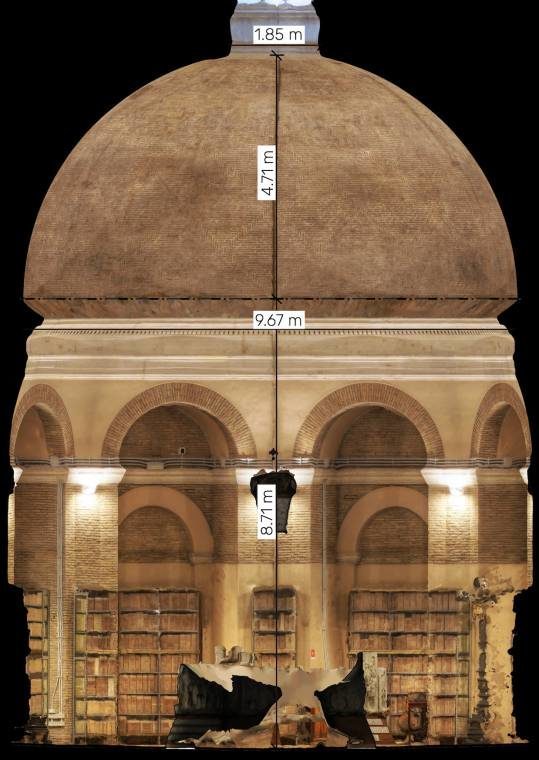
© courtesy the researchers in collaboration with Lab-SABE, University of Bergamo.St. Peter's Basilica in Rome, built by the Sangallo masters and consecrated in 1626, exhibits the double loxodrome technique.
Another advantage of unearthing new building techniques from ancient sources is that it can yield environmental benefits. "The construction industry is one of the most wasteful ones, so that means if we don't change anything, there will be a lot more construction waste," said Adriaenssens, who is interested in using drone techniques for building very large span roofs that are self-supporting and require no shoring or formwork.
"Overall, this project speaks to an ancient narrative that tells of stones finding their equilibrium in the wonder of reason," said Pizzigoni, "from Brunelleschi's dome to the mechanical arms of modern-day robotics where technology is performative of spaces and its social use."
Support for this research was provided by the University of Bergamo, and the Princeton University International Fund at the Office for International Affairs and Operations at Princeton University. Software 3DEC was provided by Itasca C.G. under the Education Partnership Program.





People lie in order to cheat, defraud, even to start wars -- but they would never ever lie about history, right?