
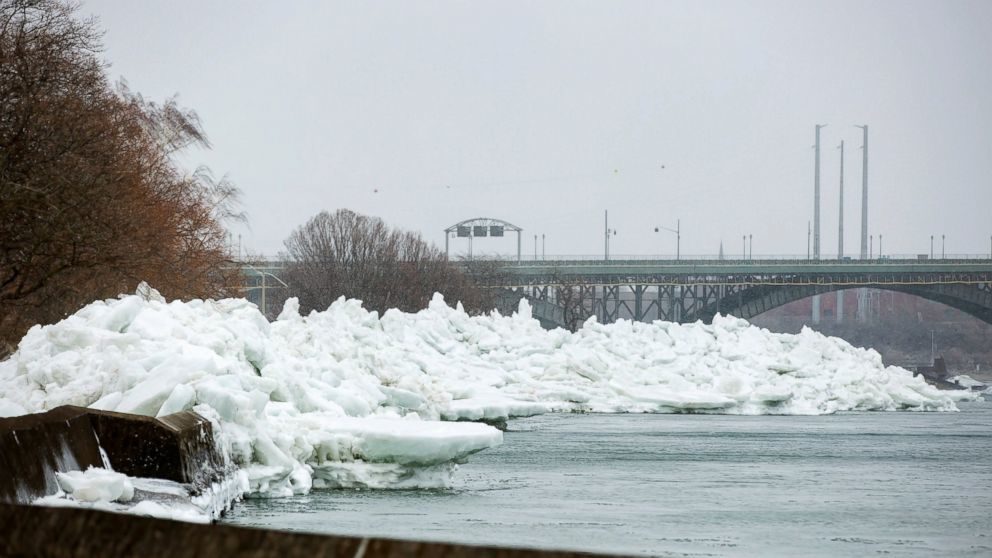
© Tara Walton/The Canadian Press via APA massive build up of ice is seen after being pushed onto the shore of Mather Park, near the Peace Bridge in Fort Erie, Ont., Monday, Feb. 25, 2019. A windstorm Sunday broke an ice boom in Lake Erie and allowed the ice, which was floating on the water at the mouth of the Niagara River, to spill over the retaining wall and onto the shore and the roadway above.
At midday, nearly 80 million people were under high-wind warnings or advisories across parts of 14 states, according to the National Weather Service. At least 1,200 flights were canceled Monday, according to FlightAware.
Wind gusts of up to 81 mph were reported from the storm, toppling trees and power lines. Giant chunks of ice spilled over the banks of the Niagara River across from Buffalo on Sunday, creating bizarre, 30-foot-tall ice mounds. At one point early Monday, 650,000 were without power.
The storm was the same system that earlier had brought snow to Los Angeles and Las Vegas, record snow to Flagstaff, Arizona, a blizzard and bitter cold to the upper Midwest and floods and deadly tornadoes in the South. It is called a bomb cyclone because it rapidly intensified after a dramatic drop in atmospheric pressure.
Over the weekend, a woman was killed when a tornado hit Mississippi, and a man died when he drove into floodwaters in Tennessee, officials said.
Knoxville was among the hardest hit cities in Tennessee when a record-setting amount of rain and devastating floods swamped the state. "There were no areas of Knoxville that weren't affected," Knox County Commissioner Larsen Jay said.

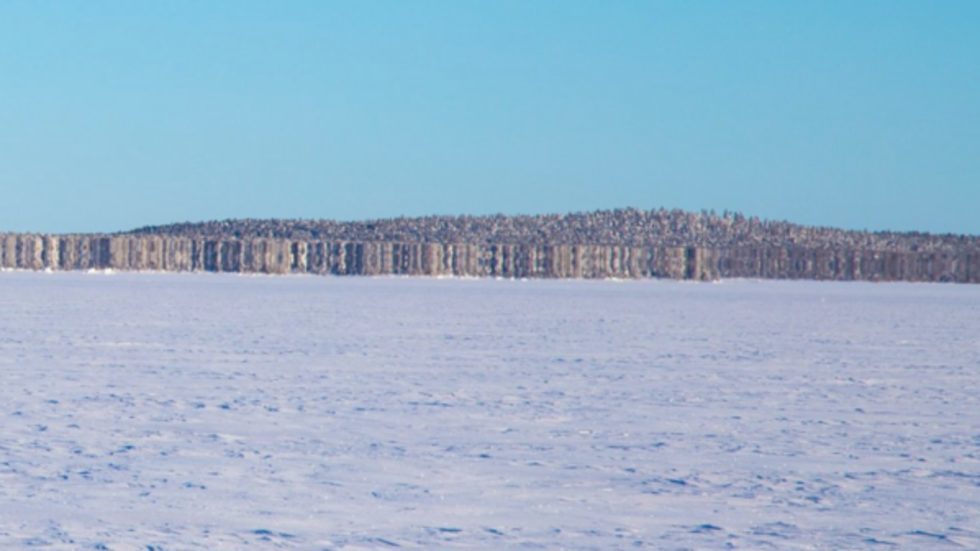









Comment: According to Wiki it seems mirages in the Arctic may be more common than we think: The National Snow and Ice Data Center details how these mirages are formed in the Arctic: Although the Finnish coast guard could be forgiven for assuming it was either a mirage or a new island, because nearly every day unusual events are being documented that confirm our planets changing atmosphere, and its geography. But we can't say for sure whether or not this mirage is typical for the region or reflective of these new conditions: