Puppet MastersS


Arrow Down

A Requiem For Privacy

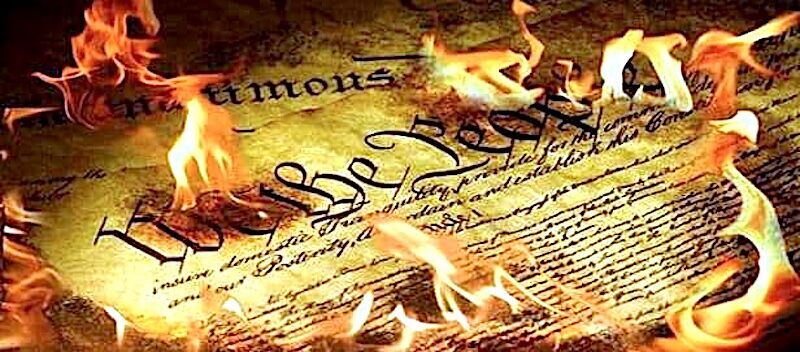
US Constitution on fire
© UnknownUS Constitution in flames
When President Donald Trump appointed an obviously unqualified friend, a home builder executive, to be acting director of national intelligence, he inadvertently triggered attention to Section 702 of the Foreign Intelligence Surveillance Act. The director of national intelligence is the head of the umbrella agency that gathers intelligence from the 17 federal spying agencies and from that data prepares and delivers the president's daily briefing. Sec. 702, which permits warrantless spying, expires this month.

Trump prefers to receive his briefings directly from the CIA and its foreign colleagues, leaving the DNI as an appendage with little to do. Nevertheless, the DNI employs hundreds of spies and analysts, and most of them have national security clearances that permit them to view the nation's most closely guarded secrets and to invade anyone's privacy.

Section 702 of FISA theoretically permits federal agents to spy without warrants or suspicion on foreign persons. In reality, it is used as a fig leaf to spy on Americans.

A few years ago, Department of Justice lawyers persuaded the FISA court secretly to permit the National Security Agency — America's domestic spies — to spy on Americans with whom foreign persons communicate; even suspicionless Americans whose communications with foreigners are benign; even Americans removed by six degrees from conversations with foreigners.

Star of David

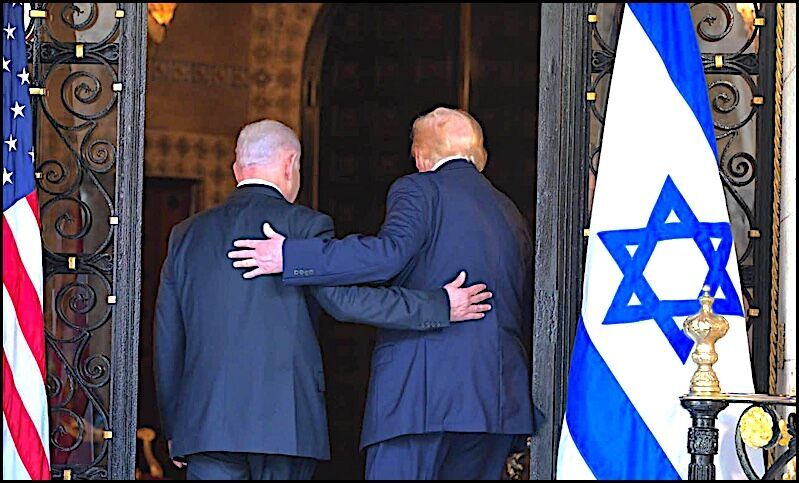
Israel is tearing down the American order that once protected it

Neti and Donald
© Israeli Prime Minister’s Office/APA ImagesIsraeli PM Benjamin Netanyahu • U.S. President Donald Trump • Mar-a-Lago • Palm Beach, Florida • December 29, 2025
The American order that gave Israel stability now constrains Israel's expansion. In response, Israel is dismantling U.S. hegemony in the region, turning allies Turkey and Egypt into enemies, and working to end the U.S.'s ability to restrain.

"Fifteen years from now, Israel will have a war with Egypt."

The words belong to Amiad Cohen, delivered last Sunday at the second annual International Policy Summit of the Jewish News Syndicate (JNS). Cohen is the CEO of Herut — the Center for Israeli Liberty, a nationalist-conservative think tank whose intellectual infrastructure runs through the settler movement, the religious Zionist right, and the Tikvah Fund network that has, over the past two decades, done more than any comparable institution to give Israel's expansionist right a coherent ideological vocabulary.

His reasoning at the summit was precise and 'deserves to be followed in full':
The Muslim Brotherhood, he argued, is steadily expanding its influence inside the United States, corroding the political foundations that sustain the American-Israeli alliance; it could eventually return to power in Egypt, at which point the 1979 Camp David peace treaty becomes a dead letter, and war follows.
With the "Shia jihad " weakened by the Iran war, he warned, a rising "Sunni jihad " anchored by Turkey and future Islamist-aligned Egypt would constitute Israel's next existential challenge. Israeli leaders must begin preparing now, he urged.

At the same event, Cohen called for Israel to "diversify our alliances if we want to act as an independent nation," because America, in his telling, is growing weaker and cannot be assumed to remain a reliable anchor.

Gavel

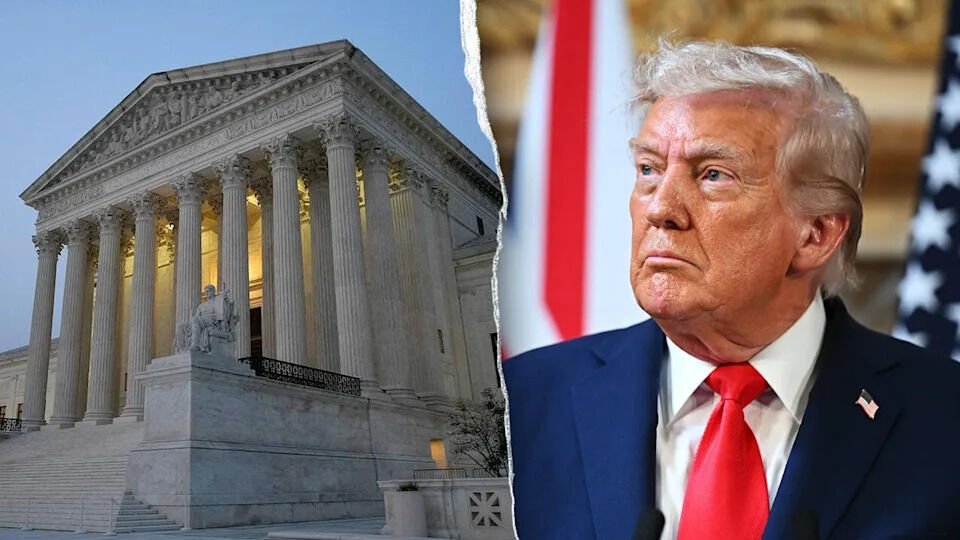
Supreme Court sides with Trump administration in green card holders case

trump supreme court composite
The Supreme Court sided with the Trump administration Tuesday in an immigration case dealing with the government's power over green card holders accused of crimes.

The 6-3 decision centers on an immigration officers' 2012 decision to put lawful permanent resident Muk Choi Lau on immigration parole when he returned from a short trip to China because he had been accused of a counterfeiting crime.

Lau argued that the officer overstepped their authority, and the decision wrongly allowed the Department of Homeland Security under then-President Barack Obama an easier path to removal after he pleaded guilty to selling counterfeit clothes in New Jersey.

The high court disagreed. "Border officers did not have the burden to establish by clear and convincing evidence that Lau had committed a crime involving moral turpitude," Justice Clarence Thomas wrote in the opinion.

Comment: Epoch Times adds:
Justice Samuel Alito wrote the majority opinion, which said the sole constitutional argument in the case would likely fail.
"Citing statements made by President Trump and former Secretary of Homeland Security Kristi Noem, one set of respondents advances an equal protection claim that Haiti's TPS [Temporary Protected Status] designation was terminated because of the racial makeup of that country's population," Alito wrote.

"But, ironically, one of respondents' other arguments undermines the equal protection claim by offering a strong, race-neutral explanation for Haiti's termination: namely, that the current administration, which has terminated every TPS designation that has come up for renewal, simply opposes the TPS program, at least as it has been implemented in the past."
During oral argument in April, the Justice Department argued that lower court judges had exceeded their authority in blocking DHS's decisions to terminate protected status for those groups.

Some of the arguments focused on a portion of the Immigration and Nationality Act that says,
"There is no judicial review of any determination of the [DHS Secretary] with respect to the designation, or termination or extension of a designation, of a foreign state under this subsection."
The decision is expected to impact thousands of Haitians and Syrians who received temporary protected status.
The Haitians received 'temporary protected status' fifteen years ago.

Trump admin ends temporary protected status for Haitian migrants currently in the US


Attention

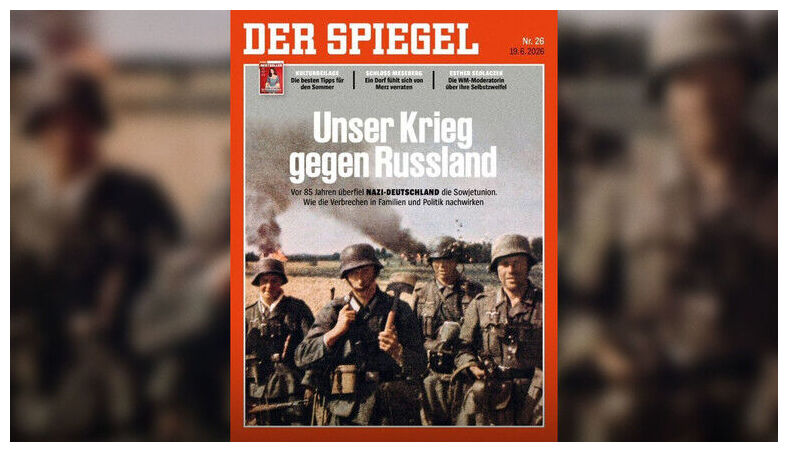
'Our War Against Russia': Germany is re-normalizing the unthinkable

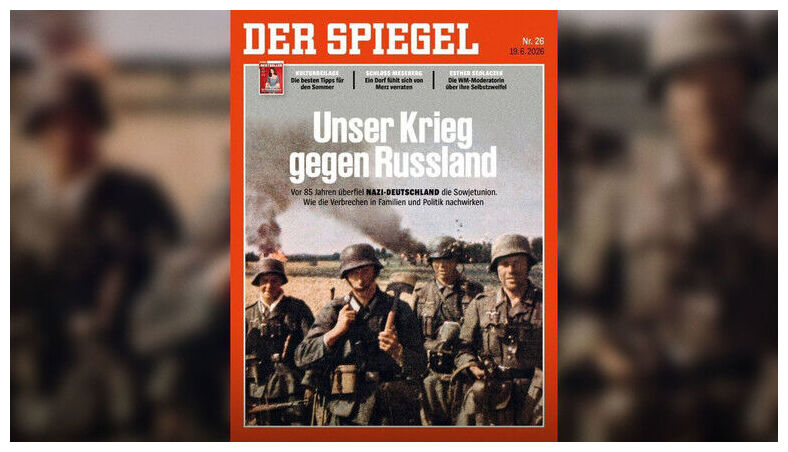
Spiegel's Barbarossa cover is beyond bad framing - it reflects a country where war is being made to seem conceivable again.
Der Spiegel
© Der Spiegel
For the anniversary of Operation Barbarossa, the German name for the attack on the Soviet Union of 22 June 1941, Germany's declining yet still dominant mainstream news magazine Der Spiegel has dedicated a long title story and a sensationalist cover to Berlin's last open war in, as the Germans used to say back then, the East. So far, so expected. There is no doubt, after all, that this was a historic as well as horrific event.

Launching their surprise attack with millions of troops and the explicit intention to wage a war of extermination, those Germans of yore, sought to build a 'lebensraum' empire from hell, based on multiple deliberate genocides (including one of Soviet POWs), warfare with all legal or moral restraints systematically removed, and a supremacist ideology that would have designated anyone surviving among the conquered as a slave of inferior, if any, humanity.

Moreover, if those Germans, who attacked 85 years ago, had won in 'the East', their form of genocidal fascism - officially termed National Socialism - would have had a realistic chance to survive and even maintain domination in large parts of Eurasia (at least). For the preponderant majority of German forces were destroyed by the Soviet military. If that had not happened, we might all have ended up living in a very different, even worse world now.

The stakes were as high as they could possibly be not just for Europe but humanity as a whole. That is why the defeat of Germany's Operation Barbarossa belongs to the most important facts of global history. The Germans were not stopped by a combination of vile weather, muddy roads, and silly mistakes of their own, as some may still want to believe in blissful ignorance and with more than a hint of racist arrogance. What killed the fascist German bid for world power was the Soviet Union, the leadership of its generals, who after initial setbacks, rapidly learned to out-think and out-plan the Germans, the supreme valor of its soldiers, and the unimaginable grit as well as organization of its home front.

But the price was steep. Especially as Berlin had made a decision to fight a war of extermination, Soviet losses were terrible. 27 million killed (soldiers and civilians) and a corresponding storm of massive economic devastation, social dislocation, and mass trauma, physical and psychological.

Attention

Peace will be won on the battlefield

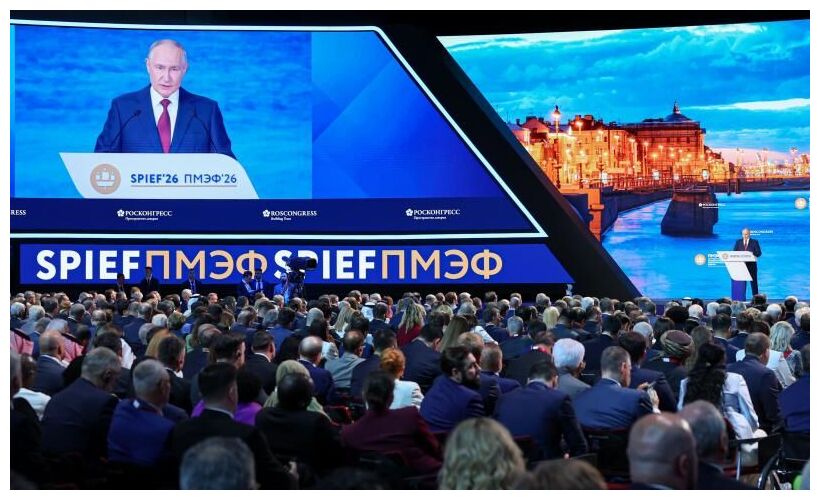
At SPIEF 2026, Putin ignored Ukrainian provocations to celebrate Russia's prosperity before stating bluntly that peace would be won on the battlefield, not at the negotiating table.
SPIEF 2026
© Forum Geopitica
There has been much discussion in western circles about the need for, and prospects of, a diplomatic resolution to the conflict in Ukraine. Much of this discussion is centered around the need to get Russia and Ukraine to sit at the same table so that meaningful negotiations can take place. Indeed, much of the western approach toward the conflict is focused on the need for Ukraine to escalate the conflict in a manner designed to confront Russia with the inevitability of a military stalemate, and as such the necessity of a negotiated settlement. Russian President Vladimir Putin's appearance at the Saint Petersburg International Economic Forum (SPIEF), however, appeared to pour cold water on any such possibility. Russia, according to President Putin, is ready and desirous for a negotiated settlement to the conflict with Ukraine, but only on terms acceptable to Russia. As such, the prospects for peace in the near term are non-existent, and the conditions for conflict termination with be defined on the battlefield, and not around a negotiating table.

In the weeks leading up to SPIEF 2026, there had been much talk in both western and Russian intellectual circles about a change in attitude among the Russian people regarding the ongoing conflict between Ukraine and Russia, which has entered its fifth year. One of the themes popular in the west was premised on the notion that Russia was becoming exhausted, physically and mentally, from a conflict for which there seemed to be no light at the end of the tunnel. Slow gains on the frontlines in Ukraine, often at significant human cost, combined with an increase in long-range Ukrainian drone attacks on strategic infrastructure in the Russian strategic depth, according to this narrative, was having a telling effect on a population for whom the previous unquestioned support for the Russian President was beginning to wane.

In Russia similar sentiments were echoed among conservative circles (there is no longer a viable liberal elite in Russia) whose support for the conflict remained steadfast, but for whom the pace and methodology of conflict lacked the kind of urgency and direction necessary to decisively defeat not just Ukraine, but a notional "collective West" (Europe, Nato, and the United States) whose material and financial assistance to Ukraine was seen as the decisive component in Ukraine's ability to keep fighting.

Stop

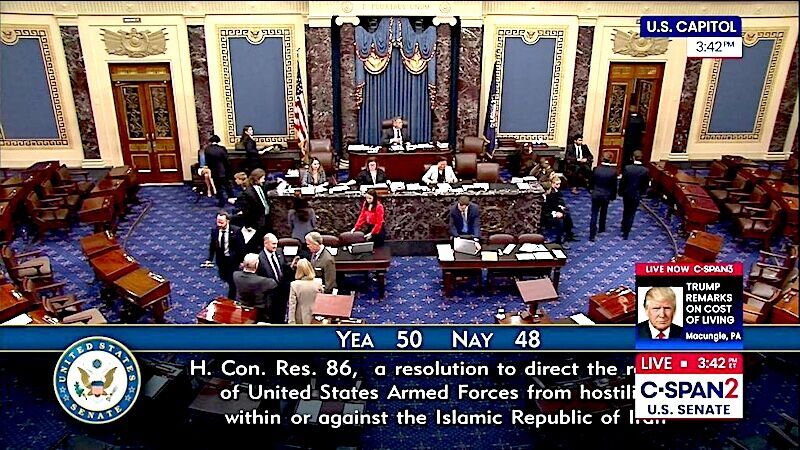
In historic first, Congress passes concurrent War Powers Resolution to end Iran war

US Senate vote
Screenshot of the Senate vote
The Senate on Tuesday approved a House-passed concurrent War Powers Resolution directing President Trump to end hostilities against Iran, marking the first time Congress has approved a concurrent resolution under the 1973 War Powers Act directing the termination of an unauthorized war.

In previous years, Congress has passed joint resolutions directing the president to end wars, such as the 2019 bill to end US support for the Saudi war in Yemen, which President Trump vetoed at the time, but a concurrent resolution doesn't require the president's signature.

Section 5(c) of the 1973 War Powers Act states:
"At any time that United States Armed Forces are engaged in hostilities outside the territory of the United States, its possessions and territories without a declaration of war or specific statutory authorization, such forces shall be removed by the President if the Congress so directs by concurrent resolution."
The bill passed the Senate on Tuesday by a 50-48 vote, with four Republicans — Senators Rand Paul (KY), Lisa Murkowski (AK), Susan Collins (ME), and Bill Cassidy (LA) — voting in favor. Senator Jon Fetterman (PA) was the only Democrat to oppose the effort, and Republican Senators Mitch McConnell (KY) and Dave McCormick (PA) were not present for the vote.

Comment: Regarding Israel, congressional resolution against war will be Trump's ace in his pocket.


Star of David

'Israel picking up the pieces of its deep-seated hubris'

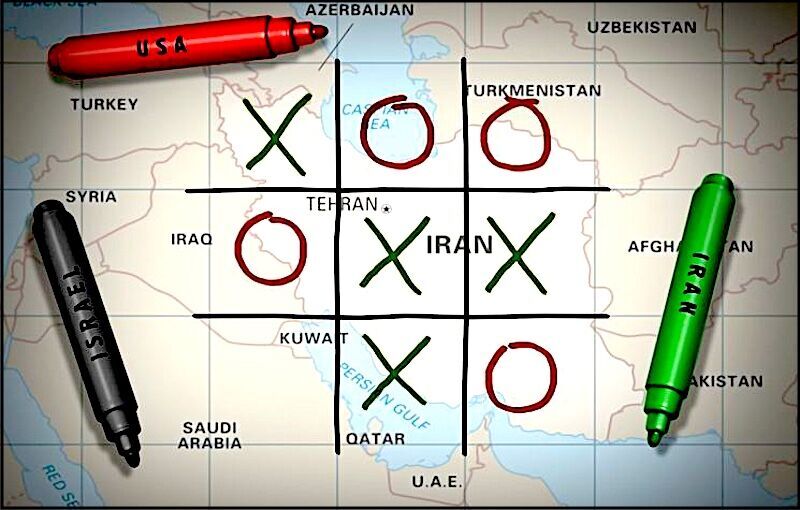
Tic-Tac-Toe US/IS/IR
© Public DomainWho Wins?
The Iran-U.S. de-escalation framework has been signed. As always, getting a framework agreed is one thing, but preserving it from disruptive actors or malicious distortion of the text is quite another. Who knows how long it will survive intact? The MoU nonetheless constitutes an important phase - albeit one leg - in a long journey ahead for Iran. The Agreement however, may also prompt wider geo-economic 'plate' shifts.

Iran has succeeded in pushing a reluctant Trump to cross the Rubicon. Danny Citrinowicz, a former senior Israeli Iran military intelligence analyst, says that for Trump, "achieving a deal with Iran and ending the current cycle of escalation is not merely an option but a clear strategic goal ... He now envisions a broader vision of U.S.-Iran relations".

An unquestioned dogma has bitten the dust:
"The long-standing expectation in parts of Jerusalem and Washington has been that sustained pressure could lead to regime change in Tehran ... [However] the announced agreement suggests a [new] fundamental reality: The campaign that many hoped would weaken or even destabilise the Islamic Republic will instead conclude with the regime intact, strengthened, and formally engaged by the U.S. ... [This] amounts to the collapse of a broader strategic assumption: that coordinated American and Israeli pressure could generate conditions conducive to fundamental political change inside Iran. Instead, the likely outcome is the opposite ... [it is] an outcome likely to reinforce confidence amongst [Iran's] ruling elite rather than weaken it ...".
This moment represents a major strategic achievement for Iran: A heroic image is surging across the globe - whereas Israel's isolation on the Iran issue, even amongst its Gulf allies, has spiked. On the personal level, Netanyahu's standing in Israel has plunged catastrophically.

Comment: Given the 'best laid plans of mice and men'...the mice are doing better.


Attention

CIA official confirms agency flip-flopped over COVID-19 origins over five-day period

CIA entrance
© Evelyn Hockstein/File/ReutersEntrance to the Central Intelligence Agency headquarters • McLean, VA • September 24, 2022
Over the span of five days in 2021, the CIA abruptly changed its opinion on the origins of COVID-19 from a laboratory to neutral, a newly released document confirms.

Originally, CIA analysts concluded that COVID-19 likely came from a high-level laboratory in Wuhan, China located near where the first cases were detected in late 2019, senior CIA officer James Erdman III told lawmakers in May. Over the span of five days in 2021, however, Edman says the agency changed its stance to 'neutral.'

Then in September of 2024 during a private briefing between intelligence officials and members of Congress, Rep. Brad Wenstrup (R-OH) inquired as to how the agency came to the conclusion that lab-origin vs. natural origin were about equal, according to yesterday's document release by outgoing DNI Tulsi Gabbard.

Attention

Why neo-Crassus desperately needs to cling to HIS deal

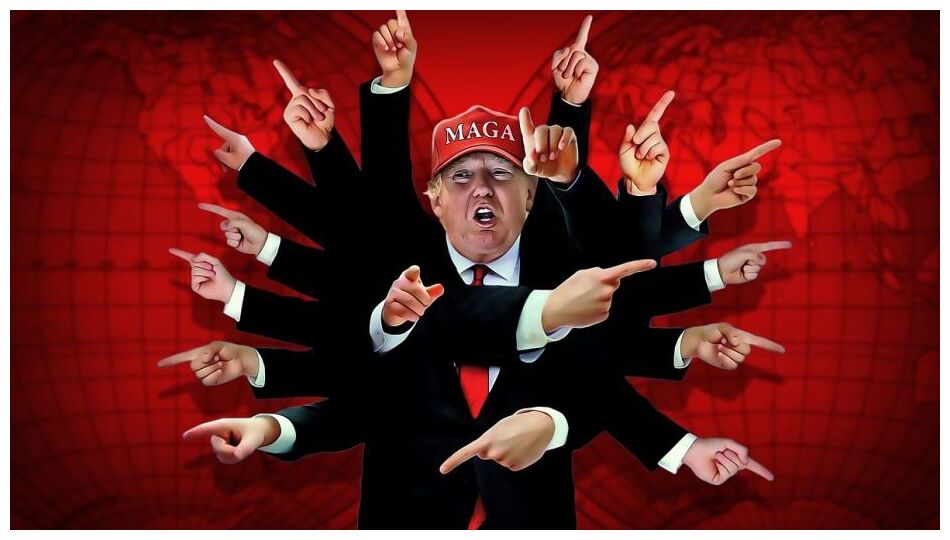
Trump MAGA
© Strategic Culture Foundation
On this dark street, the sun is black
The winter life is coming back
On this dark street, it's cold inside
There's no retreat from time that died


Cream, Deserted Cities of the Heart

One of my recent columns on How Iran engineered its multipolar breakthrough provoked some serious response by top old school U.S. Deep State intel operatives, now involved in global business. I was sent a consistent, detailed breakthrough about what they maintain is the main reason for President Trump to sign the Memorandum of Understanding (MoU) with Iran, which he is frantically spinning as his (italics mine) deal.

As one of these sources bluntly put it, "the main point you are missing is that Trump was scared stiff by June 15 being only 60 days away from the final emptying of the world reserve oil supplies, leading to the complete destruction of Donald J. Trump. That is the only reason for his about face. If he waited much longer, he would by August 15 be so behind the eight ball that he would not be able to recover And that may happen anyway."

The source was referring to a detailed risk assessment where the hard data points to mid-August 2026 as "the moment the U.S. must legally halt the emergency dumping. When that tap closes, the global oil supply deficit will instantly widen by millions of barrels per day, creating a world crisis."

Even tough he may be acting now, nothing is secured for Trump. The sources comment that "first, he (Republicans) would lose the first week in November elections. Then the Democrats would impeach him. And then he would be destroyed by lawsuits, losing all his money."

Way beyond the destiny awaiting the self-styled neo-Crassus, the sources mostly insist that "the 60-to-90-day runway we are currently sitting on is not just a timer on the physical oil in the ground; it is the remaining fuse on the largest credit bubble in human history."

Which bring us, once again, to the Rosebud in this Orson Welles-sized epic: the Strait of Hormuz, which for all practical purposes remains virtually closed.

The sources are careful to remind those willing to listen that
"what we have now is a rebellion at the Strait of Hormuz. 20% of global oil goes through there, and Iran wants that power to protect itself. When it is cut off the price of oil according to Goldman Sachs will go to $700 a barrel. It does not today as the U.S. and allies are dumping their storage on the market to hold the price down. They have about 2.5 months supply to do this. Then everything explodes. You have here the rebellion of the slaves."
So welcome to the current ultra high-stakes structural chess match - of course totally gamed by Tehran right before the start.

Heart - Black

The end of the Polish-Ukrainian love story

Zelensky with Polish President Karol Nawrocki
Behind Poland and Ukraine's symbolic feud lies a brutal fight over EU cash, borders, and regional dominance.

At the heart of Polish historical literature, brilliantly adapted for the screen by film director Andrzej Wajda, is a timeless, almost archetypal Slavic narrative. Take Adam Mickiewicz's poem, 'Pan Tadeusz', or Aleksander Fredro's comedy, 'The Revenge'. In both cases, we see two noble clans trapped in a shared space - whether within a city or castle walls - selflessly and relentlessly destroying each other over long-held historical grievances, ambitions, and boundary disputes, while the entire 'security architecture' around them crumbles.

The stories have different endings, but the historical circumstances are similar, which undoubtedly provides grounds for reflection on the complex fate of the Polish people. Comparing the recent 'war of the orders' between Warsaw and Kiev with the above-mentioned historical narratives, it becomes clear that June 2026 will go down in the history of Polish-Ukrainian relations and diplomacy as the political version of a scene from an old Polish comedy about squabbling neighbors. However, this incident demonstrates several important aspects that define Poland's current condition and foreign policy which are worth reflecting on.

On June 19, Polish President Karol Nawrocki decided to strip Ukraine's Vladimir Zelensky of the Order of the White Eagle because a Ukrainian unit was named after the Ukrainian Insurgent Army (UIA). He also stated that Poland would not allow those who do not understand the need to renounce the "cult of totalitarianism and violence" to join the EU.

What the Ukrainian Insurgent Army was, and why Poland was offended by it?

Comment: See also Poland, Slovakia, Hungary Defy EU By Keeping Bans On Ukraine Imports