Science & TechnologyS


Info

New Deep-Sea Cables Needed to Protect Global Economy

Deep Sea Cables
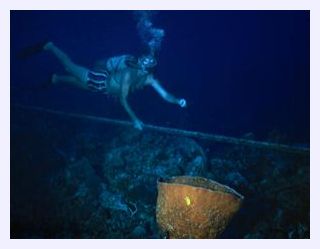
© Luis Marden/GettyLaying down the line.
URGENT action is needed to diversify the global deep-sea cable networks on which the internet depends, to secure them against attacks and accidents that could lead to economic turmoil.

So says a report that highlights the vulnerability of businesses worldwide to the targeting of "choke points" in subsea communications networks by saboteurs, pirates and thieves.

International internet and telephone links are almost entirely dependent on bundles of fibre-optic cables that span the oceans. "More than 99 per cent of intercontinental data traffic goes via submarine cable rather than satellite," says Alan Mauldin, an analyst at Telegeography Research, a New York-based market research firm. "People don't realise the vast role cables play."

It's time they did, says Karl Rauscher, the former Bell Labs engineer who compiled the Institute of Electrical and Electronics Engineers' (IEEE) report presented at the Worldwide Cybersecurity Summit in Dallas, Texas, last week.

Info

Answering an Age-Old Question: How Deep Is the Ocean?

A lead weight on a string will let you measure a pond's depth. But how to gauge the ocean's depths -- or total size? Using satellites, oceanographers have pinned the number down.

Earth's Oceans
© FOXNews.com
Using lead weights and depth sounders, scientists have made surprisingly accurate estimates of the ocean's depths in the past. Now, with satellites and radar, researchers have pinned down a more accurate answer to that age-old query: How deep is the ocean? And how big?

As long ago as 1888, John Murray dangled lead weights from a rope off a ship to calculate the ocean's volume -- the product of area and mean ocean depth. Using satellite data, researchers from the Woods Hole Oceanographic Institute (WHOI) set out to more accurately answer that question -- and found out that it's 320 million cubic miles.

And despite miles-deep abysses like the Mariana Trench, the ocean's mean depth is just 2.29 miles, thanks to the varied and bumpy ocean floor.

"A lot of water values are taken for granted," said Matthew Charette, an associate scientist in WHOI's Department of Marine Chemistry and Geochemistry who is part of a research effort to audit all the water on the planet.. "If you want to know the water volume on the planet, you Google it and you get five different numbers, most of them 30- or 40-year-old values."

Until now.

Info

Dust Cloud From China Shows How We Share the Air

Dust Plume
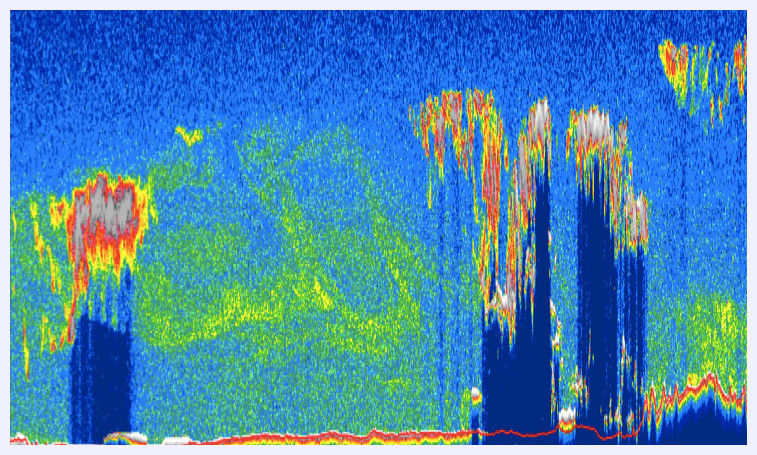
© NASAThe six-mile-high Chinese dust plume detected by CALIPSO appears as yellow-green swirls in this image. The tall columns topped in red and yellow are clouds.
The air we breathe doesn't always come from our own backyard. In fact, sometimes it doesn't even come from our neighbors.

On April 22, 2010, a NASA satellite captured the appearance of a large dust cloud over the eastern coast of United States that originated on the other side of the world -- in China.

"Dust can stimulate the production of more clouds, altering local weather and potentially the climate," said Zhoayan Liu, a researcher at the National Institute of Aerospace and NASA's Langley Research Center who is monitoring the dust movement. The dust cloud was in upper troposphere, the atmospheric layer in which we live.

The dust plume that arrived in the U.S. maintained an average size of more than 1,200 miles wide and six miles tall as it traveled across the Earth. It began in China's Taklimakan and Gobi Deserts, and over 10 days, NASA captured the dust moving across the Pacific Ocean, through the United States and Canada and over Virginia.

"It is likely that a cold front over the deserts generated strong surface winds that pushed a large amount of the dust into the atmosphere and from there the jet streams brought it across the world," said Liu.

Telescope

New type of supernova may shed light on some universal mysteries

Image
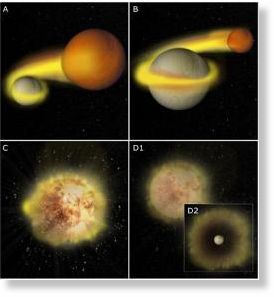
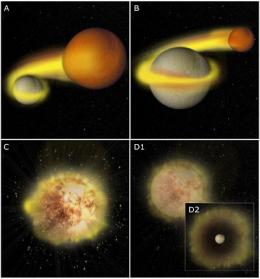
© vishay Gal-Yam; Weizmann Institute of ScienceOne theory of this new exploding system is that a white dwarf steals helium from a companion until the mass thief becomes very hot and dense and a nuclear explosion occurs. The helium is transformed into elements such as calcium and titanium, eventually producing the building blocks of life for future generations of stars.
In the past decade, robotic telescopes have turned astronomers' attention to scads of strange exploding stars, one-offs that may or may not point to new and unusual physics.

But supernova (SN) 2005E, discovered five years ago by the University of California, Berkeley's Katzman Automatic Imaging Telescope (KAIT), is one of eight known "calcium-rich supernovae" that seem to stand out as horses of a different color.

"With the sheer numbers of supernovae we're detecting, we're discovering weird ones that may represent different physical mechanisms compared with the two well-known types, or may just be variations on the standard themes," said Alex Filippenko, KAIT director and UC Berkeley professor of astronomy. "But SN 2005E was a different kind of 'bang.' It and the other calcium-rich supernovae may be a true suborder, not just one of a kind."

Filippenko is coauthor of a paper appearing in the May 20 issue of the journal Nature describing SN 2005E and arguing that it is distinct from the two main classes of supernovae: the Type Ia supernovae, thought to be old, white dwarf stars that accrete matter from a companion until they undergo a thermonuclear explosion that blows them apart entirely; and Type Ib/c or Type II supernovae, thought to be hot, massive and short-lived stars that explode and leave behind black holes or neutron stars.

Robot

New Research Reveals How DNA Could Power Computers

Image
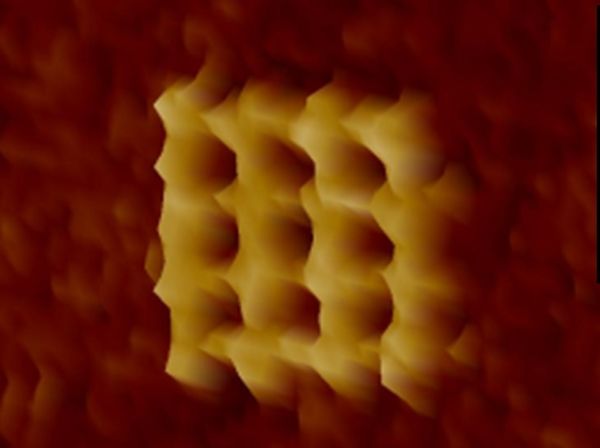
© Chris DwyerA close-up of a DNA 'waffle' nanostructure that could function as a logic circuit in a computer chip.
Engineers have long dreamed of using DNA as the backbone for the next generation of computer circuits. New research shows just how it might be done.

Instead of conventional circuits built of silicon that use electrical current, computer engineers could take advantage of the unique properties of DNA, the double-helix molecule that carries life's information.

"Conventional technology has reached its physical limits," said Chris Dwyer, assistant professor of electrical and computer engineering at Duke University's Pratt School of Engineering.

Meteor

Faint Comet in the June Dawn

We rarely see a good comet when it's at its best. Most comets are brightest when nearest the Sun - just when they're most likely to be hidden in the Sun's glare or below the sunrise or sunset horizon.

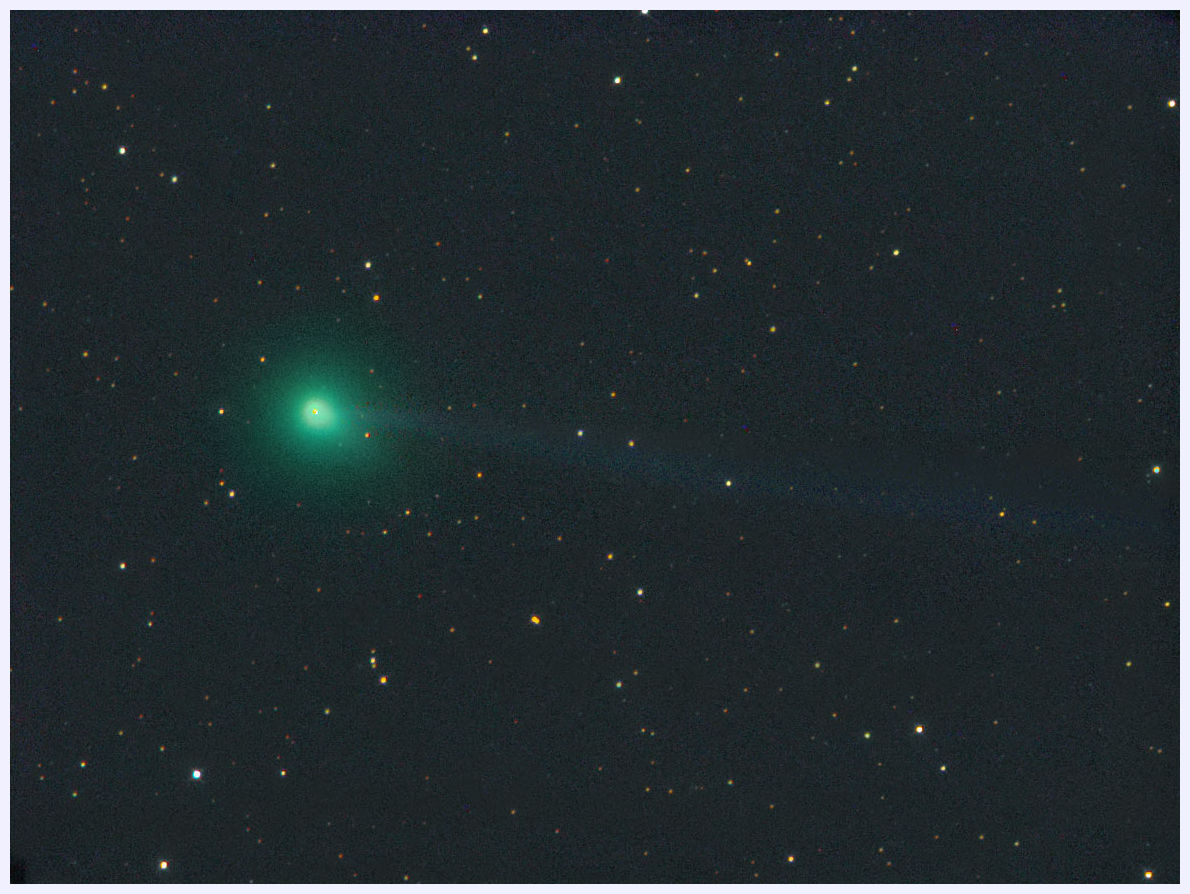
That's the situation this spring with Comet C/2009 R1 (McNaught). Even so, observers in the Northern Hemisphere should be able to pick it up with telescopes, and possibly binoculars, just before dawn for at least part of June, during its runup in brightness.

Comet C/2009 R1
© Michael JaegerOn May 19th, when Michael Jaeger shot this image from Austria, Comet C/2009 R1 was 8th magnitude and showing the characteristic green comet color in large telescopes. Note the thin blue gas tail. Click image for larger view.
And in fact, the comet is turning out to be 1 or 2 magnitudes brighter that we predicted in the June Sky & Telescope (page 60). Let's hope this behavior keeps up!

Einstein

Creative Brains Share Trait with Schizophrenic Ones, Study Finds

Creative people may think broadly and make unusual associations because they, like schizophrenics, may be less able to filter out information, a Swedish study found.

Researchers at the Stockholm-based Karolinska Institute followed 13 healthy men and women who took creativity tests. The more solutions the participants found for a problem, the higher their creativity levels were. The researchers also studied images of the people's brains.

The creative problem-solvers had a lower concentration of proteins that aid in the chemical transmission of information in the thalamus, the part of the brain that determines what data is relevant for reasoning, according to the study. That's a trait commonly found in patients with schizophrenia, a mental illness whose symptoms include hallucinations, jumbled thoughts and paranoia.

Info

Sleeping Newborns Are Data Sponges

Don't let a dozing baby's serenity fool you. As they sleep, newborns soak up information, speeding their adjustment to life ex utero. "They're better at sponging up data than we thought," says Dana Byrd at the University of Florida in Gainesville.

Together with William Fifer at the Department of Psychiatry at Columbia University in New York, and colleagues, Byrd played beeps to 26 sleeping babies aged between 10 and 73 hours old. Each beep was followed by an unpleasant puff of air to the eyelid, which prompted babies to scrunch up their eyes.

After 20 minutes, the sleeping infants were four times as likely to flinch after a beep delivered without an air puff as when they began, indicating that they had learned to associate the two in their sleep. Scalp electrodes recorded activity in the prefrontal cortex, which is involved in memory.

Magnify

University of California Berkeley Asking Incoming Students For DNA

Berkeley, California. -- UC Berkeley is adding something a little different this year in its welcome package -- cotton swabs for a DNA sample.

In the past, incoming freshman and transfer students have received a rather typical welcome book from the College of Letters and Science's On the Same Page program, but this year the students will be asked for more.

The students will be asked to voluntarily submit a DNA sample. The cotton swabs will come with two bar code labels. One label will be put on the DNA sample and the other is kept for the students own records.

Target

Isolation and Defamation: The Cost of Thinking Differently - Interview with Michael Behe on Intelligent Design

Michael Behe is an American scientist and biochemist. Being an intelligent design advocate, he serves as a professor of biochemistry at the University of Lehigh in Pennsylvania. He is also a senior fellow at Discovery Institute's Center for Science and Culture.

Behe has controversially challenged the evolution theory of Charles Darwin which underpins the ideology of western though with regards to the material life and universe.

In his 1996 book Darwin's Black Box, Behe has proposed the notion of irreducible complexity which underscores the role of an intelligent designer in the emergence of complex biological systems. According to this theory, certain biological systems are too complex to have evolved from simpler and less complex predecessors.

The theory of Behe undermines the basis of atheism and secularism as it advocates the role of an intelligent, conscious designer in the creation of human beings. That's why Michael Behe has been attacked and insulted by a number of his opponents and the materialist scientists who deny the existence of God.

Michael Behe has been accused of disseminating deceitful falsehood and what is describe as pseudo-science in the scientific circles around the world. Behe's theory has been labeled as argument from ignorance and the University of Lehigh has clearly distanced itself from his viewpoints regarding the evolution - creation debate.