Science & TechnologyS


Info

Software converts your speech into Chinese

Translator
© Microsoft ResearchMicrosoft's Chief Research Officer, Rick Rashid, recently demonstrated software under development that translated his English remarks into spoken Mandarin Chinese.
Ever wondered what you'd sound like if you were fluent in Chinese, French or another language you don't know? New software that's in development might give you an idea. Microsoft has created a program designed to provide on-the-fly, spoken translations, in the user's own voice.

"We may not have to wait until the 22nd century for a usable equivalent of Star Trek's universal translator," Rick Rashid, Microsoft's chief research officer, wrote in a blog post Nov. 8. Microsoft's translator still makes errors at a noticeable rate, but significantly improves on previous speech translators, Rashid said.

"The results can sometimes be humorous," he said. "Still, the technology has developed to be quite useful."

Rashid presented the software on Oct. 25, getting some of his remarks translated into Mandarin Chinese during a conference held in Tianjin, China.

Info

Identical twins are genetically different, research suggests

Twins
© Irogova | Dreamstime.com
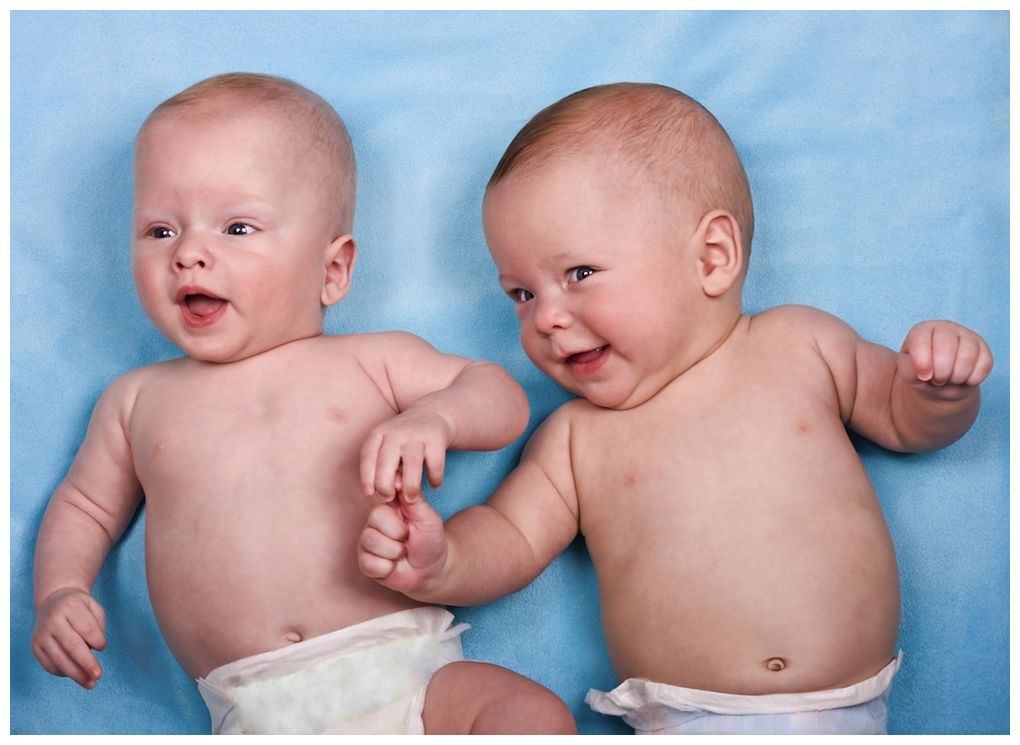
San Francisco - Identical twins may not be so identical after all. Even though identical twins supposedly share all of their DNA, they acquire hundreds of genetic changes early in development that could set them on different paths, according to new research.

The findings, presented Friday (Nov. 9) here at the American Society of Human Genetics meeting, may partly explain why one twin gets cancer while another stays healthy. The study also suggests that these genetic changes are surprisingly common.

"It's not as rare as people previously expected," said study presenter Rui Li, an epidemiologist at McGill University.

While past studies have looked at genetic changes, or mutations, in sperm and eggs, which can be passed on to offspring, very few studies have looked at somatic mutations. These mutations, also called copy errors, can occur early in fetal development, but because they aren't in the sex cells (the X or Y chromosomes) of the fetus, they can't be passed on.

Other studies have shown that chemical modifications, or epigenetic effects, can change which genes are expressed over the years, one factor that renders twins not completely identical. Still, other work has shown that identical twins can have different gene mutations, but this study didn't determine how often they occur.

Blackbox

NASA finds strange objects around our Sun?


Sun

M1.7 solar flare erupts from Region 1611 - backsided full-halo CME observed

Solar flare measuring M1.7 erupted on November 8, 2012 at 02:23 UTC. The source of this event is newly formed region rotating into view, Region 1611 (N12E66). The event started at 02:28, peaked at 02:23 and ended at 02:25 UTC. Type II Radio Emission was recorded indicating that a coronal mass ejection is associated with a flare event.

Description: Type II emissions occur in association with eruptions on the sun and typically indicate a coronal mass ejection is associated with a flare event.

SWPC later confirmed that the event was associated with a CME off the east limb (not expected to be geoeffective) and a Type II radio sweep. A backsided, full-halo CME was observed later in the day (first entering the C2 field of view at 08/1112Z); Stereo imagery indicated that old Region 1598 was the source. There are currently 6 numbered sunspot regions on the disk including two newly numbered groups: Region 1611 (N12E66) and 1612 (N06E71).


Calculator

Mastercard launches credit card with an LCD display and built-in keyboard

mastercard
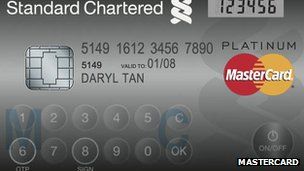
© BBCThe card may eventually display a holder's remaining balance and other information
A credit card with an LCD display and built-in keyboard has been launched in Singapore by Mastercard.

The card has touch-sensitive buttons and the ability to create a "one-time password" - doing away with the need for a separate device sometimes needed to log in to online banking.

Future versions of the card could display added information such as the remaining balance.

The card will be available from January before being rolled out globally.

Many of the world's banks require customers to log in to online banking by using a small security device to generate a one-off password.

Comet

New Comet: C/2012 V2 (LINEAR)

Cbet nr. 3290, issued on 2012, November 08, announces the discovery of a new comet (discovery magnitude 19.0) by the LINEAR survey on images obtained with the 1.0-m f/2.15 reflector + CCD on November 05.08. The new comet has been designated C/2012 V2 (LINEAR).

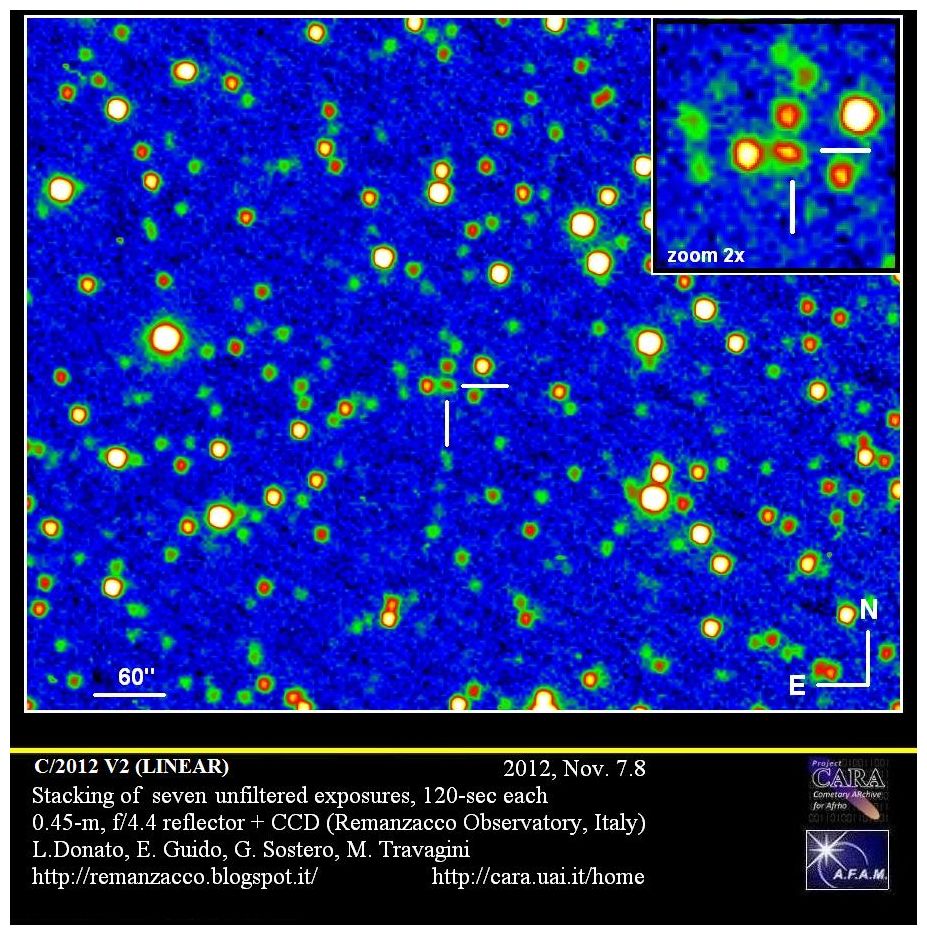
We performed some follow-up measurements of this object, while it was still on the neocp. Stacking of eleven unfiltered exposures, 120-sec each, obtained at the Remanzacco Observatory (Udine) on 2012, Nov. 7.8, through a 0.45-m, f/4.4 reflector + CCD, shows that this object is a comet: compact coma about 10" in diameter.

Our confirmation image:
C/2012 V2 (LINEAR)
© Remanzacco Observatory
M.P.E.C. 2012-V58 (including prediscovery observations from the MASTER-II Observatory, Blagoveshchensk, Russia, on Oct. 30) assigns the following preliminary parabolic orbital elements to comet C/2012 V2: T 2013 Aug. 18.22; e= 1.0; Peri. = 217.77; q = 1.44 AU; Incl.= 67.43.

Easter Egg

Saturn's egg-shaped moon Methone

Image
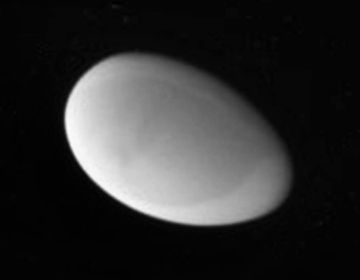
© planetary.orgMethone is a small (3-kilometer) moon of Saturn that orbits between Mimas and Enceladus near Anthe and Pallene. Cassini captured high-resolution views of it on May 20, 2012.
The reason for its egg-like shape comes down to its size, or more specifically its mass. Methone is only 3 kilometers (2 miles) wide and doesn't quite have the mass to create a gravity to pull all parts of the moon into a spherical shape. When a world does have the gravitational 'oomph' to do so, scientists will recognize the celestial body as being in 'hydrostatic equilibrium.'

Many of the gas giants' moons aren't massive enough to attain hydrostatic equilibrium, so there's a veritable menagerie of weird shaped satellites out there. What makes Methone even more interesting is the fact that its surface appears very smooth, like an egg shell. No craters or other surface features are obvious. Cassini snapped this image on May 20 when it was 4,000 kilometers (2,500 miles) from the moon.

Jupiter

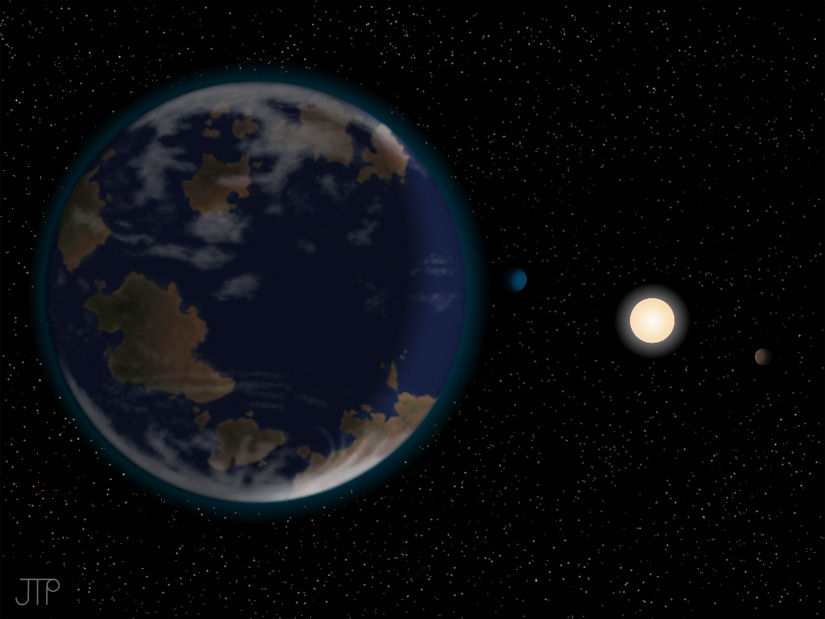
Potentially habitable planet discovered 7 times more massive than earth

Image
© J. Pinfield, for the RoPACS network at the University of Hertfordshire.This artist's impression shows HD40307g in the foreground, with its host star HD40307 and two other planets in the system.
The family of planets circling a relatively close dwarf star has grown to six, including a potential rocky world at least seven times more massive than Earth that is properly located for liquid water to exist on its surface, a condition believed to be necessary for life.

Scientists added three new planets to three discovered in 2008 orbiting an orange star called HD 40307, which is roughly three-quarters as massive as the sun and located about 42 light-years away in the constellation Pictor.

Of particular interest is the outermost planet, which is believed to fly around its parent star over 200 days, a distance that places it within HD 40307's so-called "habitable zone."

Jupiter

Jupiter's Great Red Spot is shrinking

Great Red Spot
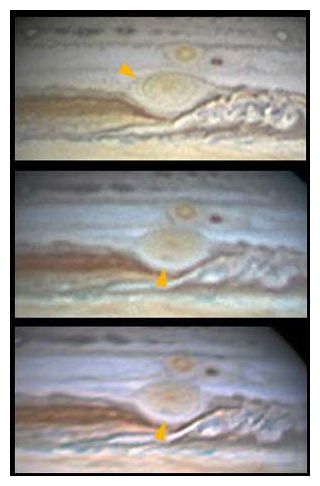
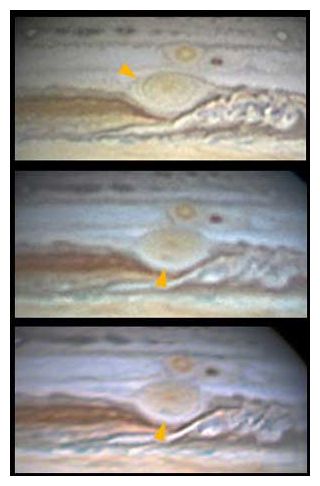
© J.H. Rogers, D. Peach, G. Walker, and D. ParkerThree shots by amateur astronomers taken on September 7th (top) and 8th (bottom), in which a small blemish (marked by the orange triangle) circles the Great Red Spot. Using these and other amateur images, Rogers was able to clock the storm's rotation period.
Jupiter's Great Red Spot is as constant as the North Star. In other words, it only looks constant - its constancy depends on how long we watch it. In the late 1800s the behemoth storm looked more like a Great Red Sausage, stretching about 40,000 kilometers (25,000 miles) wide and only about 12,000 km tall.

When the Voyager spacecraft dropped by in 1979, the storm was only 25,000 km wide but basically the same height.

Last week John Rogers (British Astronomical Association) confirmed that the storm is still tightening its waistline. Rogers clocked the maelstrom's rotation period by using images taken by an international network of amateur astronomers.

These images followed a dark streak as it whipped three times around the spot, providing a marker to gauge how fast the storm clouds whirligig. The circulating blemish made the trek in 4.0 days, shorter than the 4.5 days Rogers measured in 2006 using the same method.

The GRS's outer radius hasn't shrunk much since 2006 (it's a bit less than 20,000 km wide now), but Rogers found that the drop in rotation period is happening at about the same rate as the drop in the radius of maximum wind speed, as previously measured from spacecraft and Hubble Space Telescope images.

"It is amusing to note that the GRS now has exactly the same circulation period and the same north-south diameter as the atmosphere of Venus," he says.

What's neat about the new result is that it's all done with amateur observations. These measurements were once almost impossible from Earth-based telescopes, says Rogers. Now, amateur astronomers can confirm work done with Hubble. (Cue awestruck music.)

Info

Optical camouflage tech removes backseat of a car, transparent interior the goal


A system that makes the backseat of a car look transparent is currently being developed by a research group at Keio University.

The system applies optical camouflage technology, using recursive reflection, to vehicles. The technology was developed by Professor Masahiko Inami. This system has been optimized to make the backseat look transparent from the driver's viewpoint.

"The main feature of our system is, it makes things look as if you can really see through them, rather than giving an indirect view of what's behind. For example, with a system that shows things on a monitor, you can understand your car's position and where any obstacles are. But the point about our system is, it gives a sense of depth, by making things appear where they actually should be when you look back."

In this system, video from the rear cameras is projected onto the backseat using a half-mirror. The video is processed by a computer to make things appear actual-sized, making the driver feel as if the back seat really is transparent.