
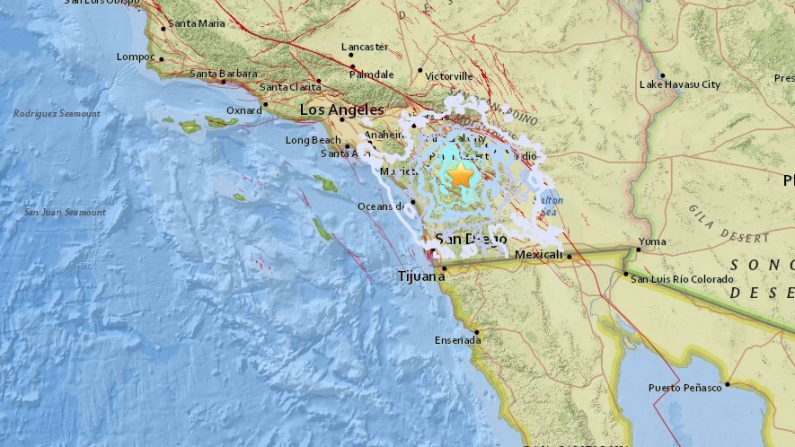
The small quake, which occurred at about 5:24 p.m. local time, was centered 4.3 miles north-east from Aguanga in Riverside County and was felt by residents up to 50 miles away. No damage or injuries have been reported.
Some locals took to social media to share their experiences.
In May this year, locals reported feeling a 3.5-magnitude earthquake, which struck the Bay Area in the state.
BART, the local train service, said it put trains on hold temporarily for track inspection, according to ABC7. And MUNI, the municipal train service, went into manual mode for the same reason.
According to the USGS, the epicenter for that quake was centered about two miles from Piedmont, four miles from Moraga, California, and about 12 miles from the San Francisco City Hall.
Locals from San Jose to Santa Rosa said they could feel the quake, according to the USGS online Community Internet Intensity Map. Those who lived near the epicenter called the shaking "light" to "weak."
There were no reports of damage or injuries associated with that temblor as well.
The Epoch Times' Jack Phillips contributed to this report







Comment: More details of the quake: Other recent quakes of note in the last week or so:
- Shallow M5.8 earthquake strikes Greenland sea, followed by M4.6
- Shallow M6.4 earthquake hits northern Alaska - 47 quakes in the last 24 hours
- 3rd earthquake in less than 14 days hits Surrey, UK - Same area as April's quakes
- Strong shallow mag. 6.2 earthquake in the South Sandwich Islands region
- 10 shallow and moderate earthquakes strike Southern Oregon coast over 5 hours
- Another shallow magnitude 6 earthquake hits Alaska - 2nd in under 24 hours
- Deadly earthquake lifts Indonesian island by nearly a foot
- Nearly two dozen earthquakes at the gigantic Katla volcano in Iceland
- New shallow 6.2 magnitude earthquake hits Indonesia's Lombok as death toll from first tremor tops 300
See also: Adapt 2030 Ice Age Report: Are the New Madrid and Alaskan fault zones waking?