
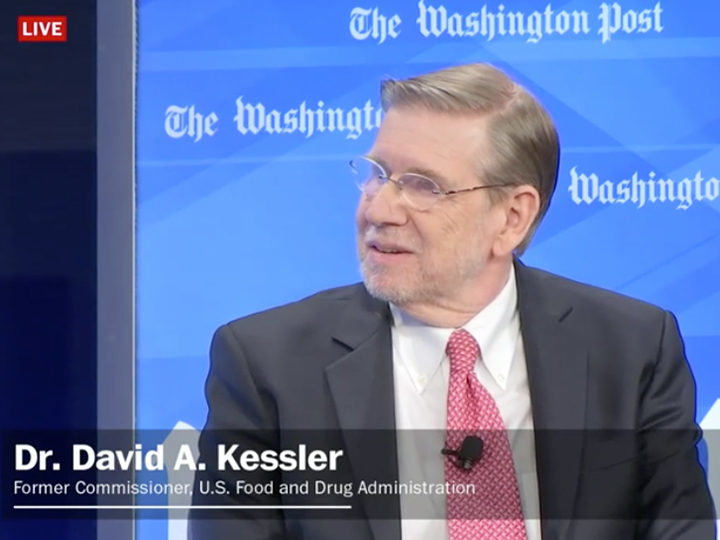
Better answers to basic nutrition questions needed, says David Kessler, MD
"I'm not sure I know what to eat."
Was this a child at a buffet, or maybe someone on a sodium-restricted diet wondering which foods contain salt? No, these were the words of former FDA commissioner David Kessler, MD, trying to figure out what his own regular diet should be.
"Something has led all of us to get bigger and bigger," Kessler said Wednesday at an event sponsored by The Washington Post and the BlueCross BlueShield Association. "It's coming from what we eat and we don't fully understand it ... I think we have failed in giving nutritional advice to people. If diet and exercise were the answer, we'd all do it and there wouldn't be a problem."
The country needs to "go back to the basics" when it comes to nutrition research, he continued. "I think it's time to set up a National Institute for Nutritional Sciences and try to get answers to very basic questions -- Is a calorie a calorie? Can I eat unprocessed meat? What's going on in my brain? I think we have failed the American public when it comes to giving them basic information."
Marion Nestle, PhD, professor emeritus of nutrition, food studies, and public health at New York University, disagreed about the answer being unknown. "I think we know what healthy calories are. They're diets that contain a lot of fruits and vegetables, balanced calories that don't contain a lot of junk food," she said.
Noting that obesity rates began to climb in 1980, Nestle said that "the real question is what happened in 1980 that changed?" She listed three changes: "We overproduced food to a much greater extent that food had to be sold. The shareholder value movement on Wall Street meant that food corporations, like all other corporations, not only had to make a profit but they had to grow their profit. And we deregulated a lot of controls around marketing."
Kessler had a different take. "We took fat, sugar, and salt. We put it on every corner, we made it available 24/7. We made it acceptable to eat anytime ... Walk into any place to eat. It's the way I have a good time, I can unwind, I can feel good. What do you expect to happen?"
In addition to the nutrition discussion, the event also included a panel on healthcare reform featuring senators Michael Bennet (D-Colo.) and Bill Cassidy, MD (R-La.). Cassidy spoke about his idea of combining patients who are enrolled in Medicaid expansion programs with those enrolled on the Affordable Care Act's health insurance exchanges, to make for a larger pool of people among which to spread risk.
"In my state, Louisiana, we have 400,000 people in the Medicaid expansion and maybe 100,000 people in the exchange," he said. "If you combine those two you suddenly have got a much bigger pool. One person's illness spread among many is much more affordable. We need to restore the law of big numbers to insurance."
But Bennet had another idea, a public option which he called "Medicare X." "It is a plan that would be administered by Medicare. So it'd be the benefit of having the much lower administrative cost of Medicare than in a private plan," he explained. "You would pay in a premium, and you'd have coverage from this public option. We start it in rural parts of America where there's only one or no insurer, and we say that you can then pool everybody.
"Over 3 years we make it available to [every individual] in the country, and over 5 [years] we make it available to small business in this country," Bennet continued. "I think it's the kind of thing that people really are looking for as they struggle with the kind of private insurance hikes that Bill Cassidy was talking about. We weren't ready for that discussion 10 years ago, but I think we are ready for it now."
Cassidy and Bennet dickered over whether Bennet's plan would cost money or save money. "Medicare is going bankrupt, according to the actuaries, in 8 years," said Cassidy. "What we know is that if you open [Medicare] up, the folks that join will typically be sicker with a higher-cost experience ... Now, I suppose you could raise taxes dramatically to pay for this, and I assume that is part of the plan. Because otherwise it won't be going bankrupt in 8 years; it'll be going bankrupt in 4 years."
Bennet responded that the program would easily pay for itself through the premiums paid by enrollees, and would actually save money. "It saves $160 billion, according to the Congressional Budget Office, because people would be opting to buy that instead of private insurance, which then we're paying high subsidies for the benefit of insurance companies instead of doing this," he said.
Wednesday's event also featured an appearance by Health and Human Services Secretary Alex Azar. He noted that HHS is asking for comment on how the agency can relieve providers of some of the restrictions in the Stark self-referral rules and anti-kickback laws, which he said end up making it more advantageous for providers to form large health systems.
"Because of the regulatory burdens around Stark and anti-kickback [rules], the easiest way around that was to actually have common ownership -- to vertically and horizontally integrate," Azar said. "And I'm not sure bigger is always better, as opposed to collaborative [efforts that] can be done virtually. I'd like to make sure that we're agnostic to ownership structures. Let economics actually drive that -- not our payment systems or our regulatory environment."






The folks intuitively know that the bureaucratic "advice" is only produced for political reasons. Not to help people to survive or make their life better.
When there is surplus of butter the "healthy food advice" is to eat more butter, when of corn, eat more corn. As simple as that.