Comets


Attention

New Webb telescope view shows unexpectedly crowded asteroid belt

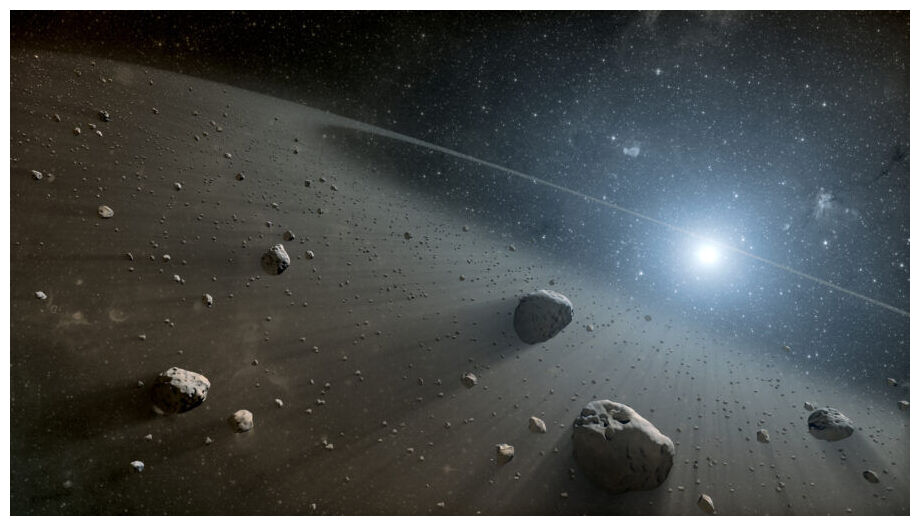
A new view of archival Webb telescope data reveals small asteroids in the main asteroid belt are more numerous than we thought.
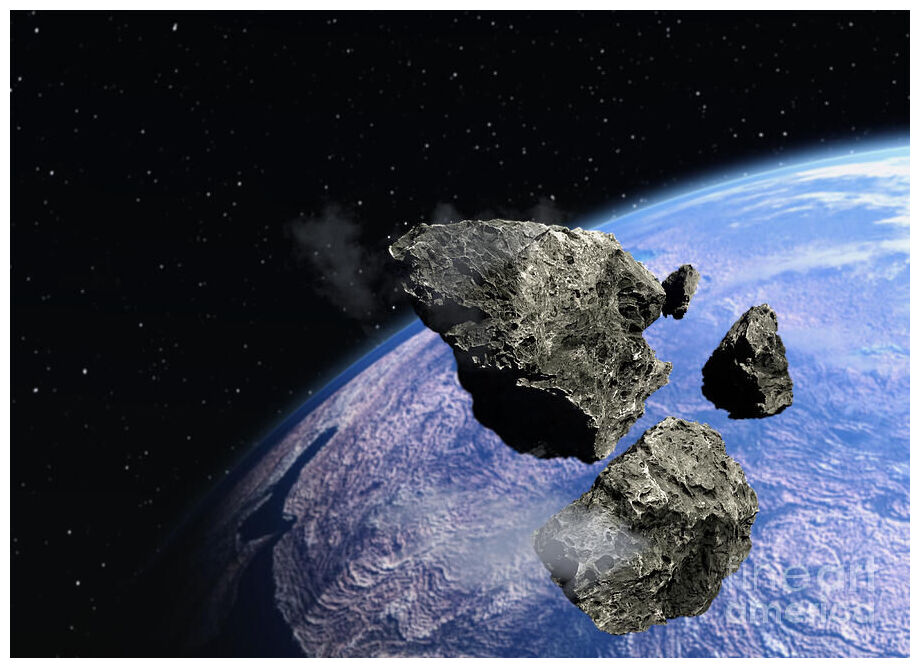
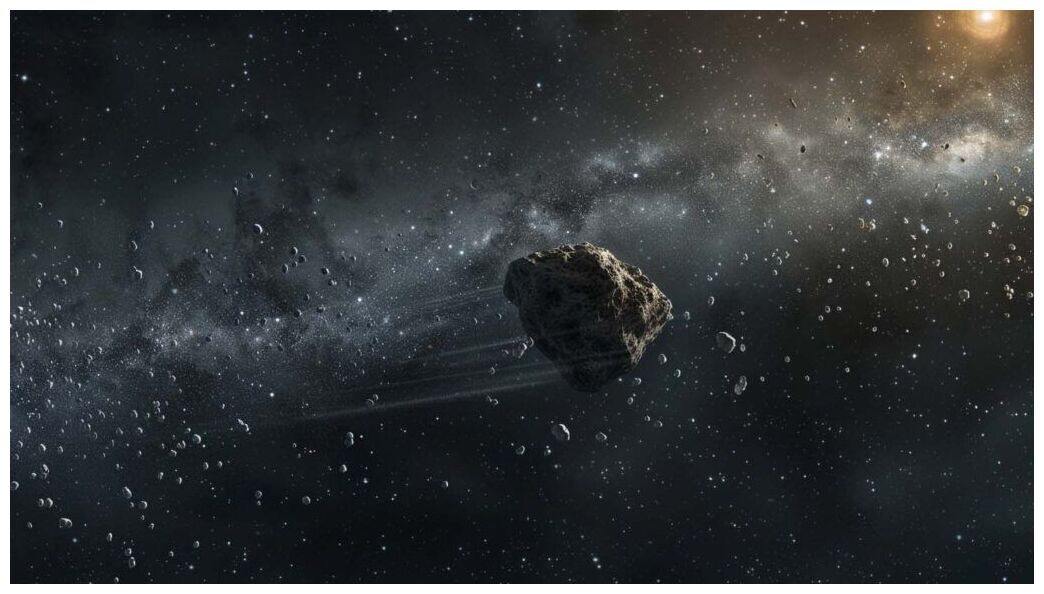
Artist´s impression of an asteroid belt.

Astronomers have uncovered an unexpectedly large population of small main-belt asteroids thanks to a new analysis of images from the James Webb Space Telescope. The finding could change calculations of the impact rate on Earth from such bodies, which range from house-size to the size of a stadium.

These are by far the smallest objects ever imaged so far away. Artem Burdanov (MIT) and colleagues applied a computationally intensive shift-and-stack method to Webb's archival images. From the telescope's sensitive infrared detectors, the team was able to accurately determine the sizes of small objects, ranging from about 10 to 500 meters (30 to 1,600 feet) across. An early release of their results appears in Nature.

Larger main-belt asteroids, whose orbits are between those of Mars and Jupiter, tend to remain in relatively stable orbits. However, gravitational interactions more frequently perturb smaller ones, which may enter the inner solar system to become potential impactors. The high number of small objects now found in the main belt — more than an order of magnitude greater than expected — could affect calculations of the frequency of such impacts.

Fireball 5

Earth from space: Wandering sand dunes circle gigantic 'eye' sculpted by meteor in the Sahara

This 2013 astronaut photo shows a giant eye-shaped impact crater in the Sahara Desert that is slowly being circled by migrating sand dunes, helping researchers track how far these dunes can move over time.
Aorounga structure
© NASA/ISS programThe Aorounga structure is a roughly 8-mile-wide impact crater left behind by a "city-killer" asteroid that slammed into Earth.
This striking astronaut photo shows off an "eye-catching" impact crater in the Sahara Desert. The oculus-like structure is surrounded by migrating sand dunes that are capable of traveling more than 100 feet (30 meters) every year.

The Aorounga structure is a 7.8-mile-wide (12.6 kilometers) impact crater located in the southeast Sahara in northern Chad. The crater is made up of two rings that give the structure its eye-like appearance: An inner ring with a central hill, or uplift structure, that looks like a pupil; and an outer ring that looks like an eyelid. The rings rise around 330 feet (100 m) above the surrounding ground but have been heavily eroded over time — similar to other ancient impact craters — and were likely even taller and wider originally.

Experts believe that the structure formed around 345 million years ago and was likely created by a meteor around 2,000 feet (600 m) across, according to estimates from the Lunar and Planetary Institute. An impactor of this size, known as a "city-killer" asteroid, would have caused widespread damage across the north of Africa and may have even triggered climatic effects on a global scale.

The structure also has several dark lines running across both of its rings, which are sections of massive ridges, known as yardangs, according to the U.S. Geological Survey. These ridges, which can reach up to 100 feet (30 m) above ground level, stretch across the surrounding areas for dozens of miles, as you can see in the 2016 astronaut images below.

Comet 2

Comet ATLAS (C/2024 S1) burns up as it flies into the sun

Comet C/2024 S1 (ATLAS) is no more.

On Monday (Oct. 28), the comet evaporated as it was heading toward perihelion, the closest point to the sun in its orbit. There were earlier hopes that the comet, officially designated C/2024 S1 (ATLAS), could become a "Halloween treat" visible to the naked eye, but these were ultimately just wishful thinking; astronomers had already begun observing the cosmic snowball beginning to disintegrate earlier this month.


Now, thanks to the Solar and Heliospheric Observatory (SOHO), a spacecraft jointly operated by NASA and the European Space Agency, we know for sure how and when comet ATLAS met its demise.

Comet C/2024 S1 (ATLAS) passed its closest point to Earth on Oct. 23, reaching a magnitude of 8.7, far too dim to be seen with the naked eye. Still, telescopes were able to catch a glimpse of the icy visitor from the outer solar system.

After that approach, the comet began flying toward the sun, making it difficult to see by anything other than specialized instruments designed for solar observations.

Fireball 5

4 large asteroids, including a skyscraper-size 'city killer,' will zoom past Earth in a 12-hour span on October 24th

Four "potentially hazardous" space rocks, which are between 100 and 580 feet across, will all make their closest approaches to Earth within less than 12 hours of one another on Thursday (Oct. 24). Two of them were only discovered earlier this month.
Asteroids
© Getty ImagesFour large space rocks, between 100 and 580 feet across, will reach their closest points to Earth in quick succession on Thursday (Oct. 24).
A quartet of particularly hefty asteroids, including two that were discovered earlier this month and another that is as tall as a skyscraper, will make their closest approaches to Earth on Thursday (Oct. 24) — all within 12 hours of one another. The "potentially hazardous" space rocks will all get similarly close to our planet, but pose zero threat to life on Earth.

The first asteroid to make its closest approach will be 2015 HM1, also the smallest of the four space rocks at around 100 feet (30 meters) across. It will reach its closest point to our planet at around 4:36 a.m. UTC (0:36 a.m. EDT) when it reaches a minimum distance of 3.4 million miles (5.5 million kilometers) from us, according to NASA's Asteroid Watch dashboard. (That's roughly 14 times the average distance between Earth and the moon.)

The next visitor will be the roughly 170-foot-wide (52 m) space rock 2024 TP17, which will make its closest approach at around 8:20 a.m. UTC (4:20 a.m. EDT) and will get to within 2.9 million miles (4.7 million km) of our planet.

The final two asteroids — 2002 NV16 and 2024 TR6 — will make their closest approaches within just four minutes of each other. 2002 NV16, which is around 580 feet (177 m) across, making it the largest of the four, will reach a minimum distance of 2.8 million miles (4.5 million km) at around 15:47 p.m. UTC (11:47 a.m. EDT). It will be quickly followed by the 150-foot-wide (46 m) asteroid 2024 TR6, which will come within 3.5 million miles (5.6 million km) of Earth at 15:51 p.m. UTC (11:51 a.m. EDT).

Fireball

Five-mile asteroid impact crater below Atlantic captured in 'exquisite' detail by seismic data

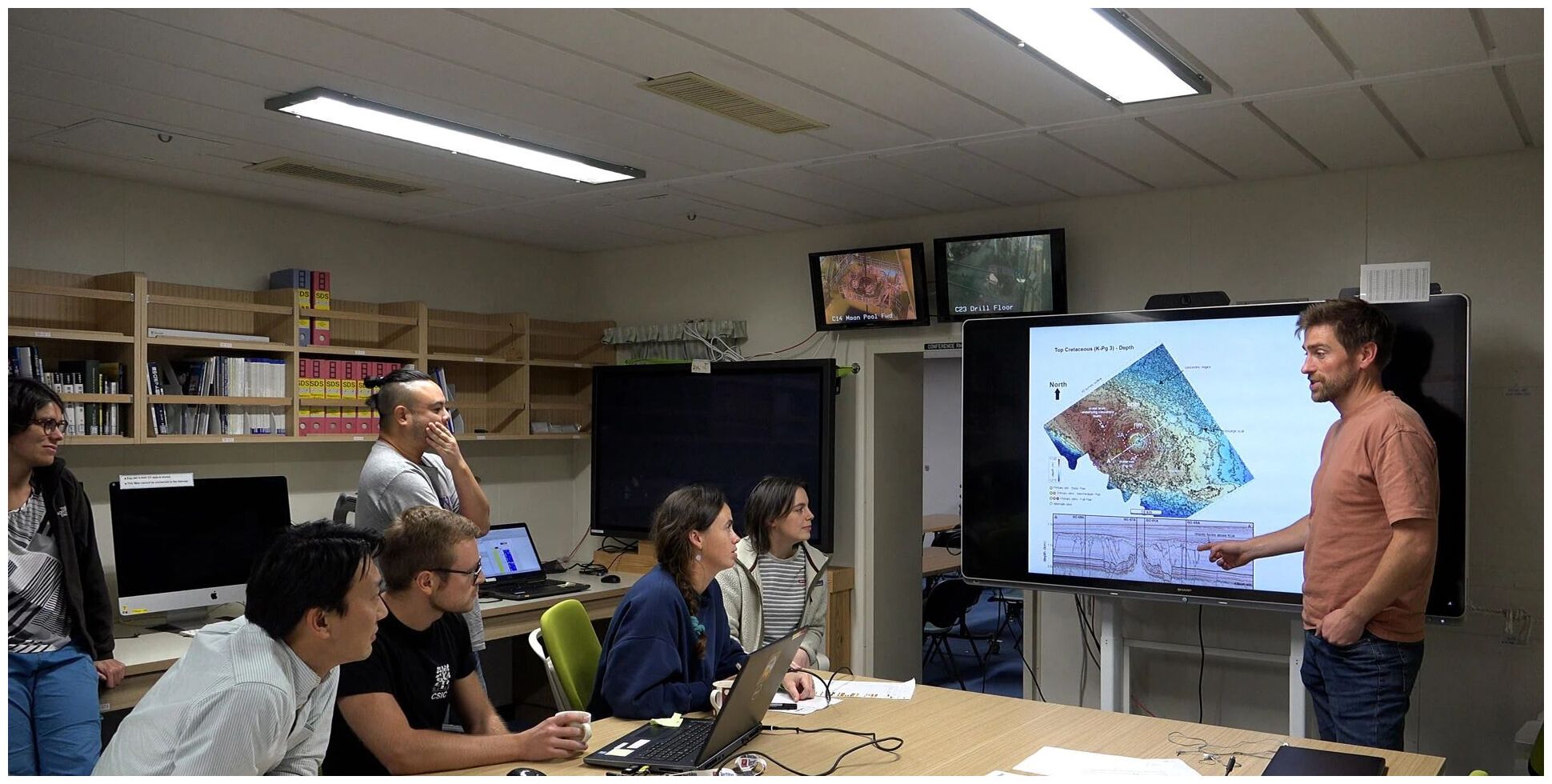
Dr Uisdean Nicholson
© Heriot-Watt UniversityDr Uisdean Nicholson presenting his findings to scientists on board a drilling ship.
New images of an asteroid impact crater buried deep below the floor of the Atlantic Ocean have been published today by researchers at Heriot-Watt University.

The images confirm the 9km Nadir Crater, located 300m under the floor of the Atlantic Ocean, was caused by an asteroid smashing into Earth at the end of the Cretaceous period around 66 million years ago.

That's the same age as the dinosaur-killing 200 km wide, Chicxulub impact crater in Mexico.
There are around 20 confirmed marine craters worldwide, and none of them has been captured in anything close to this level of detail.

Dr Uisdean Nicholson
The images have helped the researchers determine what happened in the minutes following impact: the formation of an initial bowl-shaped crater, rocks turned to a fluid-like state and flowing upwards to the crater floor, the creation of a damage zone covering thousands of square kilometres beyond the crater, and an 800-metre-plus high tsunami that would have travelled across the Atlantic ocean.

The findings are reported in Nature Communications Earth & Environment.

Comet 2

A big new sungrazing comet

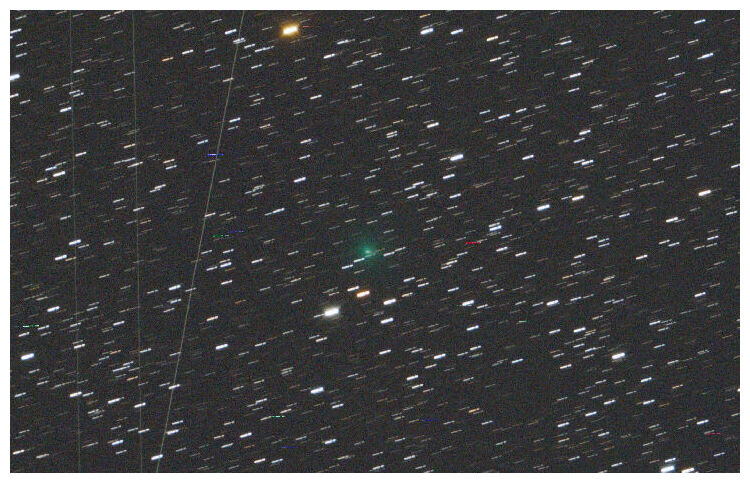
Astronomers are monitoring a new comet discovered just a few days ago by the ATLAS survey. It's so new, it doesn't have a name yet. Provisionally designated "A11bP7I," the comet appears to be a relatively large sungrazer on course to become a bright naked-eye object in late October. Dennis Möller, Michael Jäger and Gerald Rhemann photographed the new discovery last night in Namibia:
New Kreutz Comet
© Michael JägerWe are here in Namibia to observe Tsuchinshan Atlas. The new Kreutz comet was discovered not far away. It is already 11mag bright, shows a 2' coma and a short tail. Dennis Möller exposed 15x60 seconds with his self-made astrograph. The device was carried 10,000 kilometers in its case. We can follow the development for a few more days. Observers: Dennis Möller, Michael Jäger, Gerald Rhemann
"We are here in Namibia to observe Comet Tsuchinshan-ATLAS," says Jäger. "The new sungrazing comet was discovered not far away, so we took a look. It is already 11th mag with a 2' green coma and a short tail."

The orbit and brightness of A11bP7I remind experts of Comet Lovejoy (C/2011 W3), a sungrazer that flew through the sun's atmosphere in Dec. 2011. Comet Lovejoy emerged from the close encounter intact and put on a spectacular show for amateur astronomers during the Christmas holidays of that year.

Comet 2

The origins of dark comets

Dark Comets
© University of Michigan
Up to 60% of near-Earth objects could be dark comets, mysterious asteroids that orbit the sun in our solar system that likely contain or previously contained ice and could have been one route for delivering water to Earth, according to a University of Michigan study.

The findings suggest that asteroids in the asteroid belt, a region of the solar system roughly between Jupiter and Mars that contains much of the system's rocky asteroids, have subsurface ice, something that has been suspected since the 1980s, according to Aster Taylor, U-M graduate student in astronomy and lead author of the study.

The study also shows a potential pathway for delivering ice into the near-Earth solar system, Taylor says. How Earth got its water is a longstanding question.

"We don't know if these dark comets delivered water to Earth. We can't say that. But we can say that there is still debate over how exactly the Earth's water got here," Taylor said. "The work we've done has shown that this is another pathway to get ice from somewhere in the rest of the solar system to the Earth's environment."

The research further suggests that one large object may come from the Jupiter-family comets, comets whose orbits take them close to the planet Jupiter. The team's results are published in the journal Icarus.

Comet

Shocked quartz reveals evidence of historical cosmic airburst from 12,800 years ago

Shocked quartz grains
© UC Santa BarbaraShocked quartz grains, with fissures filled with meltglass.
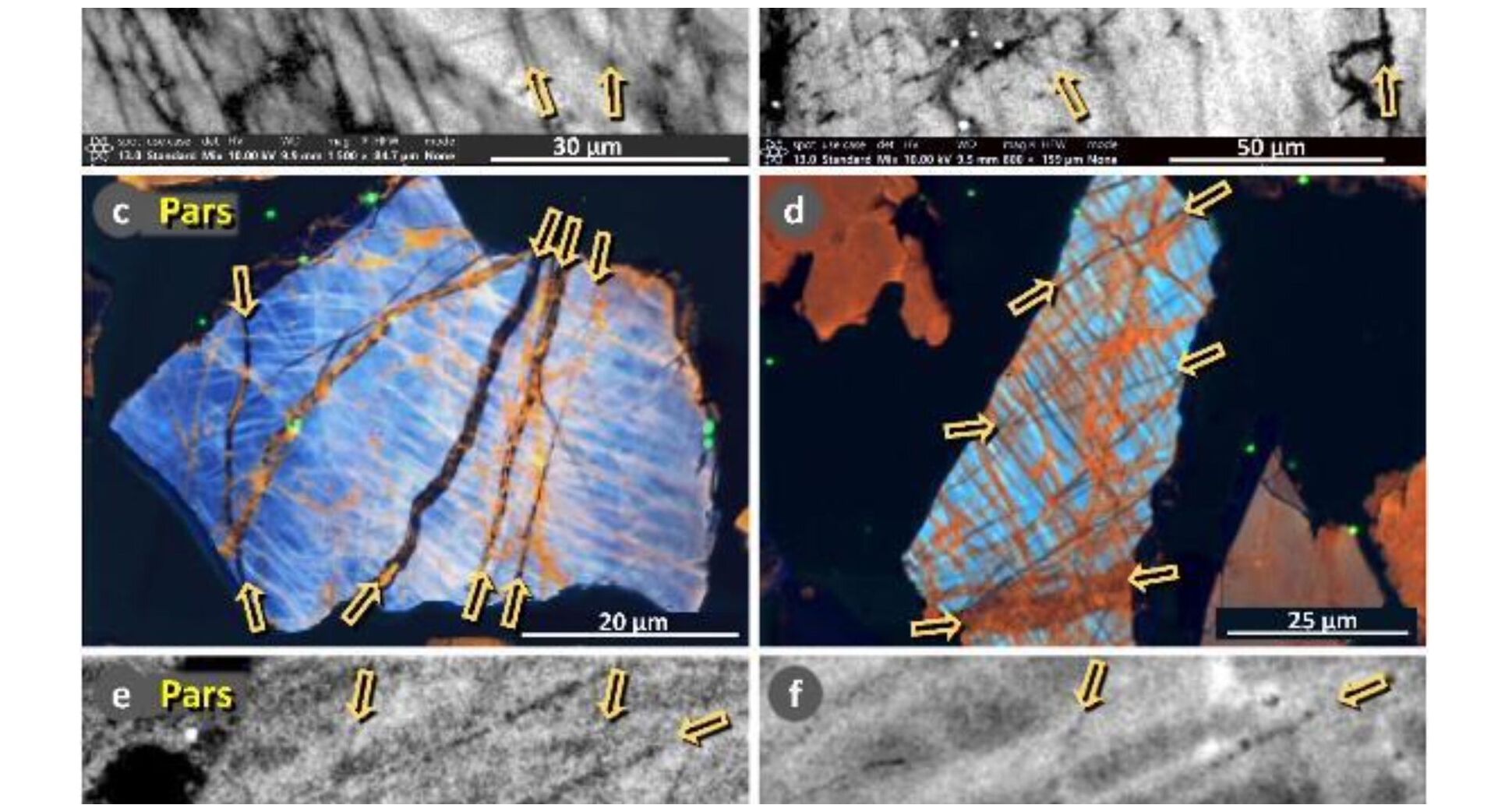
Researchers continue to expand the case for the Younger Dryas Impact hypothesis. The idea proposes that a fragmented comet smashed into the Earth's atmosphere 12,800 years ago, causing a widespread climatic shift that, among other things, led to the abrupt reversal of the Earth's warming trend and into an anomalous near-glacial period called the Younger Dryas.

Now, UC Santa Barbara emeritus professor James Kennett and colleagues report the presence of proxies associated with the cosmic airburst distributed over several separate sites in the eastern United States (New Jersey, Maryland and South Carolina), materials indicative of the force and temperature involved in such an event, including platinum, microspherules, meltglass and shock-fractured quartz. The study appears in ScienceOpen's journal Airbursts and Cratering.

"What we've found is that the pressures and temperatures were not characteristic of major crater-forming impacts but were consistent with so-called 'touchdown' airbursts that don't form much in the way of craters," Kennett said.

Comment:


Comet 2

Study uncovers new evidence supporting Younger Dryas impact hypothesis

Airburst
© Youtube
If you wanted evidence that a giant comet wiped out the wooly mammoth, you might look for a giant crater.

But so far, you'd be out of luck.

"Some of our critics have said, 'Where's the crater?'" says Christopher Moore, an archaeologist at the University of South Carolina. "As of now, we don't have a crater or craters."

But Moore says that by looking below the surface, you can find strong evidence for the Younger-Dryas impact hypothesis, which states that large comet fragments hit Earth or exploded in the atmosphere shortly after the last ice age, setting off cataclysmic changes in the environment, crater or not.


Fireball 2

Best of the Web: Bright meteor fireball illuminates night sky over Spain and Portugal on May 18 [Update: Calculated total impact energy 0.13kt TNT]

Meteor Fireball
© outono.net
Lately we have been having a lot of meteor activity over the Iberian Peninsula, a phenomenon that causes great expectation.

As you will remember, on March 29 we had two bolides over the eastern part of Spain, which generated many comments.

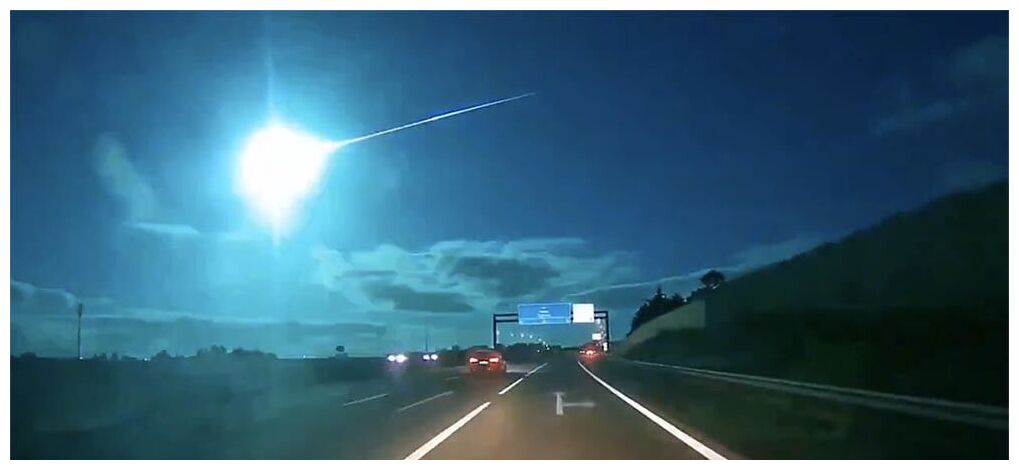
Tonight, around 0:46 CET (23:46 Lisbon time), a bright fireball has illuminated the skies of Spain and Portugal. According to the Civil Protection of Portugal, the meteor would have fallen in the village of Pereira, in Castro Daire, northern Portugal, 60 km southwest of Porto. Portugal declared an alert and mobilized its firefighters in case there was any information.

Here we can see an impressive video recorded by @rvbzzx in Lisbon and slowed down by @jpunto88_ to make it look better:


Comment: Other videos:


The following selfie-video from Avéro in Portugal was captured by Mila Vladimirovna, @milarefacho

Some of the above and other videos can be found here: International Meteor Society
Huge fireball over Spain and Portugal on May 18!


The fireball has entered the CNEOS list:
Peak Brightness Date/Time (UT) 2024-05-18 22:46:50
Latitude(deg. 41.0N
Longitude(deg.) 8.8W
Altitude(km) 74.3
Velocity(km/s 40.4
Velocity Components(km/s) vx -26.5, vy -24.1, vz 18.7
Total Radiated Energy(J) 3.7e10
Calculated Total Impact Energy(kt) 0.13
This year six others have entered the list, curiously, of very similar size. There now is one at 0.15, four at 0.13, one at 0.11 and on at 0.098. The variation last year was between 0.076 and 7.2. kt! The Chelyabinsk meteor has been estimated to between 400 and 500 kt of TNT.

The American Meteor Society has in the 2024 list recorded it as Event 2481-2024:
American Meteor Society event 2481-2024
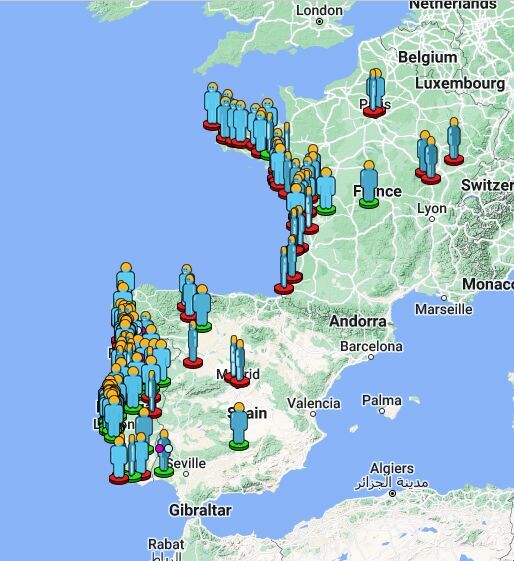
If the reports most distant from the trajectory are reliable, it was viewable at a distance of up to 1200 km. To verify if this is even possible, one can use a Distance to Horizon Calculator, like this German online calculator that also is configurable to show feet and miles.

Since the altitude of the visible meteor has been given the range of 122 km, initially, and 54 km at the end, we can insert these figures and find out how far out that is visible. For an observer at sea level, the calculator gives values between 1252 km and 831 km.

To be able to view the meteor from Paris would be a "tall order" given that the atmosphere is not clear, but if the viewing happened from one of the skyrises. several of which are around 200 meters this could add about 50 km to the first estimate of 1252 km. Alternatively, a different calculator shows that from an altitude of 122 km, the horizon to sea level is 1328 km away, and if you are viewing from an altitude of 200 meter, it would be 1382 km.

Meteors are interesting objects, see more in Cometary Encounters: Flash-Frozen Mammoths, Mars-Earth Discharge, Comet Venus and the 3,600-Year Cometary Cycle, and Earth Changes and the Human-Cosmic Connection (The Secret History of the World Book 3) by Pierre Lescaudron. The second is available in German, while both are translated into French, and Russian.