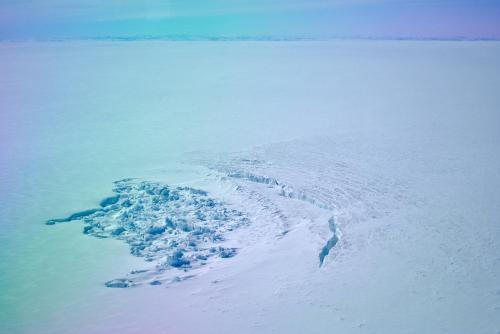
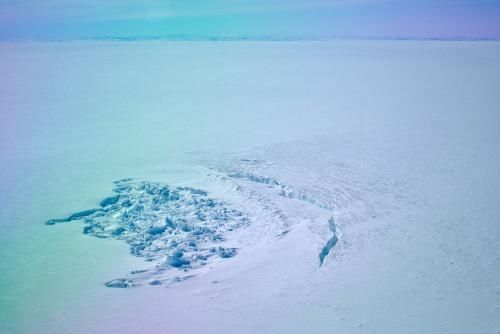
© Stephen Price, Los Alamos National Laboratory, courtesy of The Ohio State University.In April 2014, researchers flew over a site in southwest Greenland to find that a sub-glacial lake had drained away. This photo shows the crater left behind, as well as a deep crack in the ice.
Researchers who are building the highest-resolution map of the Greenland Ice Sheet to date have made a
surprising discovery:
two lakes of meltwater that pooled beneath the ice and rapidly drained away.
One lake once held billions of gallons of water and emptied to
form a mile-wide crater in just a few weeks. The
other lake has filled and emptied twice in the last two years.
Researchers at The Ohio State University published findings on each lake separately: the first in the open-access journal
The Cryosphere and the second in the journal
Nature.
Ian Howat, associate professor of earth sciences at Ohio State, leads the team that discovered the cratered lake described in
The Cryosphere . To him, the find adds to a growing body of evidence that meltwater has started overflowing the ice sheet's natural plumbing system and is
causing "blowouts" that simply drain lakes away.
"
The fact that our lake appears to have been stable for at least several decades, and
then drained in a matter of weeks - or less - after a few very hot summers, may
signal a fundamental change happening in the ice sheet," Howat said.
The two-mile-wide lake described in Nature was discovered by a team led by researcher Michael Willis of Cornell University. Michael Bevis, Ohio Eminent Scholar in Geodynamics and professor of earth sciences at Ohio State, is a co-author of the
Nature paper, and he said that the repeated filling of that lake is worrisome.
Each time the lake fills, the meltwater carries stored heat, called latent heat, along with it, reducing the stiffness of the surrounding ice and making it more likely to flow out to sea, he said.
Bevis explained the long-term implications.





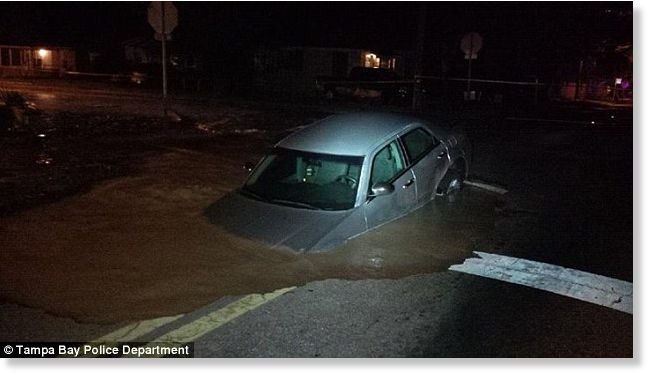

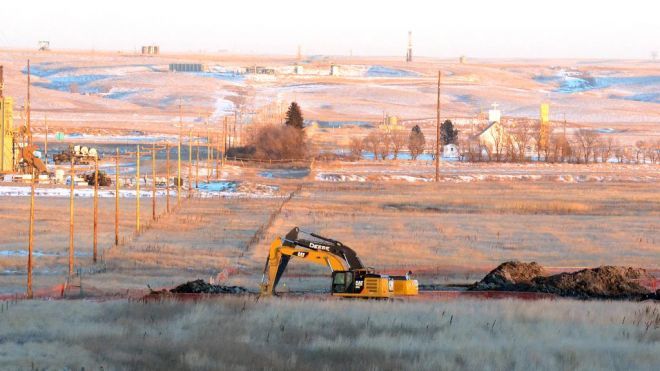






Comment: Despite assurances that the leak poses no danger to drinking water supplies or wildlife, the fact that the saltwater is a byproduct of fracking is a cause for concern. The numerous chemicals used in the fracking process are highly toxic, and the oil industry is not likely to 'own up' when profits are at stake.
Fracking Hell: The Untold Story