Secret HistoryS


USA

Declaration of Independence copy seized by British navy in 1776 uncovered in London's National Archives

copy declaration of independence london archives
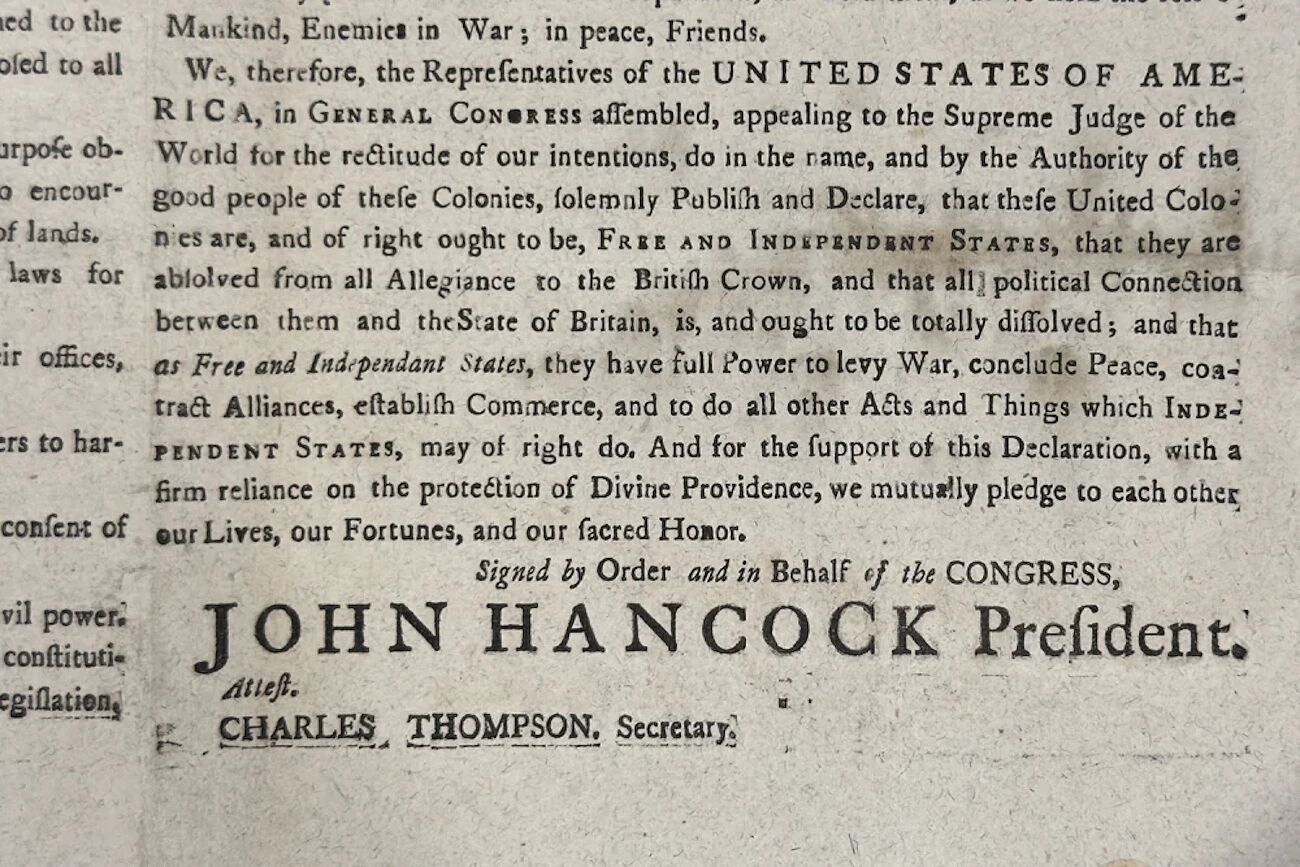
© Shivansh Gupta / PA via Getty ImagesA rare 1776 printing of the Declaration of Independence discovered at the National Archives in London.
Listed simply as "another paper" in the Royal Navy inventory, the Declaration remained buried in British archives for 250 years.

A rare copy of the Declaration of Independence lost for 250 years has been discovered in London, where it is the only known example of its kind outside the U.S.

Printed in Exeter, New Hampshire, just days after the Declaration was adopted on July 4, 1776, the document was intended to spread news of American independence throughout the American colonies.

The early copy remained tucked away in Britain's National Archives until a volunteer cataloging records from the American Revolutionary War came across it in May among the papers of Royal Navy captains.

Only 11 copies of the so-called Exeter printing are known to survive, and until this discovery, none had been found outside the U.S., Britain's National Archives said in a news release Thursday.


Car Black

"Studebaker!": The rise and fall of a US industrial dream and a forgotten alliance

Studebaker/McGovern/Russian general
© UnknownStudebaker • Ray McGovern • Russian General
Despite geopolitical disagreements and the fading of history, human connection and a shared memory of the losses and cooperation during the war — symbolized by the American "Studebaker" truck can transcend the decades and bring people together.

A Russian general who had driven "Studers" through the mud of a war that ate his generation whole gave an American stranger a bear hug because the stranger understood, in Russian, what had been lost and what had been shared.

There is a moment, small and human, that cuts through decades of geopolitical noise like a blade through fog. In April 2015, in Moscow, Ray McGovern, a former CIA analyst who spent 27 years briefing American presidents, attended a ceremony hosted by the Russians. This event marked the 70th anniversary of the Meeting on the Elbe. In April 1945, American and Soviet troops joined hands on a bridge in Germany, realizing together that the war was nearly over.

McGovern had recited Nekrasov's devastating anti-war poem in both Russian and English. When he stepped back from the podium, a towering Russian general, chest armored in medals, approached.

The general spoke no English. But he took McGovern by the shoulders and said the one word in his vocabulary that bridged the two worlds: "Studebaker! Studebaker!" And then came the Russian bear hug.

Pharoah

Egypt uncovers a complete Byzantine city in the Dakhla Oasis

Dakhla Oasis
© Egypt’s Ministry of Tourism and Antiquities via Facebook
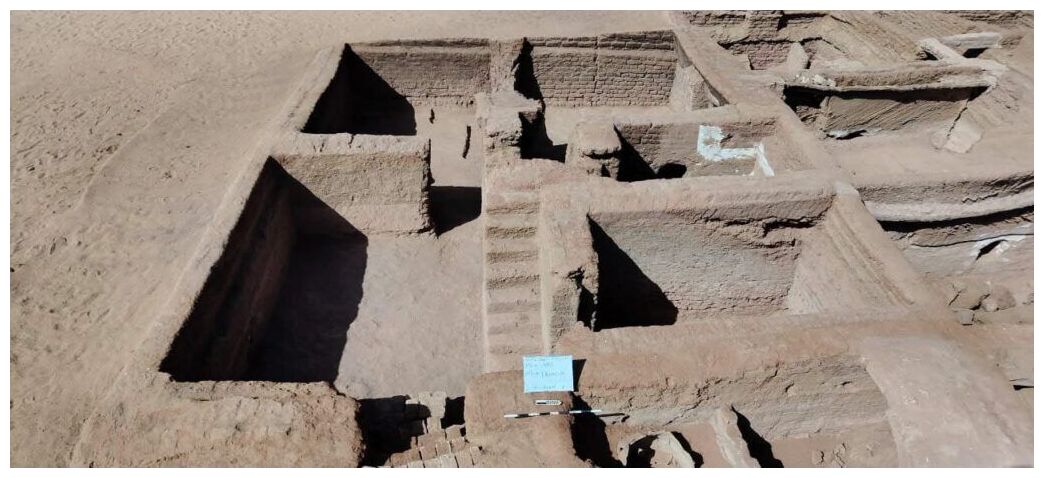
Archaeologists in Egypt have uncovered a mudbrick residential settlement at Ain el-Sabil in the Dakhla Oasis, revealing a planned Late Roman or early Byzantine community with streets, houses, a basilica church, defensive structures, written documents, and coins.

The discovery was announced by Egypt's Ministry of Tourism and Antiquities after excavations by an Egyptian mission affiliated with the Supreme Council of Antiquities. The site lies in New Valley Governorate, in Egypt's Western Desert, where the oases preserve some of the clearest archaeological evidence for daily life outside the Nile Valley during Late Antiquity.

A planned mudbrick settlement in the Western Desert

According to the ministry's statement, all of the newly uncovered buildings were made of mudbrick. The settlement follows an organized urban plan, with main streets running north to south and smaller cross-streets running east to west. These created open spaces and squares within the settlement, while a basilica-style church stood near the center, facing one of the main roads.

The layout matters because it suggests more than a loose cluster of houses. The settlement appears to have combined domestic, religious, and defensive spaces in a structured plan.

Mahmoud Masoud, General Director of Dakhla Antiquities and head of the mission, said the settlement included the main architectural elements expected in a functioning residential community: houses with large halls and vaulted ceilings, bread ovens, kitchens, grain-grinding tools, two watchtowers at the edges of the site, and a fortress with thick walls.

Info

French archaeologist cracks 4,000-year-old Elamite script from Iran

Linear Elamite
© Tehran Times
TEHRAN - French archaeologist François Desset has decoded the 4,000-year-old Linear Elamite writing system from ancient Iran, unlocking one of the last undeciphered scripts of the ancient Near East after years of research.

Desset, a researcher at the University of Liège in Belgium, said his breakthrough came after studying newly accessible inscriptions on ancient silver vases from the Mahboubian Collection in London. The additional texts enabled him to identify recurring royal names that provided the key to understanding the script, according to France 24.

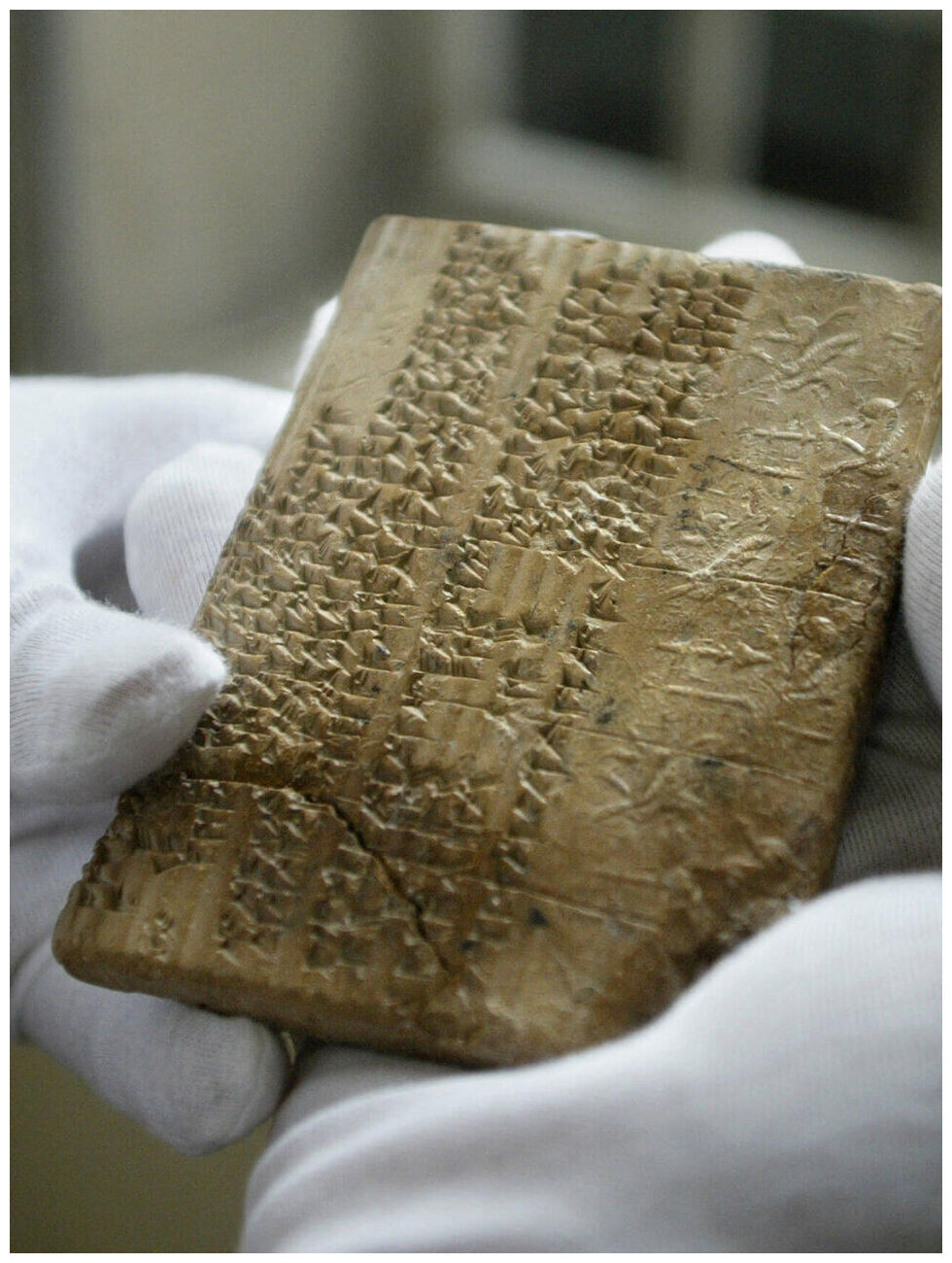
Linear Elamite, a writing system consisting of 77 geometric signs, was used during the Bronze Age by the Elamite civilization, which flourished in what is now southwestern Iran. The script was first rediscovered in 1903 during French archaeological excavations at the ancient city of Susa but remained undeciphered for more than a century because of the limited number of surviving inscriptions.

Desset said his interest in the script began in 2006 while participating in excavations in southern Iran, where Linear Elamite tablets were unearthed. He spent years attempting to decipher the inscriptions before gaining access to ten previously unavailable texts that proved decisive.

"The key to deciphering a script, as is so often the case, lies in proper names: names of places, gods, kings," Desset said.

Dollars

WTF happened in 1971?

WTF Happened in 1971?
Wanna see something weird? Get a load of this:

Cumulative Inflation 1913 - 2025
Not so weird? OK, how about this?

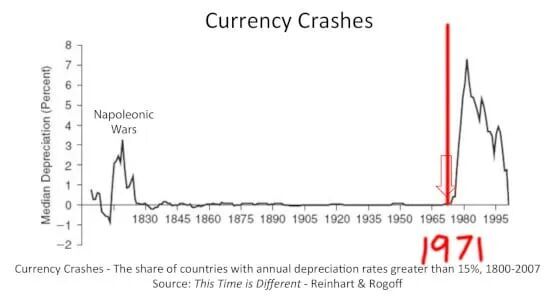
Currency Crashes
Not getting it yet? Then try this!

Workers Pay
Are you starting to get the picture? Then, feast your eyes on this:

Real GDP Per Capita and Median Male Income
And this:

Income Gains Widely Shared in Early Postyear Decades - But not Since Then
And even this:

Mean age of parents at birth

Info

4,000-year-old sealed cuneiform letters from Anatolia read without breaking their clay envelopes

Clay Tablets
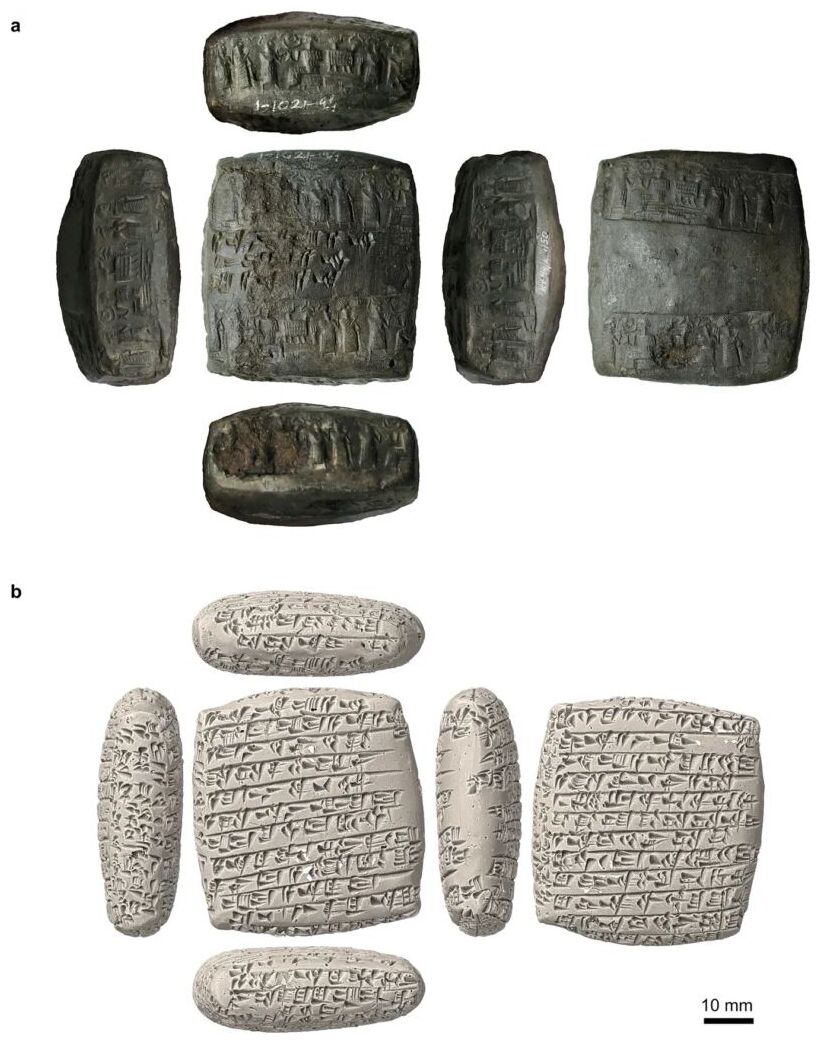
© Michel, C., et. al., 2026a Envelope of the letter. Size of the envelope: 5.3 cm × 4.9 cm × 2.6 cm. Photos: Samaneh Ehteram. b Visualisation of the hidden tablet (Kt 94/k 1150a). White surface colouring emphasises estimated patches where the envelope touches the tablet. Bounding box: 46.5 mm × 50.3 mm × 17.3 mm.
4,000-year-old sealed cuneiform letters from ancient Anatolia have been read without breaking their clay envelopes, thanks to a mobile X-ray CT scanner designed to bring advanced imaging directly into museum collections.

The study, published in npj Heritage Science, marks an important step for Assyriology and cultural heritage science. Many cuneiform tablets from Southwest Asia remain sealed inside clay envelopes, making their texts inaccessible unless the outer shell is destroyed. For decades, that was the only way to read them. It also meant losing seal impressions and other traces left by the people who sent, handled, and protected the documents.

Books

How the crossword conquered America and reigns even to this day

crossword puzzle graphic
© Tolga Akdoğan
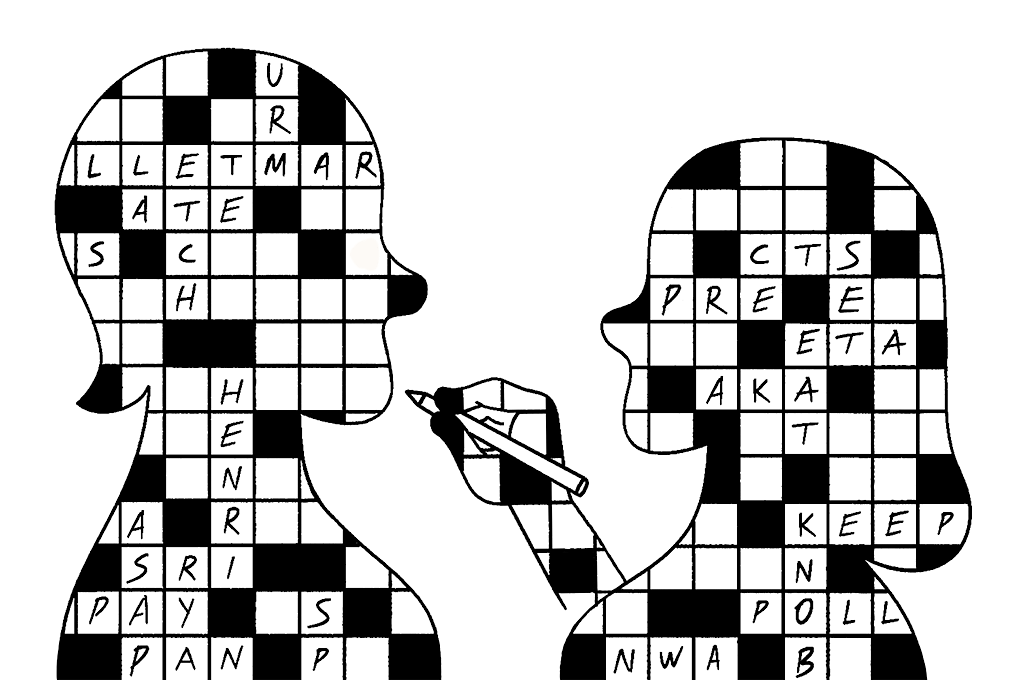
They're old fashioned. They were never supposed to be this popular. I saw why they're only getting bigger.

Even in a boom time for games, the decidedly old-fashioned puzzles are more popular than ever. I went to the best place on Earth to understand why.

What are puzzles for? They boom at times of trouble. During the 1930s, the New York Times dithered about whether to make its crossword puzzle a regular, serious feature of the paper. Then came the attack on Pearl Harbor. Margaret Farrar became the paper's first crossword puzzle editor after writing to the Times' publisher in the aftermath of the attack. "I don't think I have to sell you on the increased demand for this type of pastime in an increasingly worried world," she wrote. "You can't think of your troubles while solving a crossword."

The first crossword had been written a few decades earlier, by a Liverpool-born man called Arthur Wynne, and published in the New York World newspaper in 1913. Wynne thought he ought to patent his invention, but the paper demurred, because the patent would have cost almost $100, a decision that probably kept some executives awake every night of the 1920s, when crosswords became a full-blown worldwide fad. Newly free of the burdens of the First World War, the leisure classes latched on to crosswords, which were published widely thanks to a rapid increase in newspaper circulation at the time. Musicals were written about them, a new class of people called "celebrities" gushed over them, and one library in England even had to remove dictionaries from its reading room because they were getting worn to shreds by crossword nutters. By the end of World War II, most newspapers included their own crosswords or syndicates.

USA

The American Revolution and the danger of standing armies

American Revolution soldier
© AdobeStockAmerican Revolutionary
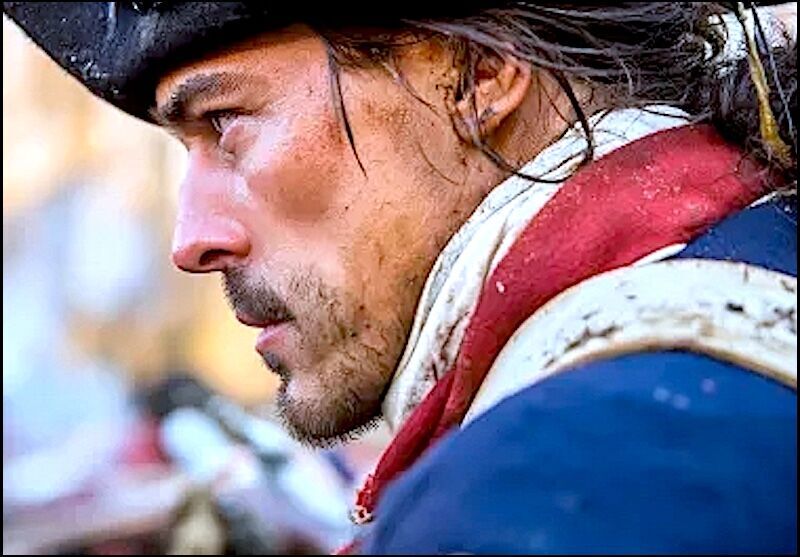
Among the key men involved in the American Revolution and the following periods, we find an oft-repeated concern that may seem foreign to us today — the threat of standing armies. This was a heritage of British legal thought and history, and it became an underappreciated part of American political thought and experience.

Why were peacetime standing armies viewed as such a threat?

To many Americans of this period, peacetime standing armies posed a threat not only because they could be used by the state to overthrow liberty, but because they tended to reshape society and government itself. A permanent military establishment could develop interests distinct from those of the people, become an instrument for enforcing unpopular or unconstitutional policies, and concentrate power in the hands of central authorities.

Standing armies also required permanent taxation, debt, and bureaucracy, fostering what later historians would call a fiscal-military state. This process also creates vested interests. Once careers, contracts, pensions, and bureaucracies depend upon military expenditures, peace may no longer seem desirable by many.

Archaeology

Enormous 2,000-year-old luxurious Roman bathhouse uncovered in the Netherlands

roman bathhouse netherlands
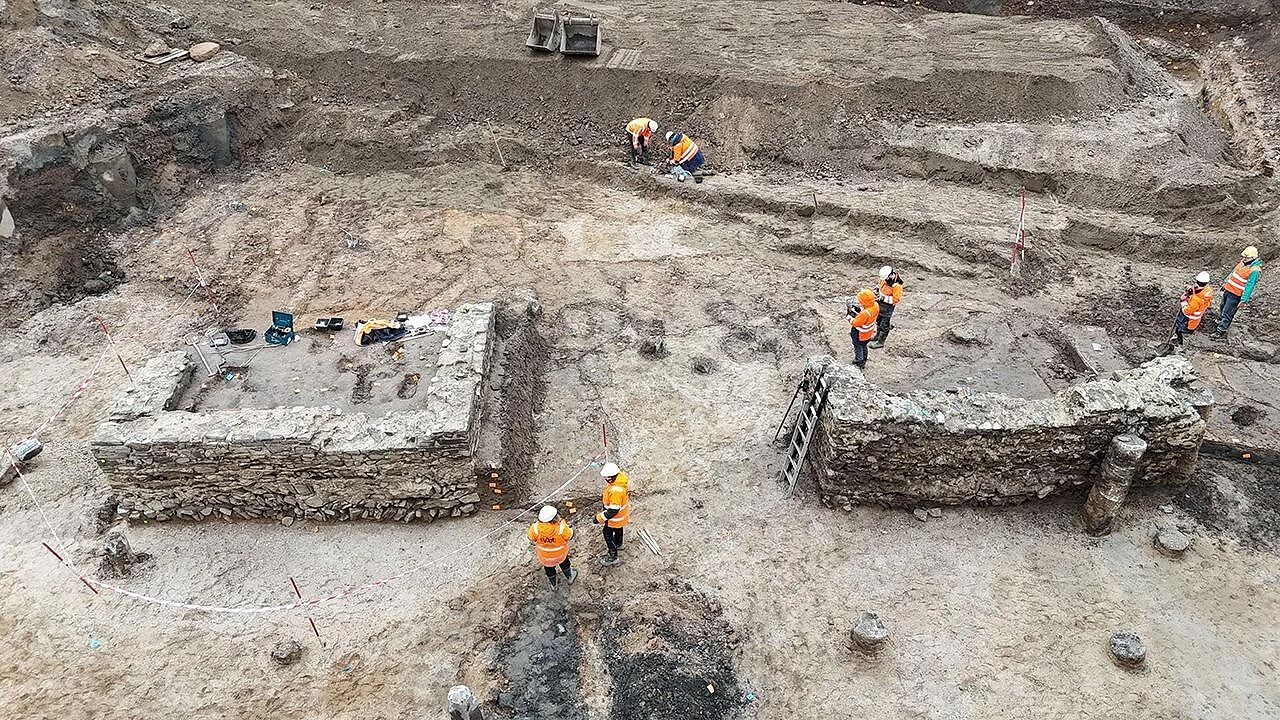
© Municipality of Nijmegen / BAAC / RAAPExcavation of the Roman bathhouse in Nijmegen
Archaeologists working in the Dutch city of Nijmegen have uncovered the largest Roman bathhouse complex ever found in the Netherlands. The structure stood in Ulpia Noviomagus, a Roman city along the River Waal, and covered at least 4,900 square meters. The size of the complex points to the importance of Nijmegen during the Roman period.

Teams from RAAP and BAAC began excavations in September at a redevelopment site in the Waalfront district, an area once occupied by industrial buildings. Their work exposed far more than a bathhouse. Researchers identified streets, residential blocks, large houses, and a tower, allowing them to reconstruct part of a prosperous urban neighborhood from the second and third centuries CE.

The bath complex was much larger than similar public bathhouses known elsewhere in the Netherlands. The bathhouse at Forum Hadriani, near modern Voorburg, covered about 2,200 square meters. The one at Coriovallum, in present-day Heerlen, measured around 2,500 square meters. The Nijmegen complex was more than twice the size of the former and nearly double the latter.

Bizarro Earth

The world government that wasn't

Hammarskjöld.Kennedy.Kruschev.Adlai Stevenson
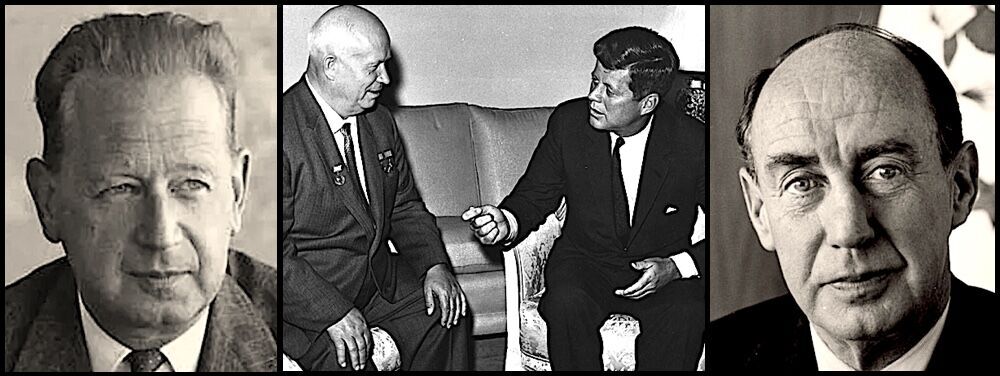
© White House Historical Society/Archives/KJNDag Hammarskjöld • John F. Kennedy and Nikita Kruschev • Adlai Stevenson
In 1961 Washington and Moscow agreed to abolish war. Then the men who meant it died.

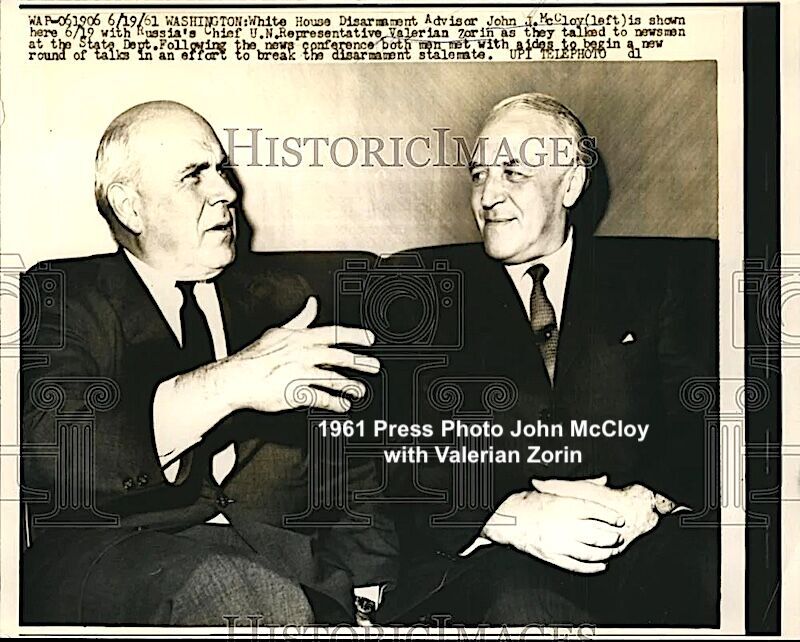
There are certain episodes in Cold War history that modern conservatives are expected to treat as either sinister fantasy or liberal delusion. The McCloy-Zorin Accords of 1961 occupy a curious place. Explain the concept today and half of the audience assumes you are describing a proto-globalist fever dream hatched in Manhattan conference rooms full of Scandinavian furniture and earnest men in rimless spectacles.

Yet for a brief moment — and this is the part that ought to unsettle both the utopians and the cynics — the United States and the Soviet Union formally agreed that the ultimate goal of international politics should be the abolition of war itself.

Not metaphorically. Literally.
McCloy/Zorin historical image
The "Joint Statement of Agreed Principles for Disarmament Negotiations," better known as the McCloy-Zorin Accords, was negotiated between American statesman John J. McCloy and Soviet diplomat Valerian Zorin in September 1961 and endorsed unanimously by the United Nations General Assembly in December 1961. It envisioned phased and verified general disarmament under international control, including the eventual elimination of national military establishments and the creation of a United Nations peace force.

Comment: Once in the lifetime of the world...there was this idea. We will never know its full value nor the outcomes history would record.