The question is not whether China rises — it already has — but what happens when that rise collides with America's entrenched empire.
© farmersjournal.ie
History has a way of whispering into the present. The 21st century is not simply another chapter in human history. It is the pivot — the point on which the balance of power turns, the moment when yesterday's world order collides with tomorrow's uncertainty. For over seven decades, the United States has ruled as the unchallenged empire, dictating the terms of global politics, finance, and security. But history, as we know, is never static. Empires rise, empires fall, and no power rules forever.
And so we ask the question: what happens when China rules the world or at least shares the stage with the American empire?
To understand this, we must go back — not to 2012 when Xi Jinping came to power, not even to 1978 when Deng Xiaoping unleashed reforms — but to the darkest days of the 20th century: a time when China was not the world's rising giant, but its bleeding victim.
When we think of World War II, most of us imagine Normandy beaches, Soviet tanks rolling into Berlin, or American bombers over the Pacific.
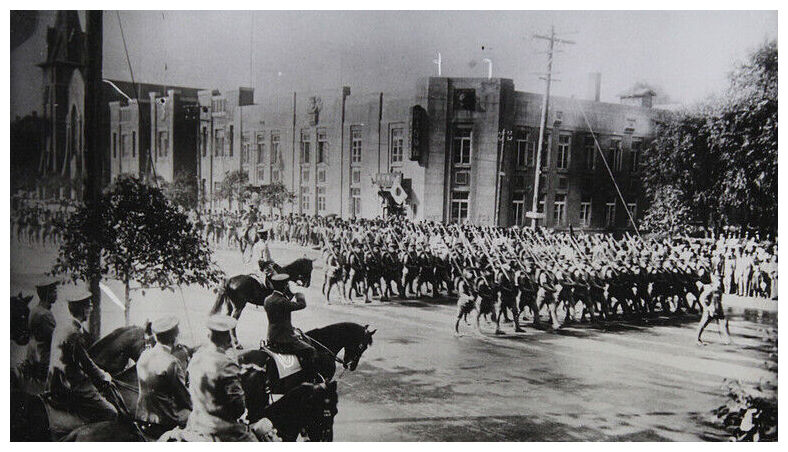
But there is another front — largely forgotten in Western narratives — where the fate of the war was shaped long before Pearl Harbor: China.On July 7th, 1937, at the Marco Polo Bridge near Beijing, the Empire of Japan launched its full-scale invasion of China. What followed was not just another colonial campaign, but the beginning of the longest continuous war of the Second World War. Eight years of bloodshed, eight years of occupation, and eight years of resistance.
China became the first nation to resist fascist expansion, standing alone against the Japanese war machine while Europe still dithered in appeasement.The scale of sacrifice defies comprehension.
Entire cities bombed relentlessly, long before London or Dresden. Chongqing became a city of fire, enduring years of aerial bombardment. The Rape of Nanjing — one of the worst atrocities of the 20th century — saw over 300,000 civilians massacred and tens of thousands of women subjected to systematic sexual violence.
By 1945, an estimated 20 million Chinese had perished — civilians and soldiers alike — second only to the Soviet Union in human loss. Millions more were displaced, starved, or broken by the grinding cruelty of war.
Yet, despite poverty, corruption, and internal division, the Nationalists under Chiang Kai-shek fought, the Communists under Mao waged guerrilla war, and ordinary peasants resisted occupation in ways large and small.











Comment: Also in the background discussion, is that Britain and France conspired to start World War I