Science & TechnologyS


Gold Bar

Chinese scientists discover way to turn copper into 'gold'

gold bar
A team of Chinese researchers have turned cheap copper into a new material "almost identical" to gold, according to a study published in peer-reviewed journal Science Advances on Saturday.

The discovery will significantly reduce the use of rare, expensive metals in factories, said the authors.

Professor Sun Jian and colleagues at the Dalian Institute of Chemical Physics, at the Chinese Academy of Sciences in Liaoning, shot a copper target with a jet of hot, electrically charged argon gas.

The fast-moving ionised particles blasted copper atoms off the target. The atoms cooled down and condensed on the surface of a collecting device, producing a thin layer of sand.

Each grain of the sand had a diameter of only a few nanometres, or a thousandth of the size of a bacterium.

Comment: See also:


People 2

New study shows why X and Y chromosomes alone don't determine sex

DNA ADN
© iStock
Scientists have discovered a new genetic regulator that plays a big role in determining whether a baby is born male or female, as well as whether or not their reproductive system is likely to develop differently after birth.

In the standard course of events, an embryo with two X chromosomes becomes a girl, while an embryo with an X and a Y chromosome becomes a boy - but the new gene and the genes it relates to can interfere with that process.

And the findings could also give us insight into what used to be known as 'junk' DNA: the parts of our genetic coding that don't actually hold any genes, but do contain regulators that have an impact on gene activity; more correctly referred to as noncoding DNA.

"The Y chromosome carries a critical gene, called SRY, which acts on another gene called SOX9 to start the development of testes in the embryo. High levels of the SOX9 gene are needed for normal testis development," says one of the researchers, Brittany Croft from the Murdoch Children's Research Institute (MCRI) in Australia.

"However, if there is some disruption to SOX9 activity and only low levels are present, a testis will not develop resulting in a baby with a disorder of sex development."

Comment: Evidently how our DNA affects us is based on a symphony of events rather than one 'switch' doing just one thing. It also goes to show just ignorant mainstream science could be when it considered vast swathes DNA as 'junk': Also check out SOTT radio's:


Coffee

New species of snake discovered inside stomach of another snake

Central American coral snake
© SVALDVARDCentral American coral snake
The Central American coral snake (Micrurus nigrocinctus) commonly eats smaller serpents, including a newfound species that hasn't yet been found in the wild.

Scientists have discovered a species of snake unlike any seen before, but this special serpent wasn't found sliding through its forested habitat in tropical Mexico. The newfound animal made its scientific debut in a more unconventional place: inside another snake's belly.

Newly described in a recent paper in the Journal of Herpetology, the creature has been dubbed Cenaspis aenigma, which translates to "mysterious dinner snake." The name derives from the Latin cena (dinner), aspis (a snake variety), and enigma.

This species has unique features that separate it from its relatives, including the shape of its skull, the covering of its hemipenis-its reproductive structure-and the scales under its tail.

Comment: See also: And check out SOTT radio's: The Truth Perspective: Are Cells the Intelligent Designers? Why Creationists and Darwinists Are Both Wrong


Cassiopaea

Earth loses hundreds of tons of atmosphere during auroras

streak sky
Scientists have known for some time that Earth's atmosphere loses several hundred tons of oxygen each day. They understand how this oxygen loss happens on Earth's night side, but they're not sure how it happens on the day side. They do know one thing though; they happen during auroras.

According to a press release from NASA's Earth Observatory, no two oxygen outflow events are exactly the same, which makes understanding them a challenge. They call the events 'fountains of gas' that escape the Earth during auroral activity, and the Earth Observatory has a mission dedicated to understanding them.

The mission is part of the NASA's Earth Observatory program called VISIONS-2 (Visualizing Ion Outflow via Neutral Atom Sensing-2), and it requires certain conditions. It's set in Ny Alesund, Svalbard, Norway for good reason. It's the northernmost year-round civilian settlement in the world. It has an ice-free harbour year round, and a modern rocket launch facility. There's also no sun in the winter night here to interfere with studying the auroras.

Comment: The chemical exchange between planet and cosmos is interesting, but scientists would probably advance their understanding by leaps and bounds if they considered the more fundamental electric-magnetic aspect of this exchange... Also check out SOTT radio's:


Info

A big space crash likely made Uranus lopsided

Uranus Struck by Object
© Jacob A. Kegerreis/Durham University via APThis image made from video provided by Durham University astronomy researcher Jacob Kegerreis shows a computer simulation generated by the open-source code SWIFT that depicts an object crashing into the planet Uranus. Kegerreis says the detailed simulations show that the collision and reshaping of Uranus 3 billion to 4 billion years ago likely caused the massive planet to tilt about 90 degrees on its side.
Washington - Uranus is a lopsided oddity, the only planet to spin on its side. Scientists now think they know how it got that way: It was pushed over by a rock at least twice as big as Earth.

Detailed computer simulations show that an enormous rock crashed into the seventh planet from the sun, said Durham University astronomy researcher Jacob Kegerreis, who presented his analysis at a large earth and space science conference this month.

Uranus is unique in the solar system. The massive planet tilts about 90 degrees on its side, as do its five largest moons. Its magnetic field is also lopsided and doesn't go out the poles like ours does, said NASA chief scientist Jim Green. It also is the only planet that doesn't have its interior heat escape from the core. It has rings like Saturn, albeit faint ones.

"It's very strange," said Carnegie Institution planetary scientist Scott Sheppard, who wasn't part of the research.

The computer simulations show that the collision and reshaping of Uranus - maybe enveloping some or all of the rock that hit it - happened in a matter of hours, Kegerreis said. He produced an animation showing the violent crash and its aftermath.

Satellite

MIT's Lidar technology accelerates hurricane recovery in the Carolinas

lidar recovery hurrican north carolina
© Massachusetts Institute of TechnologyThis lidar image shows how lake water has spilled over and washed out several large sections of roadway and train tracks in Boiling Spring Lakes, North Carolina.
Lincoln Laboratory's lidar data, processed quickly with support from the organization MCNC, helped FEMA assess flooding and damages caused by Hurricane Florence.

Hurricane Florence's slow trot over North and South Carolina in September led to inundating rain, record storm surges, and another major disaster for the Federal Emergency Management Agency (FEMA) to contend with. Facing damage over hundreds of square miles, FEMA again called upon MIT Lincoln Laboratory to use their state-of-the-art lidar system to image the destruction in the region.

Installed onto an airplane and flown nightly over a disaster site, lidar (which stands for light detection and ranging) sends out pulses of laser light that bounce off the land and structures below and are collected again by the instrument. The timing of each light pulse's return to the instrument is used to build what researchers call a "point-cloud map," a high-resolution 3-D model of the scanned area that depicts the heights of structures and landscape features. Laboratory analysts can then process this point-cloud data to glean information that helps FEMA focus their recovery efforts - for example, by estimating the number of collapsed houses in an area, the volume of debris piles, and the reach of flood waters.

Galaxy

Astronomers discover new kind planet possibly saturated with gemstones

planet sun
Precious stones might be relatively rare and hidden deep underground here on Earth, but space is an absolute treasure chest. Astronomers have found a new class of planets, and they're so abundant in the compounds that make sapphires and rubies, they could be positively sparkling.

These planets are a type of super-Earth - dense planets like Earth and Mars, with a high proportion of rock, metal or a combination of both, only much bigger (but still smaller than Neptune).

However, this group tend to orbit their stars much, much closer than Earth, or even most super-Earths. That means, if they orbit where they were formed, their composition could be very different. Rather than an iron core like Earth's, they are abundant in calcium and aluminium.

This, in turn, could mean the presence of rubies and sapphires, which are made of the mineral corundum - a crystalline form of aluminium oxide.

Comment: See also:


Galaxy

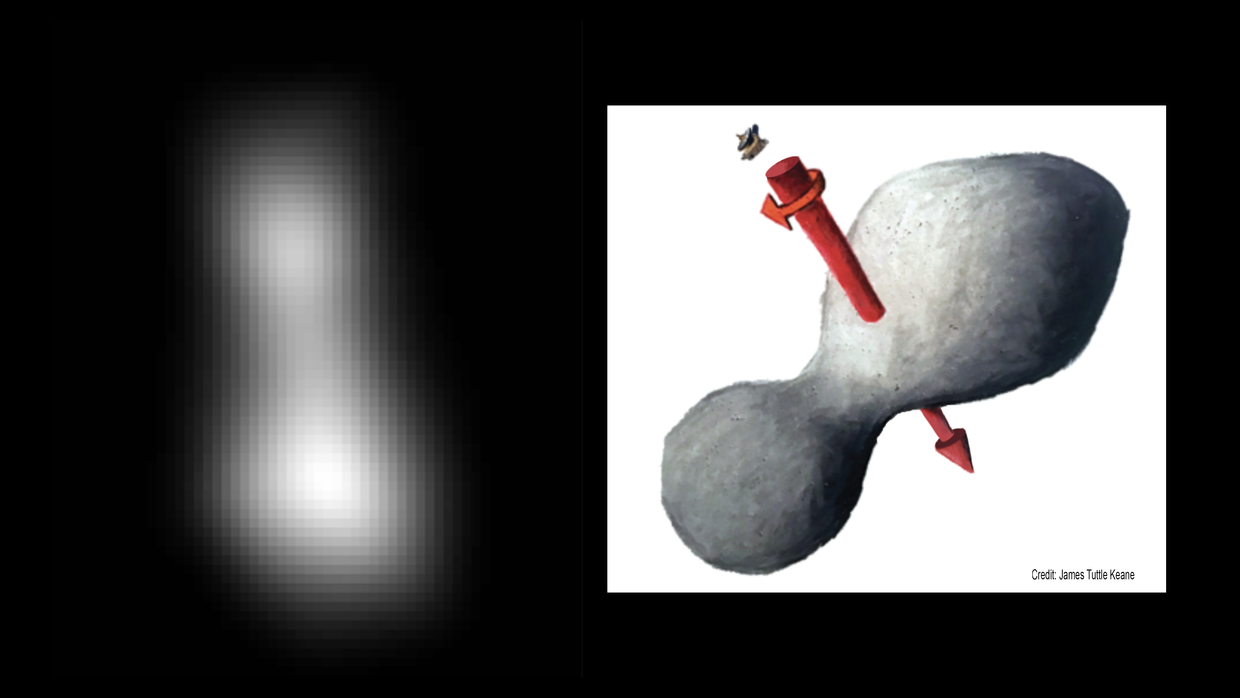
New Horizons scientists puzzled by lack of a 'light curve' from their Kuiper Belt flyby target

Ultima
© NASA/JHUAPL/SwRIUltima's shape was measured in July 2017 as its silhouette passed in front of a star – what's known as a stellar occultation.
NASA's New Horizons spacecraft is bearing down on Ultima Thule, its New Year's flyby target in the far away Kuiper Belt. Among its approach observations over the past three months, the spacecraft has been taking hundreds of images to measure Ultima's brightness and how it varies as the object rotates.

Those measurements have produced the mission's first mystery about Ultima. Even though scientists determined in 2017 that the Kuiper Belt object isn't shaped like a sphere - that it is probably elongated or maybe even two objects - they haven't seen the repeated pulsations in brightness that they'd expect from a rotating object of that shape. The periodic variation in brightness during every rotation produces what scientists refer to as a light curve.

"It's really a puzzle," said New Horizons Principal Investigator Alan Stern, of the Southwest Research Institute. "I call this Ultima's first puzzle - why does it have such a tiny light curve that we can't even detect it? I expect the detailed flyby images coming soon to give us many more mysteries, but I did not expect this, and so soon."

What could explain the tiny, still undetected light curve? New Horizons science team members have different ideas.

"It's possible that Ultima's rotation pole is aimed right at or close to the spacecraft," said Marc Buie, also of the Southwest Research Institute. That explanation is a natural, he said, but it requires the special circumstance of a particular orientation of Ultima.

Camera

Mile-long asteroid discovered makes another fly-by of Earth today

Radar image of Asteroid 2003 SD220
© NASARadar image of Asteroid 2003 SD220
It's not an Armageddon event, but a huge asteroid made a close approach to Earth early on Saturday showed its curves in a NASA photo session.

Asteroid 2003 SD220 is its official name, but American space scientists called it "hippopotamus wading in a river."

The radar images made by the US space agency's antennas in California, West Virginia and Puerto Rico revealed that the asteroid has an impressive length of at least 1.6 kilometers.

It is very slow with a rotation period of roughly 12 days as it spins like "a poorly thrown football." It's called "non-principal axis" rotation, which is very unusual for near-Earth asteroids, NASA said.

Christmas Tree

Japan's 50 year old forest circle experiment yields unusual results

Japan circle forest
© Sankei NewsThe two tree ‘crop circles’
Two peculiar 'crop circles' have recently been spotted in Japan's Miyazaki Prefecture. Viewable only from above, they were formed by sugi (Japanese cedar) trees.

Conspiracy theorists will be disappointed to learn that there is a very practical explanation for how these shapes emerged: science. Specifically, it was the result of a scientific experiment that spanned close to 50 years.

According to documentation (PDF) we obtained from Japan's Ministry of Agriculture, Forestry and Fisheries, in 1973 an area of land near Nichinan City was designated as "experimental forestry" and one of the experiments was to try and measure the effect of tree spacing on growth. The experiment was carried out by planting trees in 10 degree radial increments forming 10 concentric circles of varying diameters.

Comment: See also: