
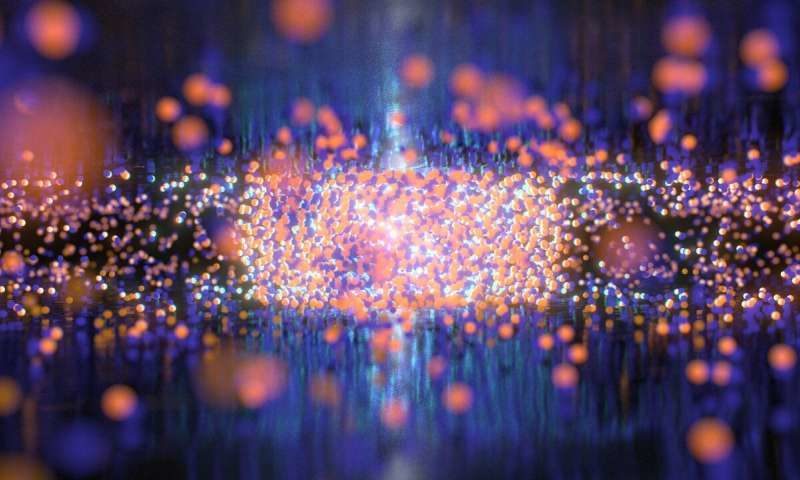
© QMO Lab, UC RiversideIn conventional electronic devices, electricity requires the movement of electrons (blue spheres) and their positive counterparts, called holes (red spheres), which behave much like the gas molecules in our atmosphere. Although they move rapidly and collide infrequently in the gas phase, electrons and holes can condense into liquid droplets akin to liquid water in devices composed of ultrathin materials.
The achievement opens a pathway for development of the first practical and efficient devices to generate and detect light at terahertz wavelengths-between infrared light and microwaves. Such devices could be used in applications as diverse as communications in outer space, cancer detection, and scanning for concealed weapons.
The research could also enable exploration of the basic physics of matter at infinitesimally small scales and help usher in an era of quantum metamaterials, whose structures are engineered at atomic dimensions.














Comment: See also: