
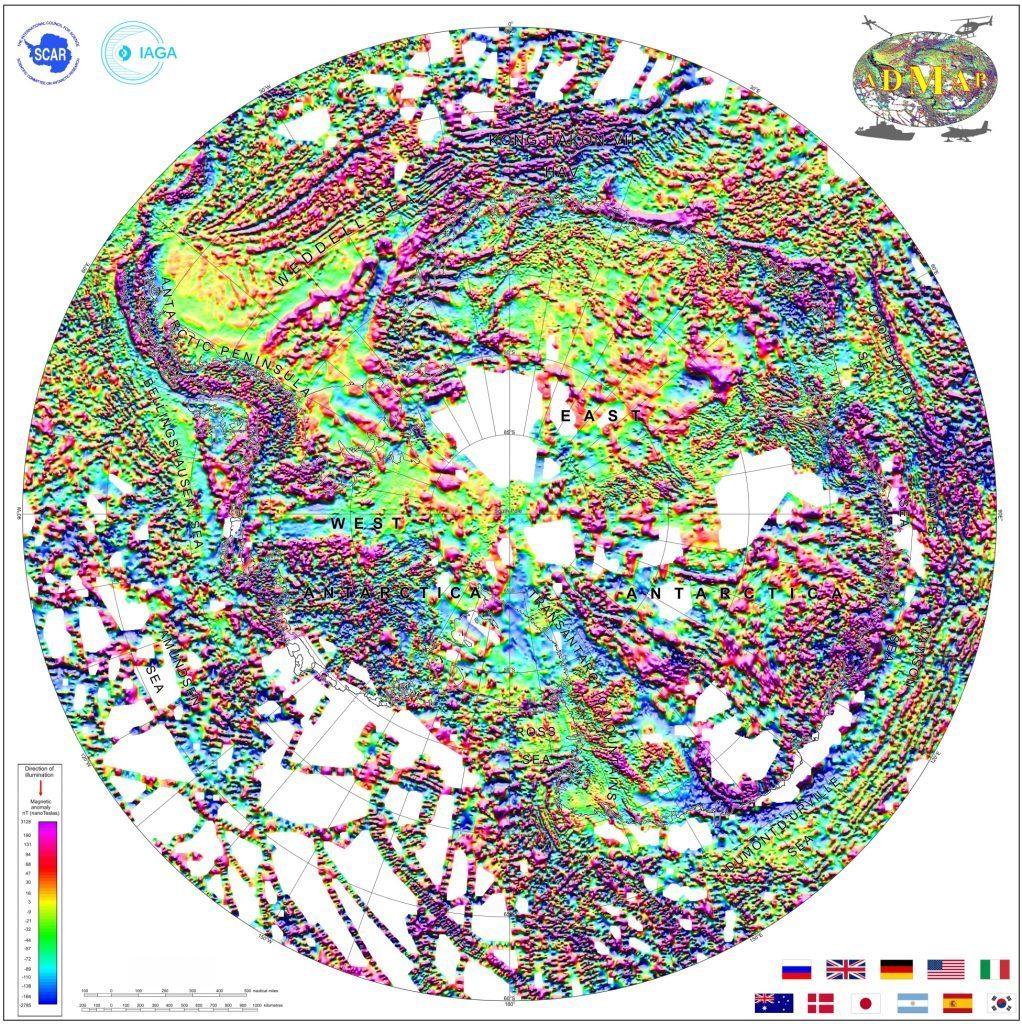
© Golynsky et al/American Geophysical UnionNew magnetic anomaly map of the Antarctic continent and surrounding oceans.
The new map - which includes 3.5 million line-kilometers of magnetic anomaly data collected over the past 50 years - sheds new light on the structure and evolution of the Antarctic continent and its surrounding oceans.
Antarctica's remoteness and harsh conditions make it a supremely challenging environment for researchers who study the continent. For geoscientists, however, research is particularly tough because the rocks they seek to understand are buried deep beneath the thick ice sheet that blankets the continent.
Less than 1 percent of Antarctica's geology is visible above its icy mantle, so in addition to using traditional geological mapping, geoscientists rely on magnetic anomalies to help them interpret the fundamental building blocks of the continent and their tectonic boundaries.
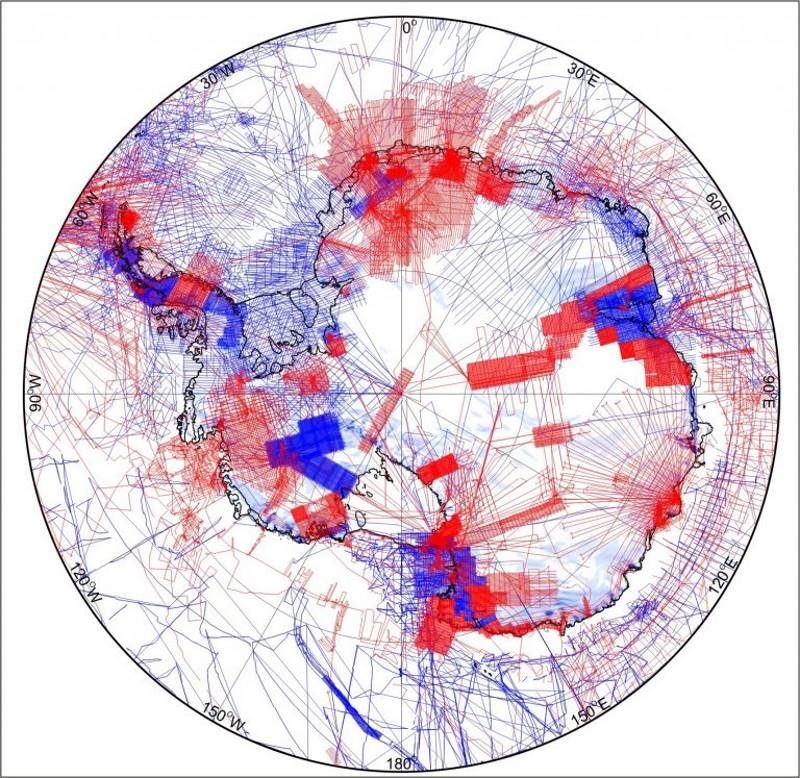
© Golynsky et al./American Geophysical UnionMap showing the location of the magnetic lines used for the ADMAP 2.0 compilation. Blue lines show the data included included in ADMAP 1. The new lines acquired by the international geophysical community since 2000 are shown in red.
ADMAP-2.0 doubles the coverage of the first version of ADMAP released in 2001. It includes data collected over previously unexplored sectors of Antarctica (e.g., Dronning Maud Land, Wilkes Land) and huge mountain ranges such as the Gamburtsev Subglacial Mountains and the Transantarctic Mountains. Both the new map and its datasets are freely available.
"The project shows the full potential of international collaboration to obtain such continental-scale compilations," said Alexander Golynsky from VNIIOkeangeologia in Russia and lead author of the new paper. "By including large new datasets and using advanced re-processing and data merging techniques we have vastly improved the Antarctic magnetic anomaly map".
"Our new map helps reveal the crustal architecture of the entire Antarctic continent with much more detail than before," according to Fausto Ferraccioli, Science Leader at the British Antarctic Survey and co-chair of the ADMAP international steering committee. "It allows us to image many of the key geological features hidden under the thick ice sheets that blanket the continent."

© Golynsky et al./American Geophysical UnionThe map shows the magnetic anomaly data density available for the ADMAP 2.0 compilation. Red to greenish colors show regions where high to medium spatial resolution is now available. Note that several large areas in both East and West Antarctica lack such good data coverage. Some of the major remaining data gaps (white areas) are now a prime target for future international exploration.
"Until now we have lacked a coherent geophysical compilation needed to trace much better-understood geological features from other continents into Antarctica. This fantastic new tool will help us answer many geological questions, such as how Gondwana broke apart and also help us understand how Antarctica's geology influences the way in which its ice sheets flow today," Ferraccioli explains.
"Our next challenge is to fill in the remaining magnetic data gaps by exploring the most remote frontier areas of Antarctica building on the success of our international collaboration," said ADMAP co-chair Graeme Eagles from the Alfred Wegner Institute.
ADMAP-2.0 involved scientists from 22 institutions across 11 nations, and the Korean Polar Research Institute funded the map compilation.



Reader Comments
to our Newsletter