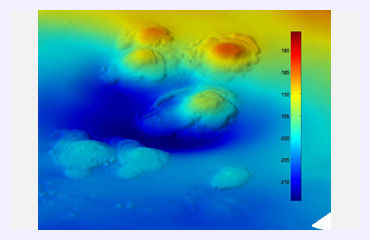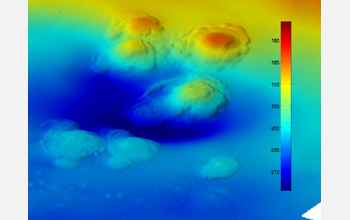
© Dana Yoerger, WHOIHigh-resolution bathymetry shows extinct asphalt volcanoes on the sea-floor off California.
About 10 miles off the Santa Barbara coast, at the bottom of the Santa Barbara Channel, a series of impressive landmarks rise from the sea floor.
They've been there for 40,000 years, but have remained hidden in the murky depths of the Pacific Ocean--until now.
They're called asphalt volcanoes.
Scientists funded by the National Science Foundation (NSF) and affiliated with the University of California at Santa Barbara (UCSB), the Woods Hole Oceanographic Institution (WHOI), University of California at Davis, University of Sydney and University of Rhode Island, have identified the series of unusual volcanoes.
The largest of these undersea Ice Age domes lies at a depth of 700 feet (220 meters), too deep for scuba diving, which explains why the volcanoes have never before been spotted by humans, says Don Rice, director of NSF's Chemical Oceanography Program, which funded the research.
"They're larger than a football-field-long and as tall as a six-story building," says David Valentine, a geoscientist at UCSB and the lead author of a paper published on-line this week in the journal
Nature Geoscience. "They're massive features, and are made completely out of asphalt."