Wildfires
S


Fire

Four killed as out-of-control bushfires burn in Western Australia

Australia bush fire
© Kate SaintyThe fires were started by strikes of lightning.
Four people have been killed and there are fears for two others caught in bushfires in Western Australia.

Hundreds of firefighters are battling major blazes that were reportedly sparked by lightning over the weekend.

The worst of the blazes are north of the coastal town of Esperance, 720km south-east of Perth.

Strong winds with gusts up to 90km/h (56mph) have hampered efforts to bring the fires under control.

They are the first serious bushfires of the Australian summer.

Cloud Lightning

Lightning strikes start bushfires in Goomalling, Kalbarri, Australia

Image
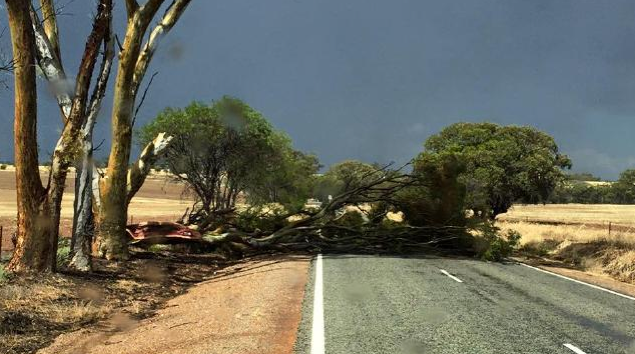
© Matt Fricker and Perth Weather LiveA tree fallen across the Goomallng-Toodyay Road after lightning strikes around the Wheatbelt.

Lightening strikes are believed to have sparked several bushfires across WA on Saturday.

Thunderstorms and lightning strikes in the Wheatbelt are believed to have sparked fires west of Goomalling on Saturday afternoon.

Pictures of fallen down trees on major roads near Goomalling, which is about 45km northeast of Northam, also emerged online.

Fire

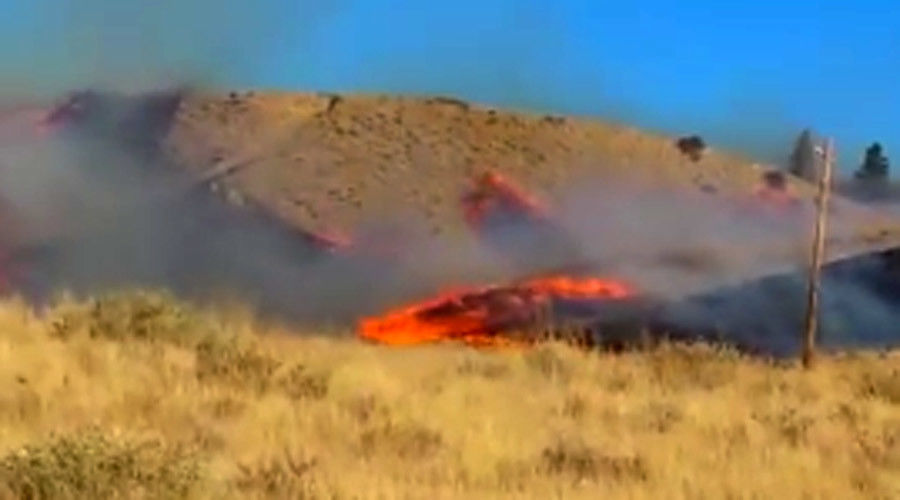
Fire power: Hill in Wyoming ablaze within seconds threatening dozens of homes

Dead horse hill fire
© Dark Veteran / YouTube

A video posted on YouTube shows a fire racing up a hill, turning it from pale yellow to charred black in a matter of seconds. The unbelievable speedy blaze put 30 to 50 homes in danger and triggered evacuation warnings.

Around 30 acres of land were affected by the fire, but luckily no one was injured and neither did any homes burn down in Dead Horse Hill in Casper, Wyoming.

"Oh my God. It's so scary. It's crazy!" you can hear someone say on the clip.

Comment: All over the world we are witnessing extensive wildfires, which in some regions have been described as "unprecedented". The National Interagency Fire Center has described the 2015 wildfire season in the United States as a record breaker.

A record 52 percent of the U.S. Forest Service's budget was dedicated to fighting wildfires this year, compared to 16 percent in 1995. Two massive wildfires that burned up parts of Northern California did nearly $2 billion in damage according to one insurance company.

Could some of these wildfires have been fueled from outgassing, then possibly 'sparked' by an increase in atmospheric electric discharge events, such as lightning strikes and other 'cosmic' ignition sources? See also:

Study: Wildfire seasons are more destructive and lasting longer almost everywhere on Earth


Fire

Massive Amazon wildfire destroys forest in Brazil and threatens uncontacted tribe

Image
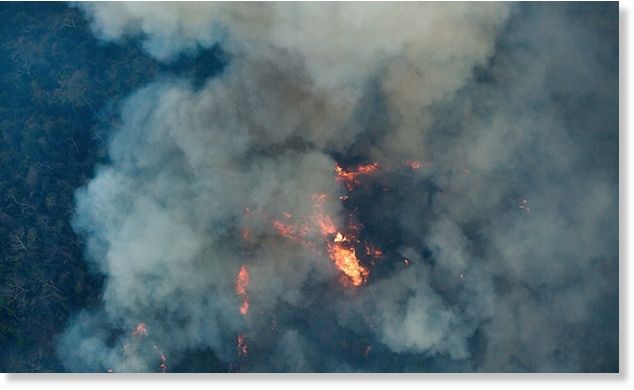
© Marizilda Cruppe/Greenpeace An aerial picture released by Greenpeace shows forest fires in the indigenous lands in Arariboia, Maranhão.
Brazilian rangers, firefighters and indigenous communities are battling against a wildfire that has blazed for two months and devastated some of the last Amazonian forest in the northern state of Maranhão, including part of the territory of an uncontacted tribe.

The fire - which has spread across 100km at its peak - is thought to be the biggest in Indian territory for decades and has prompted the local government to declare a state of emergency.

It comes amid rising tension between indigenous "forest guardians" and illegal loggers, prompting speculation among officials and environmentalists that the blaze may have been started deliberately.

According to Greenpeace, the fire has already consumed 45% of the 413,000-hectare (1m acre) Indigenous Territory of Arariboia, despite the efforts of 250 firefighters.

Worst affected are the 12,000 people from the Guajajara ethnic group, whose communities have been surrounded by flames. There are also fears for the approximately 80 members of the Awá-Guajá, an uncontacted tribe.


Fire

Toxic haze threatens millions in southeast Asia, as Indonesia's wildfires continue

Indonesia wildfires
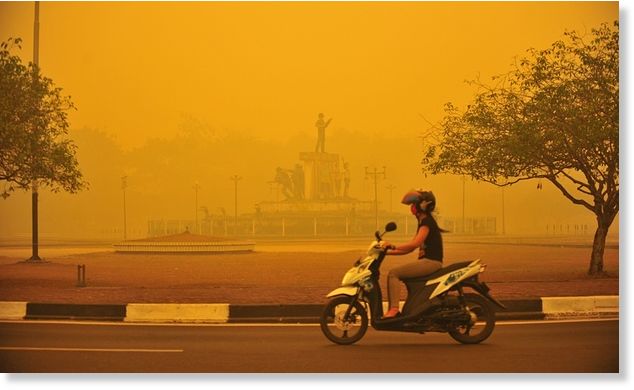
© Hugo Hudoyoko/EPAAn Indonesian woman rides a motorbike amid thick haze in Palangkaraya, Central Kalimantan province, Indonesia.
Indonesian President Joko Widodo is cutting short his visit to the US to deal with a growing environmental crisis back home.

Wildfires across the length of his country over the last few months have thrown up huge clouds of smoke that now hang over much of southeast Asia, from Malaysia and Singapore, across Indonesia, to Papua New Guinea.

The Indonesian Disaster Agency estimates 500,000 people have developed respiratory problems since the fires began in July. Millions of people are dealing with smoke levels roughly 10 times the level the World Health Organization considers hazardous.

"It's hard for people to imagine how serious this is," says Nigel Sizer, forests director for the World Resources Institute, an environmental research group in Washington. Sizer was in Indonesia for the summer and is heading back next week.

"This is literally almost off the charts in terms of air quality," adds Sizer. "It's like you're staring through thick bonfire smoke day after day. ... It's an extraordinary situation."

Comment: According to researchers some of the noxious components of the smoke include: ozone, carbon monoxide, cyanide, ammonia and formaldehyde, which is "extremely hazardous" for health, prompting child evacuation plans to be prepared.

Martin Wooster, Professor of Earth Observation Science at King's College London and National Centre for Earth Observation (NCEO) states:
"I've visited quite a few sites of biomass burning during my 10 years or so of research in the area. And I can certainly say this is the worst situation I've ever encountered for biomass burning or any form of combustion in a natural environment,"
All over the world we are witnessing extensive wildfires, which in some regions have been described as "unprecedented". The National Interagency Fire Center has described the 2015 wildfire season in the United States as a record breaker.

Could some of these wildfires have been fueled from outgassing, then possibly 'sparked' by an increase in atmospheric electric discharge events, such as lightning strikes and other 'cosmic' ignition sources? See also:

Study: Wildfire seasons are more destructive and lasting longer almost everywhere on Earth


Fire

Texas wildfire explodes in size

A rapidly growing wildfire is burning across 4000 acres in Texas and has forced 400 families from their homes. There is a state of emergency tonight and several homes have already burned to the ground. Military helicopters are helping to take on a blaze. The fire exploded in size overnight burning at least nine homes to the ground with Governor Greg Abbott declaring a state of disaster.

Fire

State of emergency declared in central Texas county hit by wildfires

bastop wildfire, texas wildfire 2015
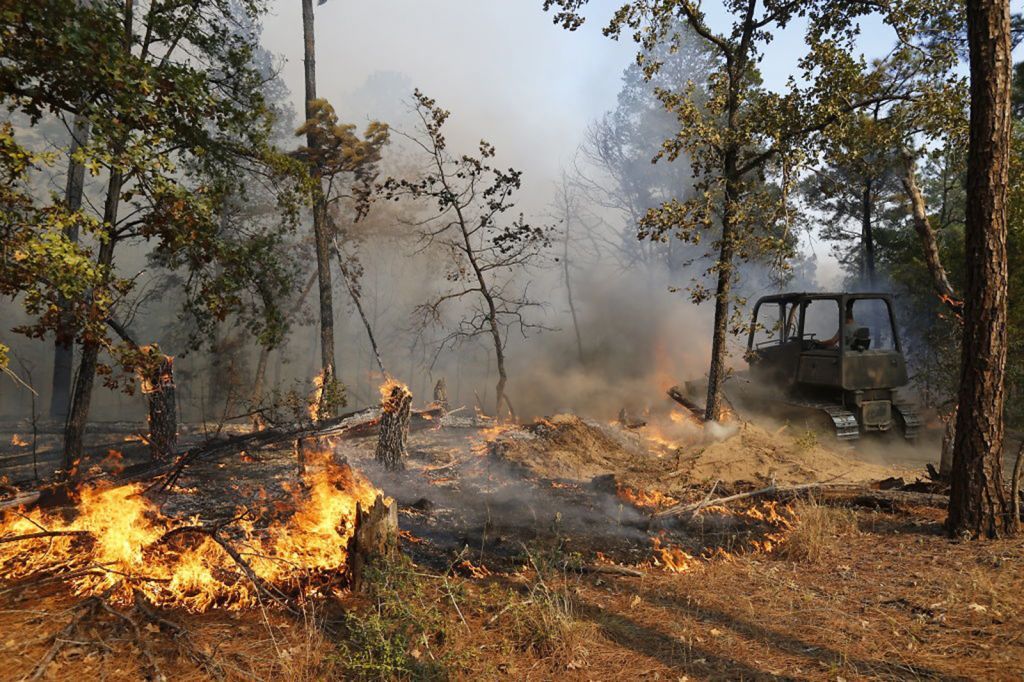
© Rodolfo Gonzalez, AP Firefighters work with heavy machinery to contain the fire near Smithville, Texas, Wednesday, Oct. 14, 2015.
Texas Governor Greg Abbott declared a state of disaster on Thursday in a central Texas county hit by a wildfire that has destroyed 34 structures, sent scores of people fleeing for safety and scorched nearly 7 square miles.

Abbott said he has authorized the deployment of military helicopters for the fire that has hit Bastrop County, east of Austin. He also sought a fire assistance grant from the Federal Emergency Management Agency, which was immediately approved.

"So far, we have been very fortunate in this fire in that no person has lost their life. We want to conclude this fire by being able to say the same thing," Abbott told a news conference.

Bizarro Earth

Australian wildfires rage as 'Godzilla El Nino' takes affect

Image
© AFPA charred car stands destroyed after a bushfire moved through the area near One Tree Hill in the Adelaide Hills on January 5, 2015
Over 100 bushfires are blazing in the state of Victoria, Australia, with over 200 homes at risk. Unusually high temperatures and strong winds have fueled the fires, which are threatening areas about 80 kilometers northwest of Melbourne.

Firefighters are struggling to put out the blazes, with changing wind directions making their task even more difficult. Aerial water bombers have also been called in to provide assistance, as gusts of wind have reached over 100 kilometers an hour.

The Country Fire Authority (CFA) says that over 100 fires are raging north of Melbourne, while local politicians have been urging locals to take precautions.

Fire

2015 wildfire season already a record-breaker

Image
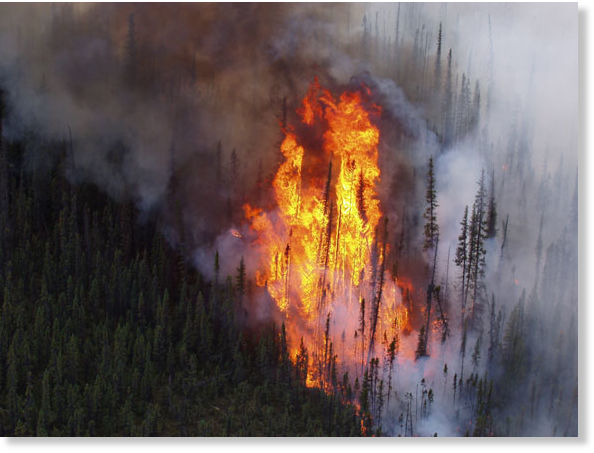
© U.S. Fish and Wildlife Service.Trees engulfed in flames at the Tetlin National Wildlife Refuge in Alaska.
Worst recorded years for U.S. wildfires are 2005, 2006, 2007, 2011 and 2012. This year has already joined that list, and wildfire season is still going strong.

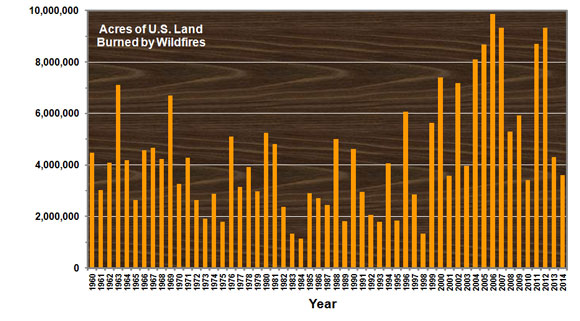
The 2015 wildfire season in the United States has already broken records. So far this year, more acres of land have burned as of mid-September than the total annual amount in 2011, which was the 4th worst year for wildfires at least since the 1960s. So will this year be the new fourth worst, third worst, second worst, or worst wildfire year since then? Read on, and take a guess.

The National Interagency Fire Center in Boise, Idaho, publishes a ton of useful statistics on wildfires that are critical for helping state and federal agencies manage the flames. These records date back to the 1960s.

The chart below, created with the National Interagency Fire Center data, shows that the worst years for wildfires in the U.S., since these records began being kept, were 2006 (9,873,745 acres burned), 2007 (9,328,045 acres burned), 2012 (9,326,238 acres burned), 2011 (8,711,367 acres burned), and 2005 (8,689,389 acres burned).
Image
© D. E. Conners, EarthSky.Annual amount of land burned by wildfires in the U.S.
Already as of September 18, 2015, 8,821,040 acres of land have burned across the U.S., and this number exceeds the total number of acres burned for 2011. Hence, 2015 has already earned a spot as the 4th worst year on record, and the 2015 wildfire season is still going strong.

Comment:


Fire

California wildfires continue to rage, destroying more than 1,600 structures, killing six

California wildfire plane
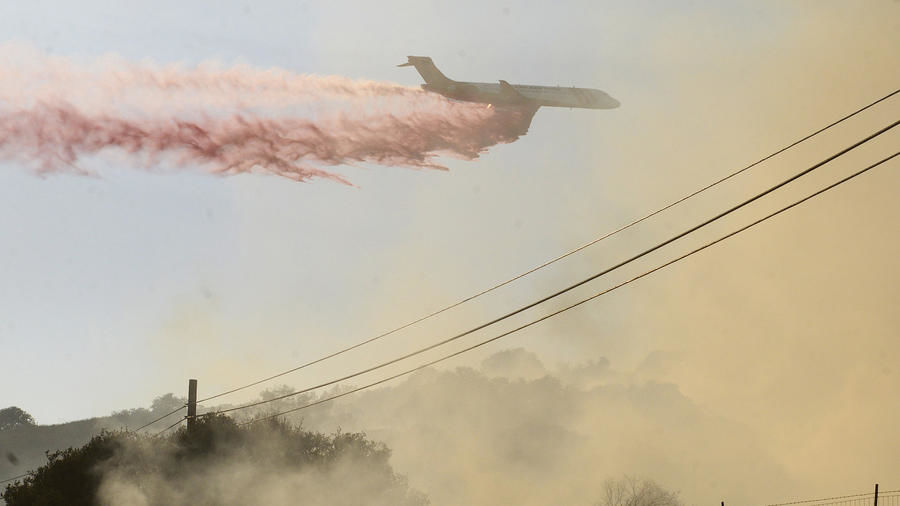
© David Royal / Associated PressA plane drops fire retardant on a fire along Highway 68 east of Laureles Grade in rural Salinas, Calif., on Saturday, Sept. 19, 2015.
More than 1,600 structures have been destroyed as three deadly wildfires continued to burn through thousands of the acres in Northern California.

As firefighters made progress on the Valley and Butte fires, hundreds of people displaced by the blazes returned over the weekend to find the charred remains of their homes and towns.

The Valley fire, one of the most destructive in the state's history, has burned 75,781 acres, destroyed 1,050 structures and left three dead. It ignited Sept. 12 and traveled 10 miles in 10 hours, expanding to 50,000 acres in the space of a day.

Teams of firefighters were still crisscrossing the burn area Sunday, stamping out remaining hotspots and putting out smoldering stumps. By Monday morning, the fire was 70% contained.

"We're in the mopping-up stages now, just extinguishing smoke and hotspots," said Capt. Richard Cordova, a spokesman for the California Department of Forestry and Fire Protection. "You're not going to see any flames."

Comment: According to the National Interagency Fire Center, the 2015 wildfire season in the United States is a record breaker. All over the world we are witnessing extensive wildfires, which in some regions have been described as "unprecedented".

Could some of these wildfires have been fueled from outgassing, then possibly 'sparked' by an increase in atmospheric electric discharge events, such as lightning strikes? See also:

Study: Wildfire seasons are more destructive and lasting longer almost everywhere on Earth
Image
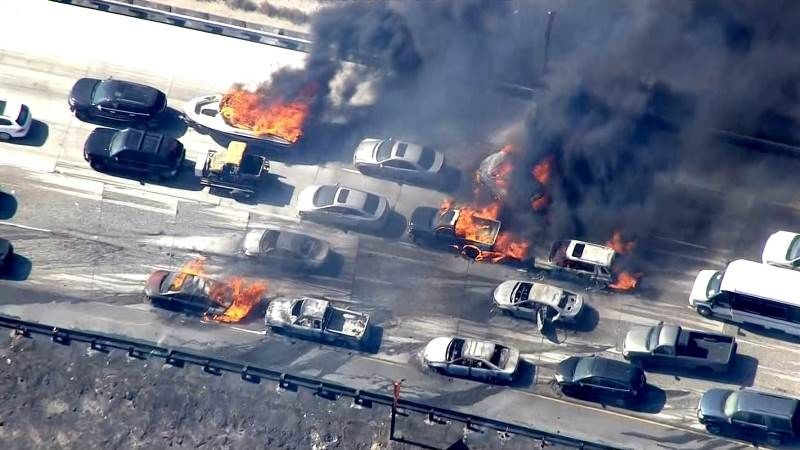
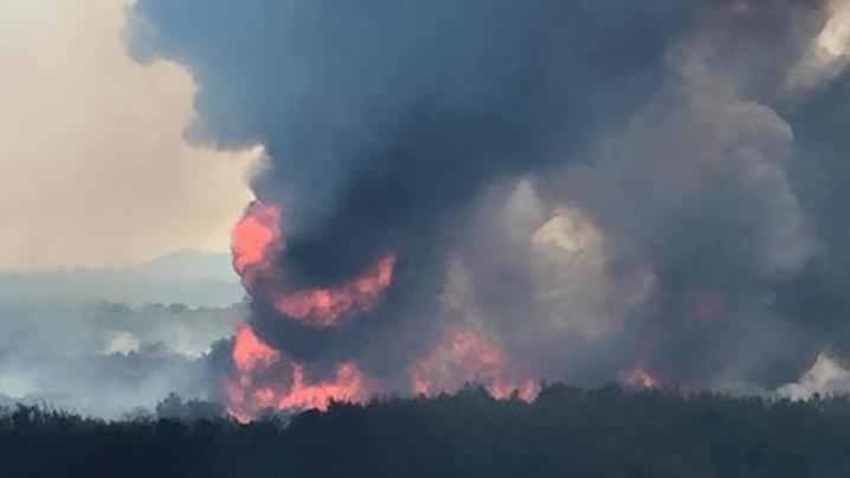
The wildfire outside Los Angeles in July this year that torched vehicles on its way through a major highway