I would be remiss if I did not note that the Discovery Networks, which recently purchased the Travel Channel, moved
Expedition Unknown from Travel to the Discovery mothership. That's about as far as my interest goes, however. I suppose it's nice that Josh Gates has a bigger platform, but I hope that the parent network will keep a tighter leash on quality control and avoid the forays into ancient astronautics and guest spots from problematic figures like Brien Foerster that marred the show's original Travel Channel run.
Anyway... I have been invited to write the cover feature for an upcoming issue of
All About History magazine, but the deadline is rather short, and this will necessitate me taking some time off to work on the piece. I'm working out the details with
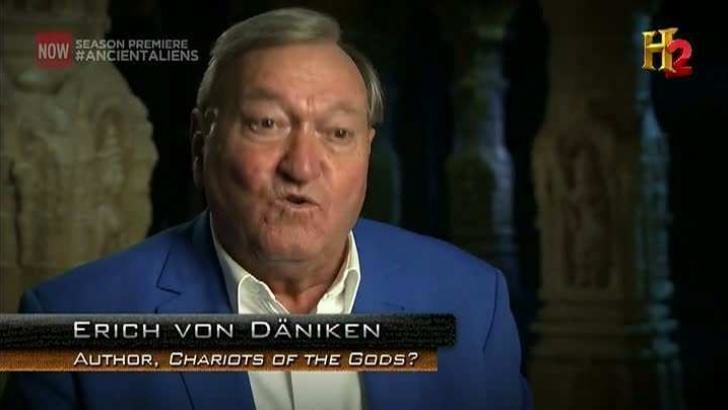
All About History right now, but I imagine that over the next couple of weeks, I'll need to cut down my blogging or take a week off while I write the article. I'll post details as I figure them out. In the meantime, Erich von Däniken has some new things to say.
The Austrian newspaper
Kronen Zeitung published a
German-language interview with von Däniken earlier this month, and in it they asked him what the aliens really look like. "It is assumed that evolution has been different on planets other than ours," he said, in my translation. "I always scoff and say, maybe they're flying crocodiles or talking trees." He then told the interviewer that the panspermia hypothesis suggests that aliens look like humans because Earth was seeded from the stars. He then cited the ancient epics of India as "proof" that space aliens visited the ancient Earth. He cited an unnamed passage from one epic about "three cities" floating through the sky and called the ancient texts "scientific information." He asserted that the space aliens have already returned to Earth and are among us.
He alleged that central European "journalists and scientists" have created a culture where belief in UFOs is heavily criticized and therefore Austrians, Germans, and Swiss are less likely to report UFO sightings than their American counterparts. What he really said is that in places where science and facts are still respected, people are less likely to indulge in open fantasy.
Comment: What seems to be the case with reporting of UFO related topics in the mainstream media, whether in print or on television, is that serious and open reporting, debate and information exchange has for the most part, until just recently, not been allowed. Only recently has this changed in a small way with the To The Stars Academy coming onto the scene and mainstream media reporting on some past military encounters with UFOs. And then we should be asking, "why the change?"
Sure they will let shows like
Ancient Aliens on television because it really doesn't lead people to objective information and makes the whole topic of UFOs and aliens look ridiculous to the general public and then paints an easy target for skeptics and official organizations to debunk and ridicule. Besides making the study and discussion of UFOs and aliens look ridiculous and paint a picture of mental instability and lack of objectivity for those who take the topics seriously, it can also be seen as a form of disinformation, whether it is created deliberately for that purpose or not. There is some truth mixed with either lies, distortions or a less than critical examination of the evidence and information. This then allows skeptics, like the author above, a platform to question what is going on and to bolster their position.
Tom DeLonge forms public UFO research project with government insiders including DoD and CIA veteransFormer manager of DOD aerospace threat program: "UFOs are real"How did a UFO story make the front page of the New York Times?














Comment: Another possibility: Advanced life may exist in a form beyond matter