Earth ChangesS


Bizarro Earth

Russian Volcano Shows Signs Of Impending Eruption

Image
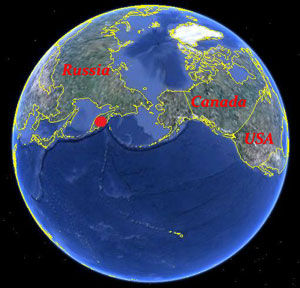
Kamchatka Peninsula marked on GOOGLE EARTH
The Kamchatka Peninsula, along Russia's Pacific coast, is currently the most volcanically active area in the world: four volcanoes are erupting simultaneously, and a fifth is showing signs of an impending eruption.

Ash plumes from two of these volcanoes are visible in this natural-colour satellite image. Along the northern (top) edge of the image Shiveluch emits a broad gray plume from the lava dome growing on its southern flank. 90 kilometres (60 miles) to the southwest a much smaller plume escapes from Bezymianny.

This image was acquired by the Moderate Resolution Imaging Spectroradiometer (MODIS) aboard the Aqua satellite on August 3, 2011. Bright green vegetation covers the river floodplains and mountainsides, which gives way to bare rock and eventually snow at higher elevations.

Cloud Lightning

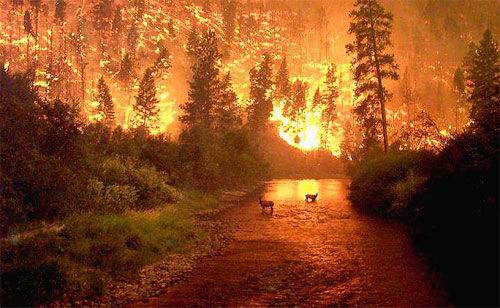
US: Lightning sparks 3 wildfires in Bitterroot National Forest, Montana

bitteroot national forest fire
© John McColgan
Lightning sparked three wildfires in the Bitteroot National Forest after Thursday night's storm.

A fire burning in the Sapphire Mountains is about 10 miles northeast of Corvallis. Two engines and 26 firefighters are on the scene. A U.S. Forest Service helincopter dumped water on the six-acre blaze Friday morning.

Another fire is burning near Sula Peak and Forest Road 5728. Six firefighters are working to contain the fire, which has burned less than an acre.

Info

Solving World's Water Shortage Will Require Improved Desalination

Desalination
© redOrbit
The need for fresh water is expanding every day and over one-third of the world's population currently inhabit areas struggling to keep up with the demand for water. Researchers estimate that by 2025, that number will nearly double.

Digging deeper or pumping water from further upstream in the water table is only a short-term solution that often leads to disputes between countries and water conservation and reuse projects have only limited effectiveness.

A new study from Yale University and the University of Notre Dame argues that seawater desalination should play an important role in helping combat worldwide fresh water shortage, once conservation, reuse and other methods have been exhausted, providing insight into how desalination technology can be made more affordable and energy efficient.

"The globe's oceans are a virtually inexhaustible source of water, but the process of removing its salt is expensive and energy intensive," said Menachem Elimelech, a professor of chemical and environmental engineering at Yale and lead author of the study, which appears in the journal Science.

Cow Skull

US: Texas Town to Recycle Urine

Recycled Water
© Discovery NewsWater from the toilet? Not quite, but a Texas town plans to clean sewage for its water supply.

The drought in Texas has gotten so severe municipal water managers have turned to a once untenable idea: recycling sewage water.

"When you talk about toilet-to-(water) tank it makes a lot of people nervous and grossed out," says Terri Telchik, who works in the city manager's office in Big Spring, Texas.

Water for the town's 27,000 residents comes through the Colorado River Municipal Water District, which has broken ground on a plant to capture treated wastewater for recycling.

"We're taking treated effluent (wastewater), normally discharged into a creek, and blending it with (traditionally supplied potable) water," district manager John Grant told Discovery News.

In essence, the system speeds up what would naturally occur with the flow of discharged water through wetlands, with more pristine results, Grant added.

Less than 0.1 inches of rain has fallen on West Texas for months. Normally, the region gets more than 7 inches of rain this time of year. This week's Department of Agriculture Drought Monitor map shows 75 percent of Texas is in "exceptional" drought stages.

Blackbox

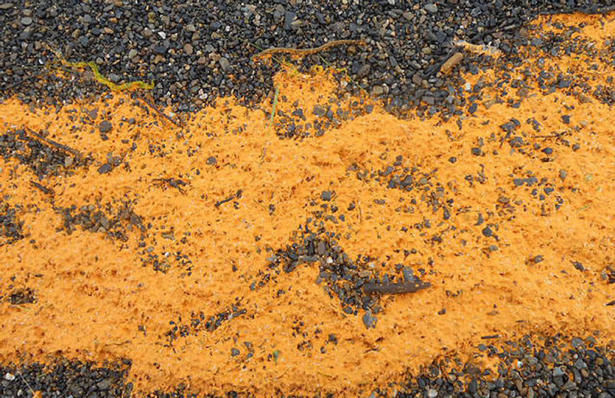
US: Mysterious orange goo washes up in Alaska village

orange goo
© MIDA SWAN/AP
Authorities say a mysterious orange-coloured substance has washed up on the shores of a remote village in northwest Alaska.

Tests have been conducted on the substance on the surface of the water in Kivalina. City Administrator Janet Mitchell told the Associated Press that the substance has also shown up in some residents' rain buckets.

Coast Guard Petty Officer David Mosely tells KTUU that it's not a petroleum substance and it's not man-made.

Mitchell says the village is requesting that an algae expert from the University of Alaska Fairbanks investigate.

Pictures taken by resident Mida Swan show an orange sheen across the harbour and on beaches in the village about 1,006 kilometres northwest of Anchorage.

Swan says she didn't smell anything odd when she dipped her hand into the substance.

Fish

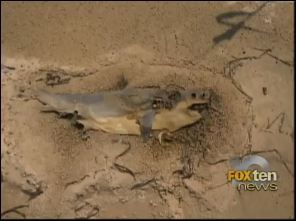
Alabama, US: Sharks Wash Up on Montrose Beach

dead shark
© Fox 10
Salinity may be to blame

Montrose - It seems Shark Week has taken on a whole new meaning in south Alabama. More than 14 sharks washed ashore just a little more than a mile down Montrose Beach.

FOX10 showed video of the occurrence to several Marine and Fishery Biologists. They said they know it's a shark but are not sure what species.

"I can't tell what type of shark this is. The bodies are decomposed so bad I can't tell what species this is," said biologist Chris Denson.

Some suggested they could be small bull sharks. They said the sight is not uncommon along the Gulf Coast.

"First part of July we had a call from someone about sharks on shore," said Dr. Marcus Drymon, Fisheries Biologist with the Dauphin Island Sea Lab. "Turns out they were eight to 10 bull sharks."

The exact cause of death remains a mystery, but researchers said salinity really affects these fish, and anything from a pulse of fresh water or extremely dry weather can change the amount of salt in the water.

No Entry

US, Alabama: Rain creates sinkhole on Ingram Road


A sinkhole on Ingram Road off U.S. 31 stranded a man Thursday, trapping his SUV on the road. According to a county official, the road will be closed through the weekend.

Emergency crews said a towing company was able to pull the vehicle from the sinkhole just before 11 a.m. Thursday morning.

Matthew Keil told WAFF 48 he was driving home from work when he saw what looked like a pothole in the road. When he tried to drive over it, the road buckled underneath him. Keil said he was afraid the SUV might fall if he tried to exit it. Both he and the SUV are fine.

Info

US, Washington: Sinkhole Opens in East Vancouver Roadway

Image
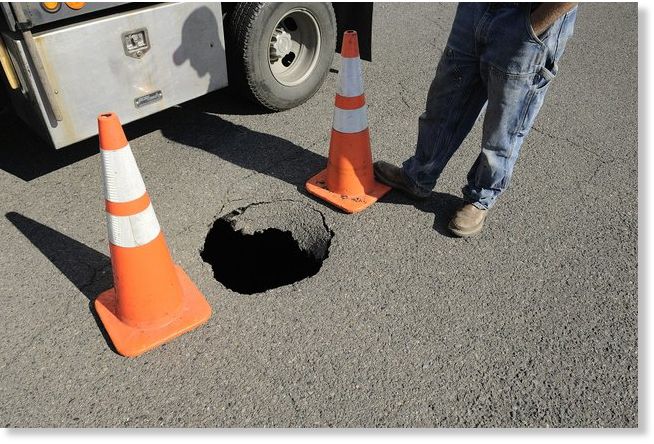
© Troy Wayrynen Aaron Hendrickson, a Clark County maintenance specialist, watches over a sinkhole while waiting for gravel to be delivered Thursday on Northeast 165th Avenue near 80th Street. The sinkhole, which was caused by a collapsed drainage pipe under the street, left a hole about 18-inches in diameter and a void underneath big enough to accommodate an older model Volkswagen Beetle, Hendrickson said.
The Clark County Public Works department is working to repair a sinkhole that has opened on a residential street in east Vancouver. Department spokesman Jeff Mize said crews hoped to have the hole filled later Thursday night.

"This is the type of thing we try to get on right away," Mize said.

The sinkhole was reported at Northeast 165th Avenue and 80th Street, caused by a collapsed drainage pipe under the street, Mize said.

The opening in the street measured about 18 inches in diameter, but the sinkhole underneath was about 6 feet around and about 8 feet deep.

Public works crews will likely fill the hole with packed gravel at first, Mize said, then return next week to repair the pipe.

Bulb

US: Heat Waves Pushes Texas Power Grid into Red Zone


The Texas power grid operator has scrambled this week to meet soaring electricity demand in the face of a brutal heat wave, and residents of the second most populous U.S. state are one power plant shut-down away from rolling blackouts.

Power demand for Electric Reliability Council of Texas, Inc, or ERCOT, which runs the power grid for most of the state, hit three consecutive records this week as Texans cranked up air conditioners to escape one of the hottest summers on record.

The grid operator on Thursday cut power to some big industrial users, and businesses and households face a repeat of the rolling blackouts they faced in February, when a bitter cold snap interrupted power supplies.

Though ERCOT has done a good job balancing supply and demand, "You always have to expect the unexpected can happen," said Arshad Mansoor, senior vice president at the Electric Power Research Institute (EPRI). "A unit can shut. The wind may not blow."

It's been a year of extreme weather for the Lone Star State, already suffering from the worst drought on record.

Fish

US: Huge tar balls and a dead dolphin - a stroll down the beach in Grand Isle

Read the original at The Examiner

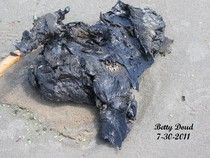
tar ball
© Betty Doud, July 30, 2011Huge tar chunk found by Betty Doud at Grand Isle. Some chunks were bigger than her foot.
Betty Doud, a painter who lives in one of the hardest-hit areas from the BP oil spill, spoke again to Examiner this week. She had posted a video on Facebook that showed some horrifically large tar "balls" that had washed up on the beach. These weren't balls - they were huge chunks, like dried petroleum bowling balls.

Examiner asked Betty if she'd respond to some questions. She ended up writing a thorough report of what she observed over just the past few days. Here's what she had to say (this has only been lightly edited for clarity):