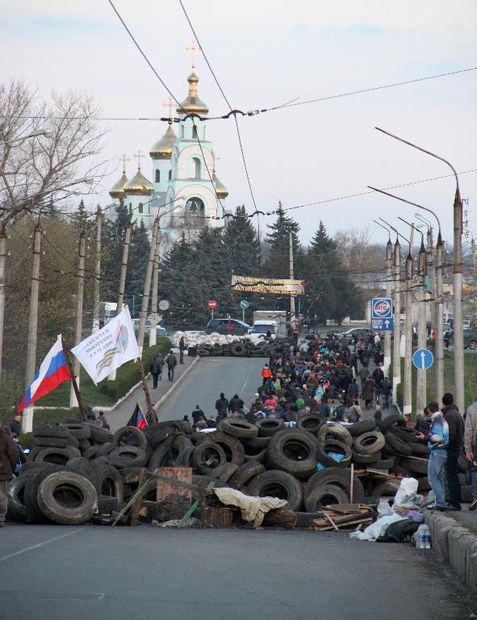
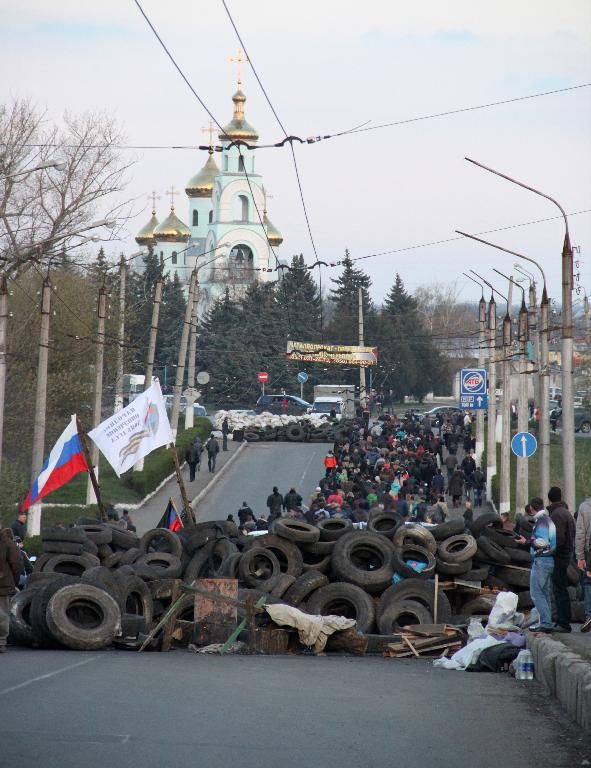
© Associated Press/Alexander ErmochenkoPro-Russian people walk towards the airport in Kramatorsk, eastern Ukraine, on Tuesday, April 15. In the first Ukrainian military action against a pro-Russian uprising in the east, government forces clashed Tuesday with about 30 armed gunmen at a small airport in Kramatorsk.
The last separatist barricade at Kramatorsk was an impressive affair; four giant fuel tankers behind a wall of tyres and stone. The armoured personnel carriers of the government forces, lined up ahead, opened fire without warning; a salvo from a main gun streaking down the street.
The wall disintegrated and burst into flames, the tankers were sliced open as if with a can opener, the severed parts of each one left lying across the road. One round overshot and hit a car, leaving it a smoking heap, another went whizzing by a petrol station. The number of casualties, considering the scale of the damage, was relatively low. There were two dead, the driver of the car and an elderly man still clutching his plastic bag of shopping; around half a dozen were injured, two seriously.
There was an interlude of near silence as people who had thrown themselves to the ground and to the grass verge on the side of the road slowly picked themselves up, glad to be alive, and began to help bloodied figures into cars to be taken to hospital. Those who had thought that the horrific events in Odessa, with more than 40 dead, many of them trapped in a burning building, would lead to a lull in the strife in eastern Ukraine - a pause for reflection - found themselves mistaken.
In Odessa on Friday four people were killed, at least three shot dead, in running battles between Kiev supporters and pro-Russian activists. The clashes ended with separatists holed up in the trade union building. Regional police chief Petro Lutsiuk said more than 130 people had been detained and could face charges ranging from participating in riots to premeditated murder.
The forces of the Kiev administration continued their "anti-terrorist operation" yesterday, with mixed successes but deepening enmity among the many residents who believed themselves to be targeted. Vasyl Krutov, head of a Kiev government's "anti-terrorist centre" behind the operation in the east, told a news conference: "What we are facing... is not just some kind of short-lived uprising, it is in fact a war."







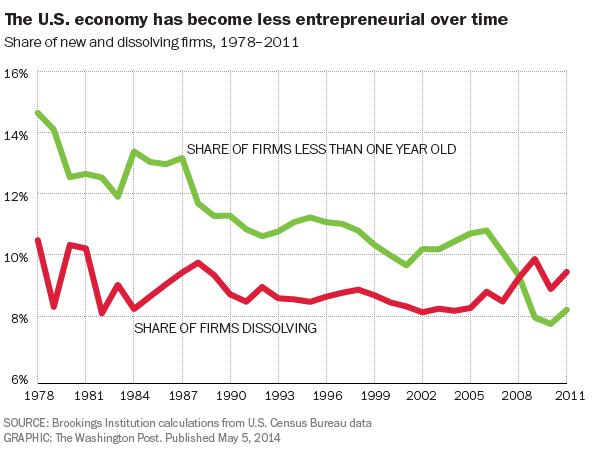




Comment: This is really a no-brainer. When the majority of profits from economic activity are being funneled up to the 1% oligarchy, there's not going to be a lot left over for new entrepreneurs. How can a new business grow when potential customers are being paid poverty-level wages by that same oligarchy? It means little new competition and that's just how they like it.