
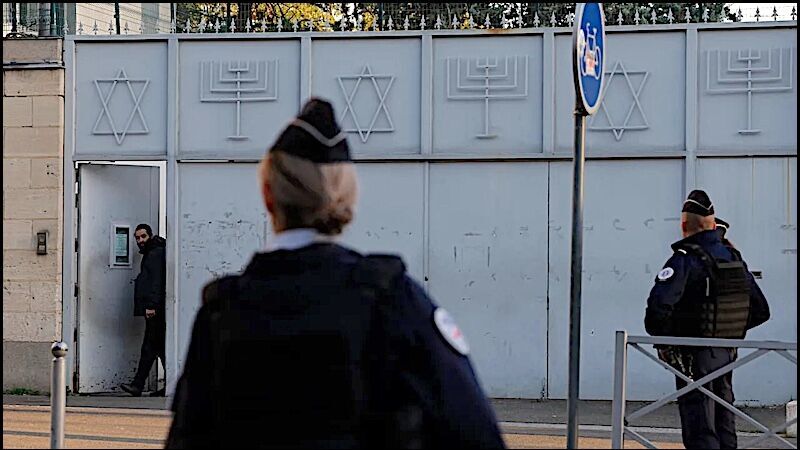
© Geoffroy van der Hasselt/AFP/Getty ImagesFrench police officers stand guard at Synagogue of Sarcelles, Paris's suburb
Around 300 people were evacuated on Saturday, 11 July, from a neighborhood in Sarcelles, north of Paris, after a suspicious vehicle containing a military-grade weapon was discovered in the vicinity of a synagogue.
On Saturday evening, at around 9:30 p.m., the Anti-Crime Brigade (BAC) and General Directorate for Internal Security (DGSI) were informed of a possible Islamist terrorist attack targeting a synagogue in Sarcelles, potentially involving a Toyota vehicle.
The location of the vehicle was Rue Henri Dunant, 500 meters (about 550 yards) from the Great Synagogue, a cinema, and several restaurants.
France's specialized National Anti-Terrorism Prosecutor's Office (PNAT) confirmed to The Jerusalem Post on Sunday that the vehicle was unoccupied when it was discovered by security forces. It was also found to have been stolen, and its license plates had been partially removed.





















Comment: Thousands protest in Albania after PM says pristine land 'belongs' to Kushner-backed group