

© John TrumbullPresentation of the Declaration of Independence
Commissioned 1817; purchased 1819; placed 1826 in the Capitol Rotunda
Commissioned 1817; purchased 1819; placed 1826 in the Capitol Rotunda


"You had to live — did live, from habit that became instinct — in the assumption that every sound you made was overheard, and, except in darkness, every movement scrutinized." — George Orwell, 1984While Americans remain transfixed by the political circus — cheering for their preferred party, jeering at the opposition, obsessing over every manufactured outrage and waiting for the next spectacle — the Surveillance State continues its steady march forward.


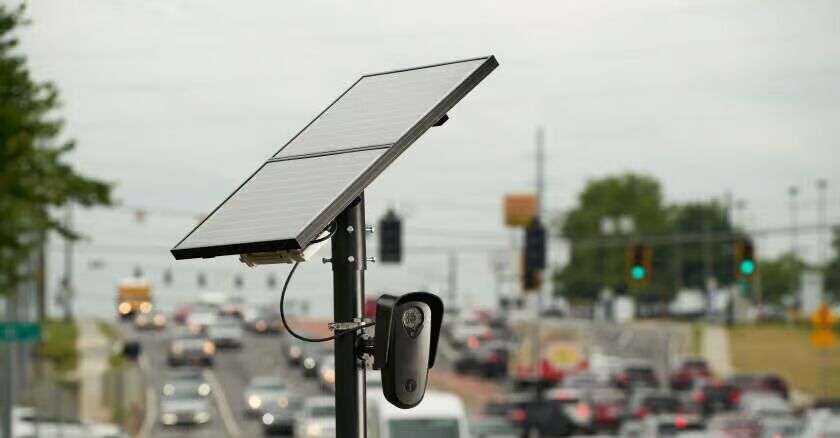
"A growing number of Flock surveillance cameras are being intentionally vandalized across the country, including in Virginia, as critics raise concerns about privacy and how the data collected by the cameras could be shared among law enforcement agencies.
Arlington County police confirmed to WUSA9 that two Flock cameras were spray-painted on May 31. No suspect description has been released.
Flock cameras are automated license plate readers that use artificial intelligence to record when and where a vehicle is seen, along with its license plate, make and model. The cameras can also identify distinguishing characteristics, such as roof racks, bumper stickers and other visible features...
"I think the police need these tools," said Sean Kennedy with Virginians for Safe Families*. "These tools aren't new, and the hysteria around Flock cameras and some of these surveillance tools is overblown."
Kennedy also noted that courts have consistently held that there is no reasonable expectation of privacy on public roadways, making the recording of vehicles traveling on public streets constitutional.
"This vandalism or any type of vigilante action against these license plate readers is unwarranted," Kennedy said. "You have every right to change the law and change the allowances, but you have no right to destroy public property.""
If you thought Flock cameras were concerning, meet what comes next.
A company called Leonardo has developed a system called ELSAG SignalTrace. It broke into public awareness just days ago and is already being marketed to law enforcement agencies across the country. It makes Flock Safety look modest by comparison.
Here is what SignalTrace does:
It clips sensors directly onto existing license plate reader cameras — the same poles, the same hardware already installed in your community. No new infrastructure required. A software and sensor upgrade is all it takes.
Every time you drive past one of these upgraded cameras, the sensor sweeps up the unique electronic identifiers of every device in your vehicle. Your cell phone. Your smartwatch. Your wireless headphones. Your fitness tracker. Your laptop. Your tablet. Your car's own infotainment system. Your tire pressure sensors. Your vehicle's Bluetooth hotspot.
And your pet's microchip.
Every one of those devices emits a signal. SignalTrace captures those signals, timestamps them, ties them to your license plate, and stores them in a searchable database for future investigative use. The result is what Leonardo calls an electronic fingerprint — a unique profile built not from your face or your name, but from the constellation of devices you carry with you every day.
Leonardo announced the ELSAG EOC Plus patent as early as May 2024, describing it as an electronic detection system for identifying people of interest through electronic device signatures. SignalTrace is the commercial product built on that foundation. The patent came first. The marketing came after. The sales calls are happening now.
Here is where it gets worse.
SignalTrace is explicitly designed to track vehicles even when the license plate cannot be read. If your plate is obscured, dirty, or misread — it does not matter. The system identifies your vehicle by the electronic fingerprint of the devices inside it instead. The plate reader becomes optional. The surveillance does not.
The strategic advantage for police agencies is adoption friction. SignalTrace can be pitched as an extension of an existing ALPR ecosystem rather than a wholly separate surveillance buildout. That is exactly what happened with Flock. License plate readers went in first. Video came later through a software update. Nobody voted on the expansion. Nobody was told. SignalTrace follows the same playbook — attach to existing infrastructure and expand what it captures without requiring a new procurement process, a new vote, or a new public conversation.
Who is Leonardo and why does their background matter?
Leonardo US Cyber and Security Solutions is not a Silicon Valley startup. It is the American subsidiary of Leonardo S.p.A. — one of the largest aerospace, defense, and security conglomerates in the world, headquartered in Rome, Italy. Recent public market estimates place Leonardo S.p.A.'s market capitalization at approximately €29.76 billion — roughly $32 billion USD. For context that is nearly four times Flock Safety's valuation.
Leonardo's US operations trace back to a joint venture with Remington Arms in 2004, became a wholly owned subsidiary in 2008, and in 2024 rebranded from Selex ES Inc. to Leonardo US Cyber and Security Solutions — a change the company said better reflects the synergy between its brand and the cutting-edge products it offers. Leonardo US has manufacturing facilities in Greensboro, North Carolina and software engineering in Brewster, New York. Its US arm holds contracts with US Special Operations Command and the General Services Administration. This is a major international defense contractor with a direct pipeline from special operations military applications to local American law enforcement.
The Italian government holds a significant ownership stake in Leonardo S.p.A. That means a foreign government — through a defense contractor — is selling surveillance technology to American law enforcement. If the Flock Safety story involves a CIA-seeded venture capital network, the Leonardo story involves a partially state-owned Italian defense conglomerate with US Special Operations Command contracts. Neither of these companies is what most Americans picture when their city council votes to upgrade the cameras on a street pole.
What is ELSAG — and why SignalTrace is more dangerous than it sounds.
ELSAG is Leonardo's license plate recognition product line — the company's core law enforcement technology that has been deployed across American communities for over two decades. ELSAG cameras are what you think of when you picture a standard license plate reader. Fixed cameras on poles. Mobile units mounted on patrol vehicles. Solar powered. Cellular connected. Reading plates and logging vehicle data.
ELSAG is already deployed in all fifty states. Virginia State Police is a documented customer. Leonardo holds statewide procurement contracts in New York, Maryland, New Mexico, Ohio, and Pennsylvania among others, and is listed on the federal GSA schedule available to agencies nationwide. Their cameras are already on street poles and patrol vehicles across the country — quietly, routinely, and largely without public awareness.
SignalTrace is not a new camera. It is not a new company. It is an upgrade — a sensor that clips directly onto ELSAG cameras already in the field and adds a new layer of data collection on top of the license plate reading that was already happening. The same pole. The same hardware. A new sensor attached to it that now also sweeps up every electronic device signal in every passing vehicle.
That is precisely what makes it so significant. The deployment barrier is almost zero. Any law enforcement agency that already has Leonardo ELSAG cameras can add SignalTrace capability without purchasing new infrastructure, without a new procurement process, and — depending on how their existing contract is written — potentially without returning to their city council for approval. Sound familiar? It should. It is the exact same function creep mechanism that allowed Flock Safety to add video streaming, vehicle fingerprinting, and AI people search to cameras that were originally sold as simple plate readers.
The infrastructure goes in first. The capabilities expand later. The public finds out last — if at all.
Leonardo's defense of the system sounds very familiar.
They say SignalTrace captures device signals but does not read the contents of communications. They say it stores data until a specific investigative request is made of the system by an investigator. They say it was designed to ensure it does not infringe on the rights of individuals.
That is the exact same argument Flock Safety makes about license plate readers. It captures plate numbers but not driver information. It stores data until law enforcement queries it. It was designed with privacy in mind.
Courts are still debating whether Flock's version of that argument is constitutionally sound after eight years of deployment and 80 plus cities canceling contracts. SignalTrace captures exponentially more data about exponentially more people — not just the vehicle but every person inside it and every device they carry. If the argument barely holds for plate readers, it almost certainly does not hold for a system that vacuums up every electronic signal emitted by every device in every vehicle passing a sensor.
The data retention problem.
With Flock we at least know the default data retention period is 30 days — though the contract language grants Flock a perpetual license to use that data regardless. With SignalTrace the situation is more opaque. Leonardo's product materials state that all data collected may be uploaded to the EOC server and archived for future queries and analysis — with no published retention limit. How long does Leonardo store your electronic fingerprint? Who has access to it? Can it be shared with other agencies or federal entities? Can it be purchased by data brokers? Leonardo's materials do not answer these questions. That silence is itself an answer.
The retail and private deployment problem.
Leonardo is actively marketing SignalTrace to shopping malls, retail centers, and private businesses — not just law enforcement. Their materials describe deploying SignalTrace in parking lots and inside shopping centers to track individuals involved in organized retail crime. By identifying and correlating electronic devices carried by suspects, retailers can gain critical insights into criminal patterns.
That means SignalTrace sensors could be on private property you visit every day — your grocery store parking lot, your shopping mall, your workplace — operated by a private company with no law enforcement oversight, no warrant requirement, no public accountability, and no notification to you. Your electronic fingerprint captured every time you park your car. Stored indefinitely. Shared with whoever the private operator decides to share it with.
The no-plate-needed problem — and what it means for pedestrians.
The implication of being able to track a vehicle by its electronic fingerprint without reading the plate goes further than most people realize. Deliberately obscuring your plate — which some people do to avoid surveillance — provides zero protection against SignalTrace. The sensor does not need the plate. It reads your phone.
More critically — the sensor does not know or care whether the device it is reading is inside a vehicle or in the pocket of a pedestrian walking past the pole. A person walking down the sidewalk past a SignalTrace-equipped camera is emitting the same Bluetooth and Wi-Fi signals as a person driving past in a car. The system's sensors capture signals from whatever passes within range. Whether that includes pedestrian device capture is not addressed in Leonardo's public materials. The fact that it is not addressed is worth noting.
Does Flock plan to integrate or copy this technology?
No confirmed partnership between Flock and Leonardo has been announced. But four things are worth noting.
Flock already expanded into audio detection in October 2025 — their Raven devices now listen for human distress and alert officers when they detect screaming. Device signal detection is the next logical step in exactly the same direction. Flock's product roadmap has consistently expanded from vehicle data toward person data. Vehicle fingerprinting. FreeForm people search by physical description. Audio detection of human behavior. Electronic device fingerprinting would complete that progression.
Flock's Wing platform is specifically designed to pull third-party camera infrastructure into its ecosystem. If Leonardo's SignalTrace cameras are deployed in a city that also uses Flock, the data from both systems could flow into the same FlockOS platform without any formal partnership between the two companies.
Flock's Nova platform already combines license plate data with court records, jail records, CAD records, and commercially available personal data. Adding device signal intelligence to that profile would be consistent with what Nova is already designed to do.
And Flock's entire business model is built on continuous software-defined capability expansion through over-the-air updates. No new hardware. No public vote. Whether Flock is currently developing device signal detection capability is something we do not know. Whether the competitive pressure from Leonardo creates a powerful financial incentive for them to do so is not in question.
The constitutional problem is worse than anything we have discussed before.
The Fourth Amendment arguments against Flock center on the aggregation of license plate reads into a comprehensive record of your vehicle's movements. Courts are divided on whether that crosses the constitutional line.
SignalTrace does not aggregate your vehicle's movements. It aggregates your personal electronic identity — every device you carry, every signal you emit — and ties it permanently to a location, a timestamp, and a plate number. It does not track your car. It tracks you. Personally. Individually. Every time you pass a sensor, whether you are suspected of anything or not.
The legal issue is that public policy often treats each input separately — a plate image, a device signal, a timestamp, a location record. SignalTrace's purpose is to combine recurring signals into a searchable investigative profile. The Mosaic Theory argument we have made against Flock says that aggregated location data eventually reveals the whole of a person's life. SignalTrace is designed from the ground up to reveal exactly that — not as a byproduct but as the product.
The Supreme Court has not ruled on whether device signal collection at this scale requires a warrant. The courts have not yet caught up to Flock. They are further still from catching up to what Leonardo is now selling to law enforcement agencies in all fifty states.
Why this matters right now.
We are currently waiting on the City of Texarkana to respond to our public records requests about Flock Safety cameras already operating on our streets. We do not yet know how many cameras exist here, which features are active, or what data sharing agreements are in place.
What we do know is that the surveillance infrastructure being built across America — of which Flock Safety is the most visible example — is expanding faster than public awareness, faster than legislation, and faster than the courts can rule on it.
The cameras in our area are one node. SignalTrace shows you what the next node looks like. And the one after that. Each addition is sold as a modest upgrade to existing infrastructure. Each addition captures something your government previously could not capture without a warrant. Each addition happens without a public vote.
Sources:
1. Leonardo US — ELSAG SignalTrace Product Page
2. Leonardo US — SignalTrace Product Sheet
3. Leonardo US — Procurement Contracts
4. CarBuzz — "Don't Like Car License Plate Readers Invading Your Privacy? It's About To Get A Lot Worse" (June 2026)
5. The Deep Dive — "Leonardo's SignalTrace Could Let Police Plate Readers Track Your Devices" (June 2026)
6. Security Industry Association — Leonardo/ELSAG Member Profile
7. DHS — Automated License Plate Readers Market Survey Report (June 2025 pdf)
8. Senator Ron Wyden / Congressman Raja Krishnamoorthi — Letter to FTC regarding Flock Safety cybersecurity (November 2025 pdf)
🎩 Deflocking Texarkana







Comment: It is only going to get worse with new technologies being added to the existing surveillance infrastructure. One such technology is called ELSAG SignalTrace.
The People vs. Flock (+ Redpill Real Talk)